


Role of Exogenous Pyruvate in Maintaining Adenosine Triphosphate Production under High-Glucose Conditions through PARP-Dependent Glycolysis and PARP-Independent Tricarboxylic Acid Cycle
- PMID: 39456870
- PMCID: PMC11508270
- DOI: 10.3390/ijms252011089
Role of Exogenous Pyruvate in Maintaining Adenosine Triphosphate Production under High-Glucose Conditions through PARP-Dependent Glycolysis and PARP-Independent Tricarboxylic Acid Cycle
Abstract
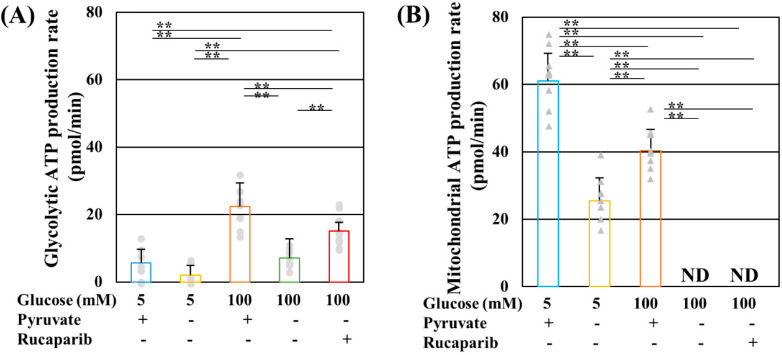
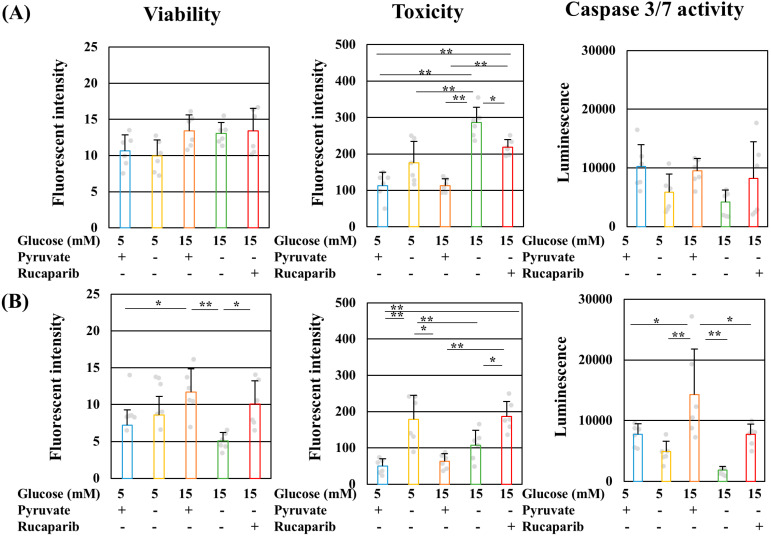
Pyruvate serves as a key metabolite in energy production and as an anti-oxidant. In our previous study, exogenous pyruvate starvation under high-glucose conditions induced IMS32 Schwann cell death because of the reduced glycolysis-tricarboxylic acid (TCA) cycle flux and adenosine triphosphate (ATP) production. Thus, this study focused on poly-(ADP-ribose) polymerase (PARP) to investigate the detailed molecular mechanism of cell death. Rucaparib, a PARP inhibitor, protected Schwann cells against cell death and decreased glycolysis but not against an impaired TCA cycle under high-glucose conditions in the absence of pyruvate. Under such conditions, reduced pyruvate dehydrogenase (PDH) activity and glycolytic and mitochondrial ATP production were observed but not oxidative phosphorylation or the electric transfer chain. In addition, rucaparib supplementation restored glycolytic ATP production but not PDH activity and mitochondrial ATP production. No differences in the increased activity of caspase 3/7 and the localization of apoptosis-inducing factor were found among the experimental conditions. These results indicate that Schwann cells undergo necrosis rather than apoptosis or parthanatos under the aforementioned conditions. Exogenous pyruvate plays a pivotal role in maintaining the flux in PARP-dependent glycolysis and the PARP-independent TCA cycle in Schwann cells under high-glucose conditions.
Keywords: PARP; Schwann cells; adenosine triphosphate depletion; cell death; exogenous pyruvate; glycolysis; high-glucose; tricarboxylic acid cycle.
Conflict of interest statement
The authors declare that the research was conducted in the absence of any commercial or financial relationships that could be construed as a potential conflict of interest.
Figures




References
-
- Kamiya H., Himeno T., Watarai A., Baba M., Nishimura R., Tajima N., Nakamura J. Prevalence and characteristics of diabetic symmetric sensorimotor polyneuropathy in Japanese patients with type 2 diabetes: The Japan Diabetes Complication and its Prevention Prospective study (JDCP study 10) J. Diabetes Investig. 2024;15:247–253. doi: 10.1111/jdi.14105. - DOI - PMC - PubMed
-
- Akamine T., Takaku S., Suzuki M., Niimi N., Yako H., Matoba K., Kawanami D., Utsunomiya K., Nishimura R., Sango K. Glycolaldehyde induces sensory neuron death through activation of the c-Jun N-terminal kinase and p-38 MAP kinase pathways. Histochem. Cell Biol. 2020;153:111–119. doi: 10.1007/s00418-019-01830-3. - DOI - PubMed
-
- Niimi N., Yako H., Takaku S., Kato H., Matsumoto T., Nishito Y., Watabe K., Ogasawara S., Mizukami H., Yagihashi S., et al. A spontaneously immortalized Schwann cell line from aldose reductase-deficient mice as a useful tool for studying polyol pathway and aldehyde metabolism. J. Neurochem. 2018;144:710–722. doi: 10.1111/jnc.14277. - DOI - PubMed
-
- Kato A., Tatsumi Y., Yako H., Sango K., Himeno T., Kondo M., Kato Y., Kamiya H., Nakamura J., Kato K. Recurrent short-term hypoglycemia and hyperglycemia induce apoptosis and oxidative stress via the ER stress response in immortalized adult mouse Schwann (IMS32) cells. Neurosci. Res. 2019;147:26–32. doi: 10.1016/j.neures.2018.11.004. - DOI - PubMed
MeSH terms
Substances
Grants and funding
LinkOut - more resources
Full Text Sources
Research Materials
