


Associations Between High-Density Lipoprotein Cholesterol Efflux and Brain Grey Matter Volume
- PMID: 39458168
- PMCID: PMC11509043
- DOI: 10.3390/jcm13206218
Associations Between High-Density Lipoprotein Cholesterol Efflux and Brain Grey Matter Volume
Abstract
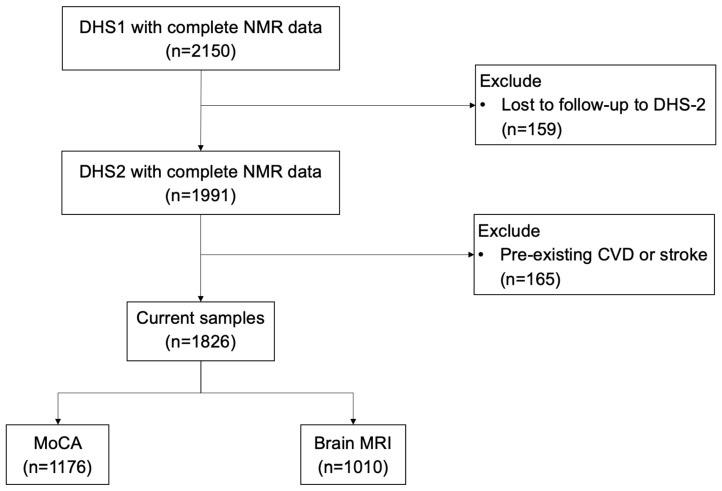
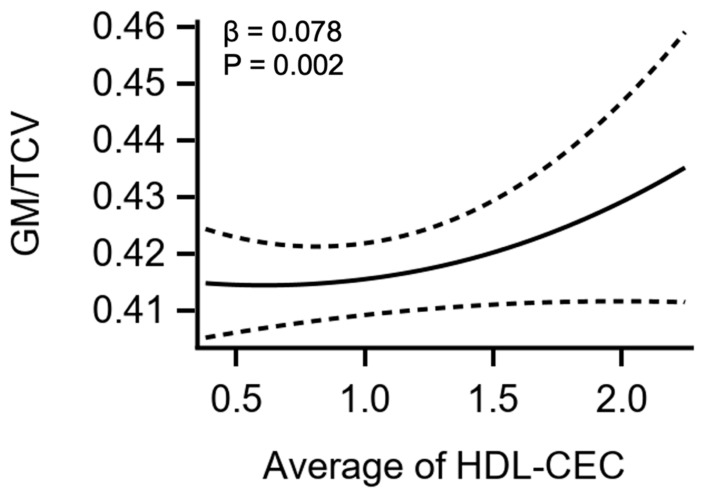
Objective: High-density lipoprotein cholesterol efflux function may prevent brain amyloid beta deposition and neurodegeneration. However, the relevance of this finding has not been established in the diverse middle-aged population. Methods: We examined 1826 adults (47% Black adults) who participated in the Dallas Heart Study to determine associations between high-density lipoprotein (HDL) measures and brain structure and function. White matter hyperintensities (WMH) and whole-brain grey matter volume (GMV) were measured using brain MRI, and the Montreal Cognitive Assessment (MoCA) was used to measure neurocognitive function. HDL cholesterol efflux capacity (HDL-CEC) was assessed using fluorescence-labeled cholesterol efflux from J774 macrophages, and HDL particle size measures were assessed using nuclear magnetic resonance (NMR) spectroscopy (LipoScience). Multivariable linear regressions were performed to elucidate associations between HDL-CEC and brain and cognitive phenotypes after adjustment for traditional risk factors such as age, smoking status, time spent in daily physical activity, and education level. Results: Higher HDL-CEC and small HDL particle (HDL-P) concentration were positively associated with higher GMV normalized to total cranial volume (TCV) (GMV/TCV) after adjustment for relevant risk factors (β = 0.078 [95% CI: 0.029, 0.126], p = 0.002, and β = 0.063 [95% CI: 0.014, 0.111], p = 0.012, respectively). Conversely, there were no associations between HDL measures and WMH or MoCA (all p > 0.05). Associations of HDL-CEC and small HDL-P with GMV/TCV were not modified by ApoE-ε4 status or race/ethnicity. Interpretation: Higher HDL cholesterol efflux and higher plasma concentration of small HDL-P were associated with higher GMV/TCV. Additional studies are needed to explore the potential neuroprotective functions of HDL.
Keywords: brain grey matter; high-density lipoprotein cholesterol; neurocognitive function; neurodegeneration.
Conflict of interest statement
The authors declare no conflicts of interest.
Figures
References
-
- Kivipelto M., Helkala E.-L., Laakso M.P., Hänninen T., Hallikainen M., Alhainen K., Soininen H., Tuomilehto J., Nissinen A. Midlife vascular risk factors and Alzheimer’s disease in later life: Longitudinal, population based study. BMJ. 2001;322:1447–1451. doi: 10.1136/bmj.322.7300.1447. - DOI - PMC - PubMed
-
- Bates K.A., Sohrabi H.R., Rainey-Smith S.R., Weinborn M., Bucks R.S., Rodrigues M., Beilby J., Howard M., Taddei K., Martins G., et al. Serum high-density lipoprotein is associated with better cognitive function in a cross-sectional study of aging women. Int. J. Neurosci. 2016;127:243–252. doi: 10.1080/00207454.2016.1182527. - DOI - PubMed
Grants and funding
LinkOut - more resources
Full Text Sources
Miscellaneous
