


Development of an Eco-Friendly Nanogel Incorporating Pectis brevipedunculata Essential Oil as a Larvicidal Agent Against Aedes aegypti
- PMID: 39458666
- PMCID: PMC11510620
- DOI: 10.3390/pharmaceutics16101337
Development of an Eco-Friendly Nanogel Incorporating Pectis brevipedunculata Essential Oil as a Larvicidal Agent Against Aedes aegypti
Abstract
Background/objectives: Arboviruses, transmitted by mosquitoes like Aedes aegypti, pose significant public health challenges globally, particularly in tropical regions. The rapid spread and adaptation of viruses such as Dengue, Zika, and Chikungunya have emphasized the need for innovative control methods. Essential oils from plants, such as Pectis brevipedunculata (Gardner) Sch.Bip. (Pb), have emerged as potential alternatives to conventional insecticides.
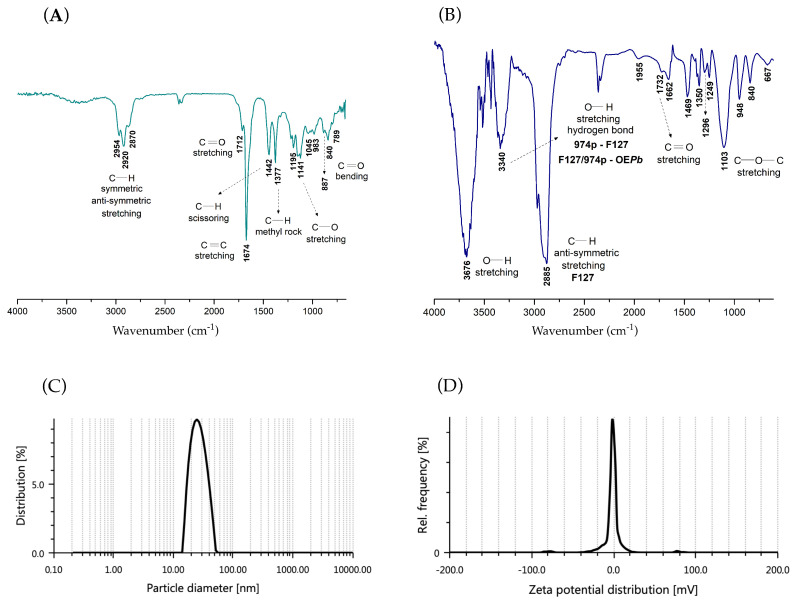
Methods: In this work, we developed an eco-friendly nanogel using a low-energy, solvent-free method, incorporating the copolymer F127 and Carbopol 974p, enriched with a high concentration of essential oil from Pb (EOPb). The resulting nanogel displayed excellent physical stability, maintained under varying temperature conditions. Characterization techniques, including FTIR and DLS, confirmed the stable incorporation of EOPb within the nanogel matrix.
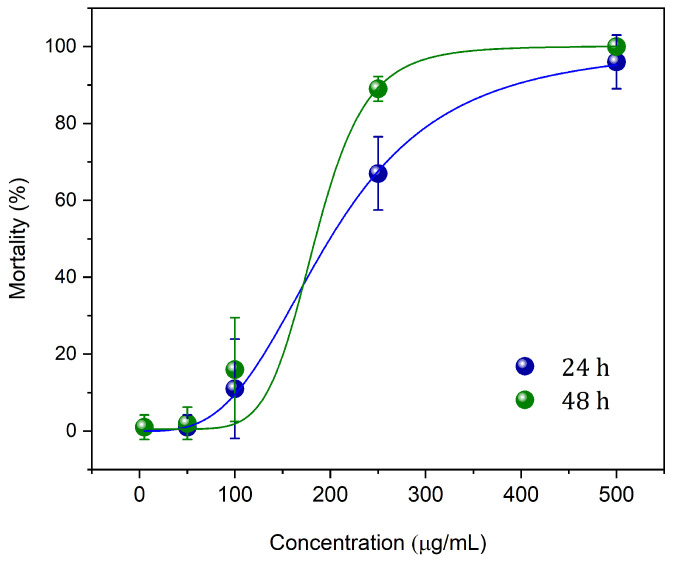
Results: The in vitro assays against Aedes aegypti larvae revealed that at 500 μg/mL, the mortality rates were 96.0% ± 7.0 after 24 h and 100.0% ± 0.0 after 48 h. The positive control group treated with temefos, achieved 100% mortality at both time points, validating the experimental conditions and providing a benchmark for assessing the efficacy of the nGF2002Pb nanogel.
Conclusions: These results indicate that nGF2002Pb demonstrates a pronounced concentration-dependent larvicidal effect against Aedes aegypti, offering an innovative and sustainable approach to arbovirus vector control.
Keywords: Aedes aegypti; Pectis brevipedunculata essential oil; thermoresponsive nanogel.
Conflict of interest statement
The authors declare no conflicts of interest.
Figures

References
-
- Ushijima Y., Abe H., Nguema Ondo G., Bikangui R., Massinga Loembé M., Zadeh V.R., Essimengane J.G.E., Mbouna A.V.N., Bache E.B., Agnandji S.T., et al. Surveillance of the Major Pathogenic Arboviruses of Public Health Concern in Gabon, Central Africa: Increased Risk of West Nile Virus and Dengue Virus Infections. BMC Infect. Dis. 2021;21:265. doi: 10.1186/s12879-021-05960-9. - DOI - PMC - PubMed
-
- Côrtes N., Lira A., Prates-Syed W., Dinis Silva J., Vuitika L., Cabral-Miranda W., Durães-Carvalho R., Balan A., Cabral-Marques O., Cabral-Miranda G. Integrated Control Strategies for Dengue, Zika, and Chikungunya Virus Infections. Front. Immunol. 2023;14:1281667. doi: 10.3389/fimmu.2023.1281667. - DOI - PMC - PubMed
Grants and funding
- PVCET3179-2022/Postgraduate Program in Chemistry (PPGQuim), Federal University of Maranhão (UFMA), São Luís, MA, Brazil
- PVCET3179-2022/Coordination for the Improvement of Higher Education Personnel (CAPES)
- PVCET3179-2022/National Council for Scientific and Technological Development (CNPq)
- PVCET3179-2022/Foundation for the Support of Research and Scientific and Technological Development of Maranhão (FAPEMA) for funding the research initiation grant for the Institutional Scientific Initiation Scholarship Program (PIBIC/AGEUFMA)
- 465357/2014-8/National Council for Scientific and Technological Development (CNPq) and the National Institutes of Science and Technology (INCT/CNPq)
LinkOut - more resources
Full Text Sources
Miscellaneous
