


Non-Adherence to Antiseizure Medications: Rate and Predictors in Saudi Arabia
- PMID: 39459436
- PMCID: PMC11509931
- DOI: 10.3390/medicina60101649
Non-Adherence to Antiseizure Medications: Rate and Predictors in Saudi Arabia
Abstract
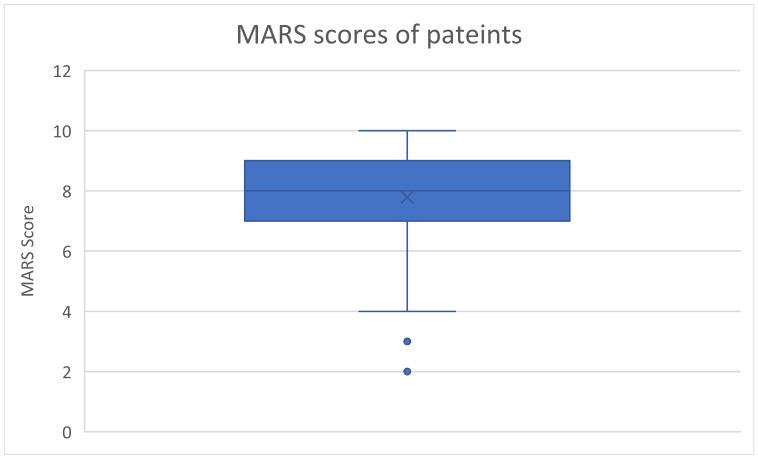
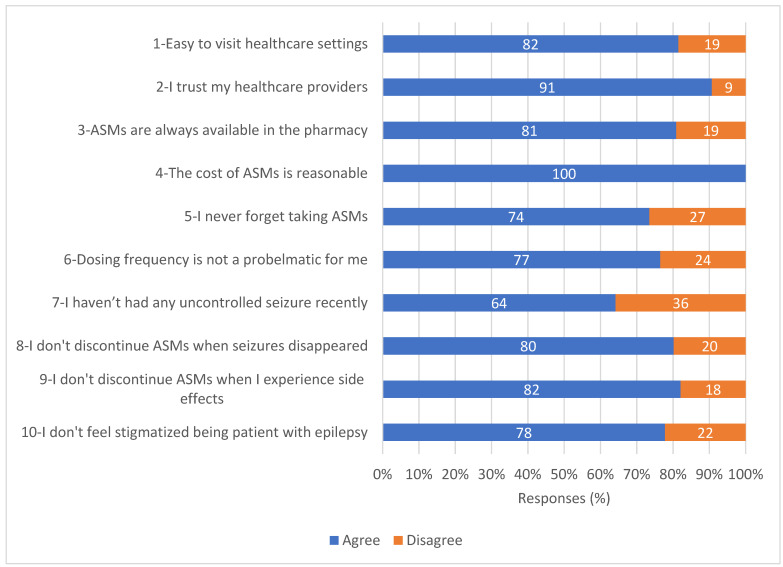
Background and Objectives: The objective of this paper is to determine the rate and predictors of non-adherence to antiseizure medications in Saudi Arabia. Materials and Methods: A cross-sectional study which involved questionnaires and data collection from patients' medical records was conducted at neurology clinics. The rate of non-adherence to antiseizure medications was measured using "the Medication Adherence Rating Scale" (MARS). Predictors of non-adherence to antiseizure medications were evaluated using a multidimensional questionnaire specific to epilepsy. Results: One hundred and sixty-two patients participated in the study. The mean (SD) age was 34.1 (10.4) years, and 56% were male. Epilepsy was controlled (i.e., seizure-free ≥ 1 year) in 42% of patients. The mean ± SD (range) MARS scores were 7.80 ± 1.59 (2-10). Out of 162 patients, 58 (36%) patients had MARS scores ≤ 7 out of 10. The most frequently rated predictor for non-adherence was poor seizure control, which was reported by around 36% of patients. Forgetfulness, dosing frequency, and social stigma were also among the commonest predictors of non-adherence to antiseizure medications that were rated by approximately 27%, 24%, and 22% of the patients, respectively. The impacts of several socio-demographic and clinical factors on adherence were assessed. In the regression analysis, the odds of non-adherence in a patient who experienced adverse effects were twice that of a patient who did not have adverse effects (p = 0.113). Furthermore, females, employers, and patients who had comorbidity, those with focal epilepsy, those on polytherapy of antiseizure medication, and those receiving multiple doses per day, were all more likely (but not significantly, p > 0.05) to be non-adherent compared to their counterparts. Conclusions: The significance of this study is that it reveals that adherence to antiseizure medications is suboptimal in Saudi Arabia. Poor seizure control, forgetfulness, dosing frequency, and social stigma were the primary patient-reported predictors of non-adherence in epilepsy. This emphasizes the importance of routine evaluation of adherence in practice to identify and address what individual patients perceive as a barrier to adherence with antiseizure medications.
Keywords: Saudi Arabia; antiepileptic drugs; compliance; epilepsy; seizures.
Conflict of interest statement
Bshra Alsfouk has received a research fund from the Saudi National Institute of Health (36298395). The other authors declare that they have no conflicts of interest.
Figures
References
-
- WHO Epilepsy. [(accessed on 5 July 2023)]. Available online: https://www.who.int/news-room/fact-sheets/detail/epilepsy.
-
- Fisher R.S., van Emde Boas W., Blume W., Elger C., Genton P., Lee P., Engel J., Jr. Epileptic seizures and epilepsy: Definitions proposed by the International League Against Epilepsy (ILAE) and the International Bureau for Epilepsy (IBE) Epilepsia. 2005;46:470–472. doi: 10.1111/j.0013-9580.2005.66104.x. - DOI - PubMed
MeSH terms
Substances
Grants and funding
LinkOut - more resources
Full Text Sources
Medical
Miscellaneous
