. 2024 Sep 24;14(10):1221.
doi: 10.3390/life14101221.

Palmitoylethanolamide (PEA) for Prevention of Gastroesophageal Inflammation: Insights from In Vitro Models

Affiliations

Palmitoylethanolamide (PEA) for Prevention of Gastroesophageal Inflammation: Insights from In Vitro Models

Renato Spigarelli et al. Life (Basel). .

Abstract

Gastroesophageal reflux disease (GERD) is a digestive disorder that can lead to chronic mucosal damage, causing esophagitis, Barrett's esophagus and esophageal cancer. GERD currently affects about 13% of the world's population and represent a major public health concern due to the increasing prevalence and incidence. The aim of this study was to explore complementary strategies for GERD management based the natural compound palmitoylethanolamide (PEA), alone or associated with plant extracts with demonstrated anti-GERD activity (Zingiber officinale, Musa × paradisiaca, Opuntia ficus-indica and Olea europaea). For this purpose, two in vitro models based on the esophageal mucosa CP-B cell line were chosen. The first one was based on the exposure of esophageal cells to HCl, while the second one was based on lipopolysaccharide (LPS) treatment to cause a strong inflammatory cell response. Inflammation induced was assessed using a Luminex® assay, measuring the secretion of IL-1β, IL-6, IL-10, IL-8 and TNF-α. Results obtained demonstrate that PEA strongly decreased the inflammatory response elicited by HCl exposure. Moreover, the effect of PEA was enhanced by the presence of natural extracts of Zingiber officinale, Musa × paradisiaca, Opuntia ficus-indica and Olea europaea. PEA should be considered as an anti-GERD natural compound of interest.

Keywords: Musa × paradisiaca; Olea europaea; Opuntia ficus-indica; Zingiber officinale; gastroesophageal reflux disease (GERD); palmitoylethanolamide (PEA).


Conflict of interest statement

The authors declare no conflict of interest.

Figures
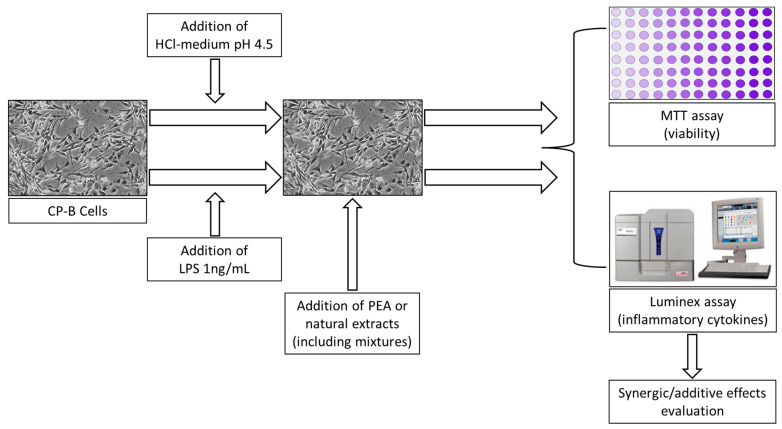
Figure 1
Figure 1
Scheme of the experimental design.
Figure 2
Figure 2
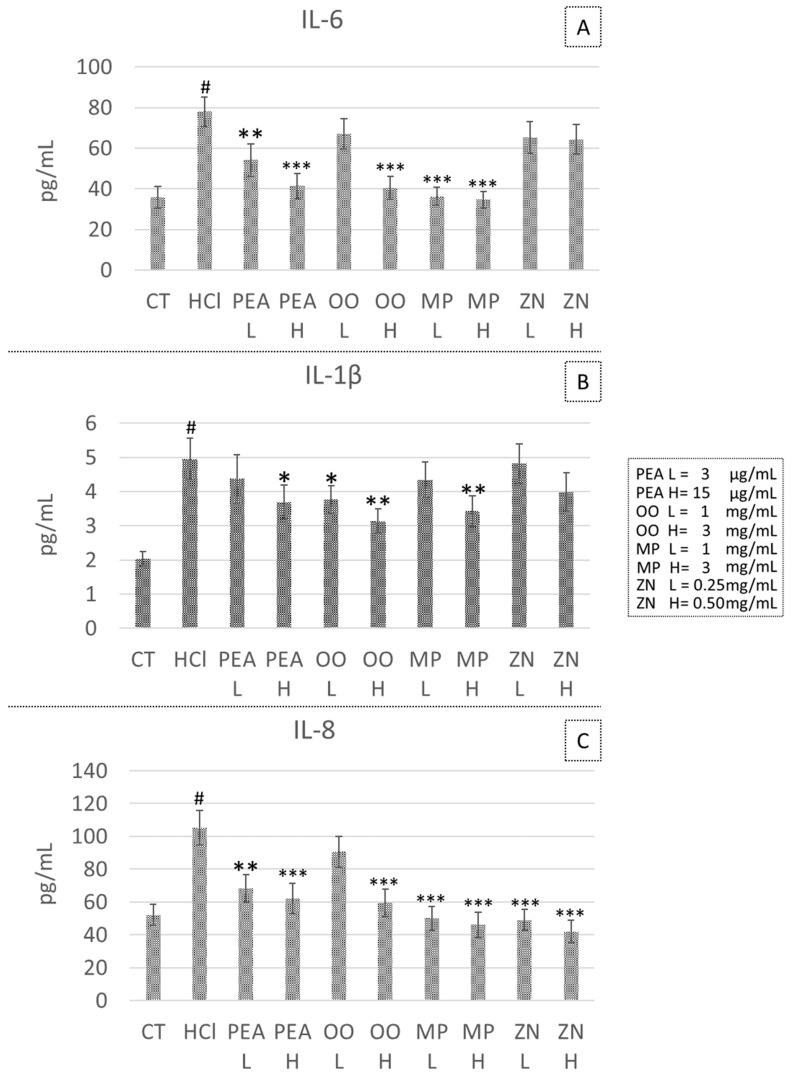
Effects of the tested compounds on the concentration of the pro-inflammatory cytokines IL-6 (A), IL-1β (B) and IL-8 (C) after acid exposure. CT, control; HCl, acid-exposed positive control; PEA, palmitoylethanolamide, OO, Olea europaea and Opuntia ficus-indica extract; MP, Musa × paradisiaca; ZN, Zingiber officinale. H, high and L, low concentration values, indicated in the figure legend. * p < 0.05, ** p < 0.01 and *** p < 0.001 compared to the HCl stimulated positive control. # p < 0.001 compared to the negative untreated control (CT).
Figure 3
Figure 3
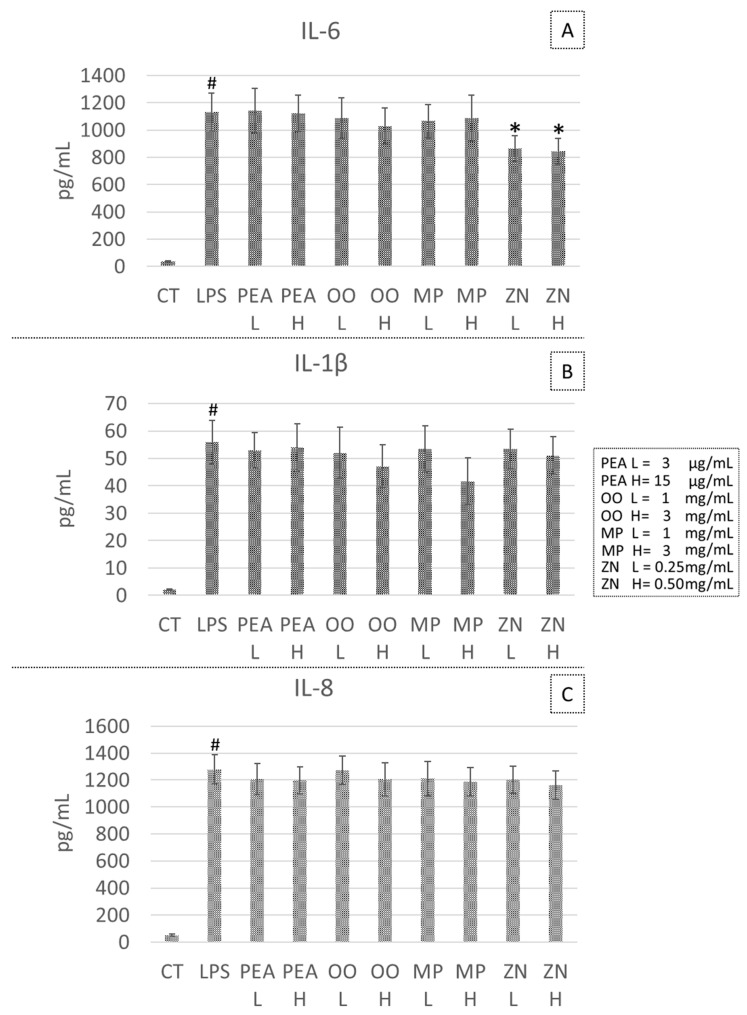
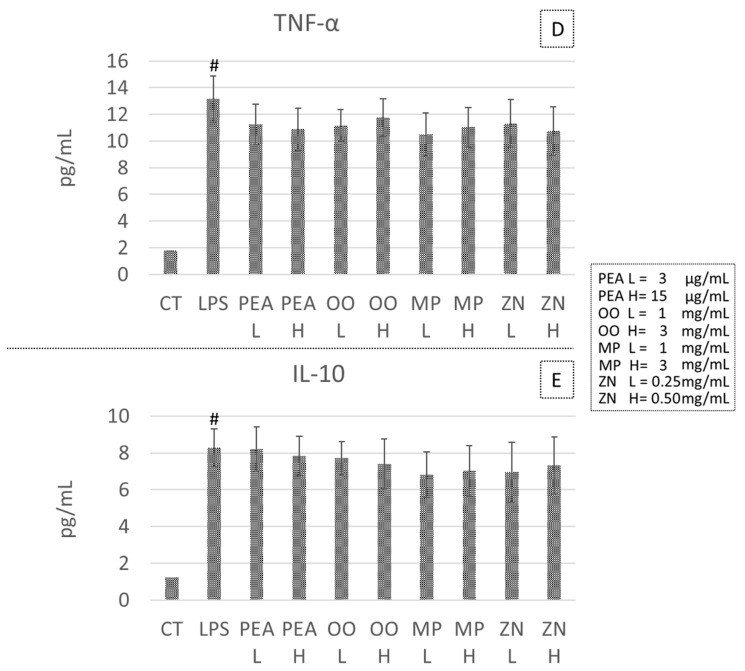
Effects of the tested compounds on the concentration of the pro-inflammatory cytokines IL-6 (A), IL-1β (B), IL-8 (C), TNF-α (D) and IL-10 (E) after LPS stimulation. CT, control; LPS, Lipopolysaccharide positive control; PEA, palmitoylethanolamide, OO, Olea europaea and Opuntia ficus indica extract; MP, Musa × paradisiaca; ZN, Zingiber officinale. H, high and L, low concentration values are indicated in the figure legend. * p < 0.05 compared to the HCl stimulated positive control. # p < 0.001 compared to the negative untreated control (CT).
Figure 3
Figure 3
Effects of the tested compounds on the concentration of the pro-inflammatory cytokines IL-6 (A), IL-1β (B), IL-8 (C), TNF-α (D) and IL-10 (E) after LPS stimulation. CT, control; LPS, Lipopolysaccharide positive control; PEA, palmitoylethanolamide, OO, Olea europaea and Opuntia ficus indica extract; MP, Musa × paradisiaca; ZN, Zingiber officinale. H, high and L, low concentration values are indicated in the figure legend. * p < 0.05 compared to the HCl stimulated positive control. # p < 0.001 compared to the negative untreated control (CT).
Figure 4
Figure 4
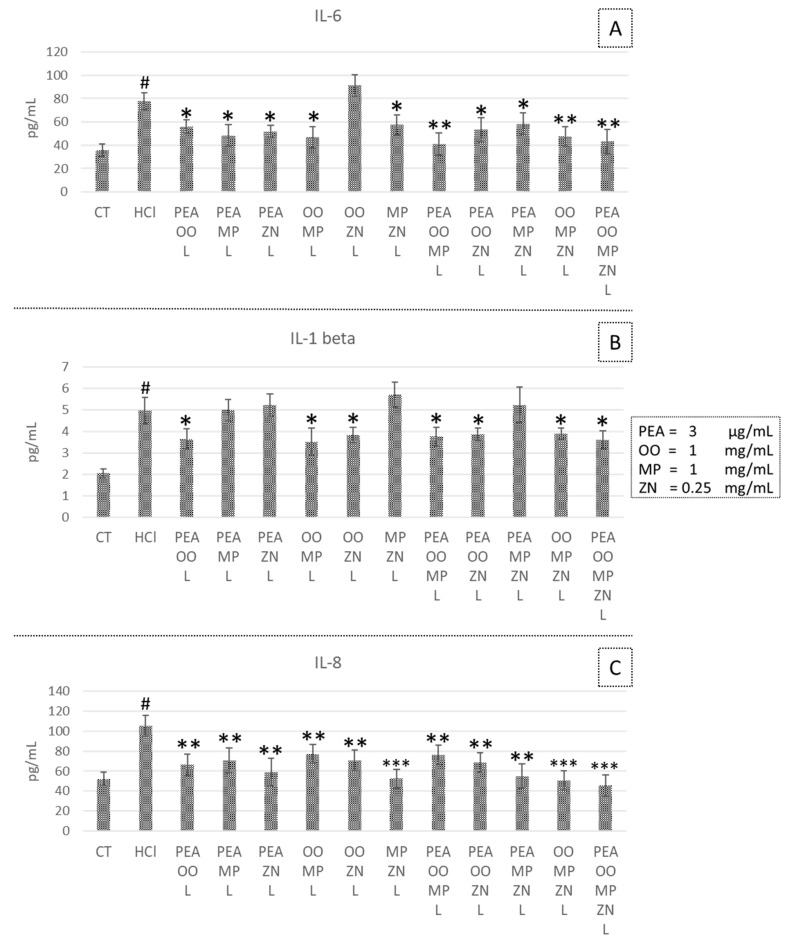
Anti-inflammatory effects of binary, ternary and quaternary mixtures at low concentrations, analyzed by measuring the secretion of the pro-inflammatory cytokines IL-6 (A), IL-1β (B) and IL-8 (C) after acid exposure. CT, control; HCl, acid-exposed positive control; PEA, palmitoylethanolamide, OO, Olea europaea and Opuntia ficus-indica extract; MP, Musa × paradisiaca; ZN, Zingiber officinale. Concentration values are listed in the figure legend. * p < 0.05, ** p < 0.01 and *** p < 0.001 compared to the HCl-stimulated positive control. # p < 0.001 compared to the negative untreated control (CT).

References

    1. Maret-Ouda J., Markar S.R., Lagergren J. Gastroesophageal Reflux Disease. JAMA. 2020;324:2565. doi: 10.1001/jama.2020.21573. - DOI - PubMed
    1. Eusebi L.H., Ratnakumaran R., Yuan Y., Solaymani-Dodaran M., Bazzoli F., Ford A.C. Global prevalence of, and risk factors for, gastro-oesophageal reflux symptoms: A meta-analysis. Gut. 2018;67:430–440. doi: 10.1136/gutjnl-2016-313589. - DOI - PubMed
    1. Mikami D.J., Murayama K.M. Physiology and pathogenesis of gastroesophageal reflux disease. Surg. Clin. N. Am. 2015;95:515–525. doi: 10.1016/j.suc.2015.02.006. - DOI - PubMed
    1. Surdea-Blaga T., Negrutiu D.E., Palage M., Dumitrascu D.L. Food and Gastroesophageal Reflux Disease. Curr. Med. Chem. 2019;26:3497–3511. doi: 10.2174/0929867324666170515123807. - DOI - PubMed
    1. Zheng Z., Nordenstedt H., Pedersen N.L., Lagergren J., Ye W. Lifestyle factors and risk for symptomatic gastroesophageal reflux in monozygotic twins. Gastroenterology. 2007;132:87–95. doi: 10.1053/j.gastro.2006.11.019. - DOI - PMC - PubMed

LinkOut - more resources