. 2024 Oct 19;16(10):1634.
doi: 10.3390/v16101634.

Patterns of HIV-1 Drug Resistance Observed Through Geospatial Analysis of Routine Diagnostic Testing in KwaZulu-Natal, South Africa

Affiliations

Patterns of HIV-1 Drug Resistance Observed Through Geospatial Analysis of Routine Diagnostic Testing in KwaZulu-Natal, South Africa

Lilishia Gounder et al. Viruses. .

Abstract

HIV-1 drug resistance (HIVDR) impedes treatment and control of HIV-1, especially in high-prevalence settings such as KwaZulu-Natal (KZN) province, South Africa. This study merged routine HIV-1 genotypic resistance test (GRT) data with Geographic Information Systems coordinates to assess patterns and geographic distribution of HIVDR in KZN, among ART-experienced adults with virological failure. We curated 3133 GRT records generated between 1 January 2018 and 30 June 2022, which includes the early phase of dolutegravir (DTG) rollout, of which 2735 (87.30%) had HIVDR. Of the 2735, major protease, nucleoside, and non-nucleoside reverse transcriptase inhibitor mutations were detected in 41.24%, 84.97% and 88.08% of GRTs, respectively. Additional genotyping of HIV-1 integrase for 41/3133 (1.31%) GRTs showed that 17/41 (41.46%) had integrase strand transfer inhibitor resistance. Notably, of 26 patients on DTG with integrase genotyping, 9 (34.62%) had DTG-associated resistance mutations. Dual- or triple-class resistance was observed in four of every five GRTs. The odds of HIVDR increased significantly with age, with ≥60 years having 5 times higher odds of HIVDR compared to 18-29 years (p = 0.001). We identified geospatial differences in the burden of HIVDR, providing proof of concept that this could be used for data-driven public health decision making. Ongoing real-time HIVDR surveillance is essential for evaluating the outcomes of the updated South African HIV treatment programme.

Keywords: HIV-1; KwaZulu-Natal; South Africa; dolutegravir; drug resistance; genotypic susceptibility scores; geospatial analysis.


Conflict of interest statement

The authors declare no conflicts of interest. The funders had no role in the design of the study; in the collection, analyses, or interpretation of data; in the writing of the manuscript; or in the decision to publish the results.

Figures
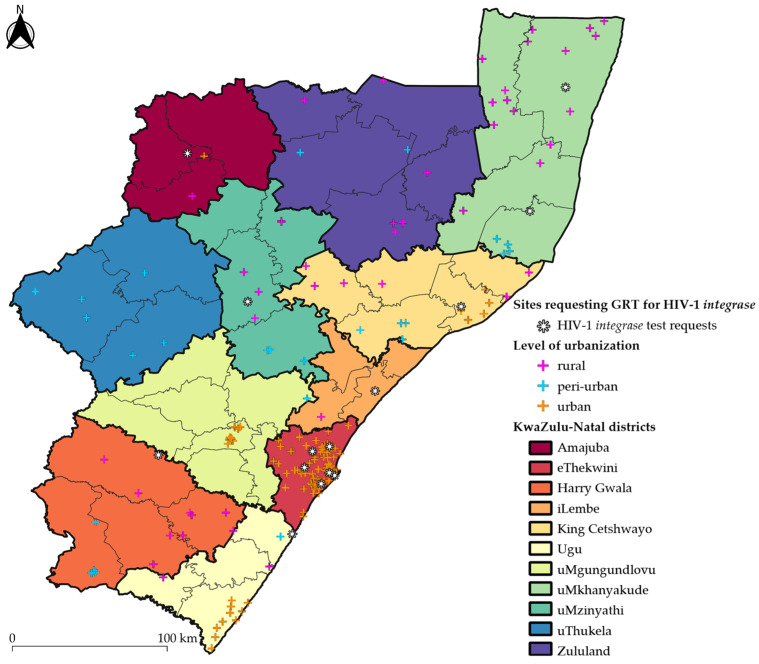
Figure 1
Figure 1
Public-sector healthcare facilities with HIV-1 genotypic resistance tests included by district in KwaZulu-Natal province, South Africa. Individual cross symbols pinpoint the Geographic Information Systems (GIS) coordinates of each healthcare facility that had requested a genotypic resistance test (GRT), the data of which had been included in the study. The asterisk denotes healthcare facilities that requested HIV-1 integrase testing. The cross symbols are coloured in pink, blue or orange based on whether the healthcare facility’s GIS coordinates are within a rural, peri-urban or urban subdistrict, respectively. The thin and thick black outlines represent the borders of the subdistricts and districts, respectively. Each district is illustrated in a different colour. The basemap of KwaZulu-Natal province was republished under a CC BY license with permission obtained from Carto Builder user Lilishia Gounder, original copyright 2024. Available at: https://pinea.app.carto.com/map/4d4c56c1-f82d-4409-b190-ea9ced309005 (accessed on 18 October 2024).
Figure 2
Figure 2
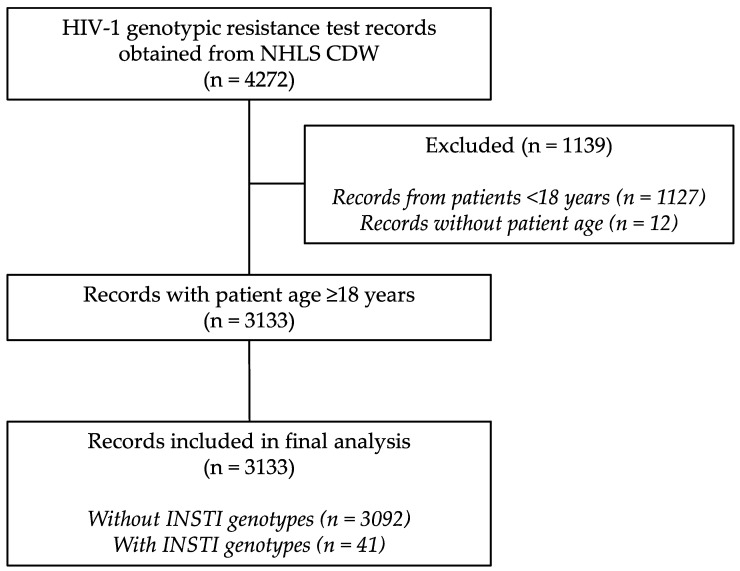
Flow diagram of HIV-1 genotypic resistance test records obtained and included in the final analysis. CDW, central data warehouse; INSTI, integrase strand transfer inhibitor; NHLS, National Health Laboratory Service.
Figure 3
Figure 3
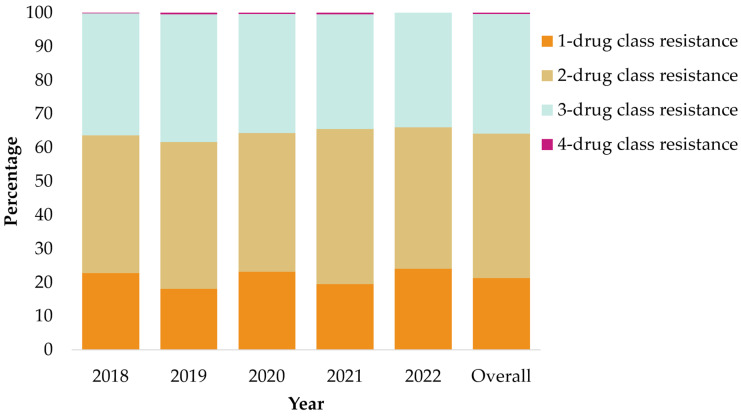
Patterns of antiretroviral drug class resistance observed in 2735 genotypes with HIVDR obtained from KwaZulu-Natal province, South Africa. Please note that 41 genotypes included HIV-1 integrase testing, of which only 9 met the definition for 4-drug class resistance.
Figure 4
Figure 4
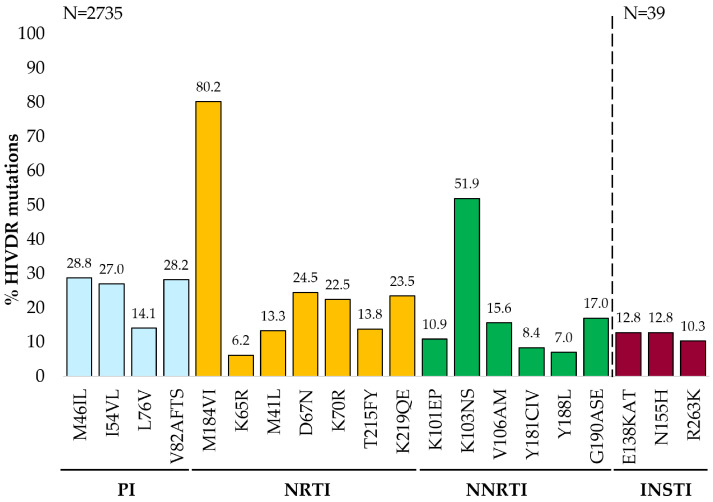
Specific mutations detected in 2735 genotypes with HIVDR obtained from KwaZulu-Natal province, South Africa. Mutations shown on the horizontal axis include “major” mutations observed in >6% of the genotypes with HIV-1 drug resistance, “major” as defined by Stanford HIV Drug Resistance Database or 2022 edition IAS–USA drug resistance mutations list [32,35]. HIVDR, HIV-1 drug resistance; INSTI, integrase strand transfer inhibitor; NNRTI, non-nucleoside reverse transcriptase inhibitor; NRTI, nucleoside reverse transcriptase inhibitor; PI, protease inhibitor.
Figure 5
Figure 5
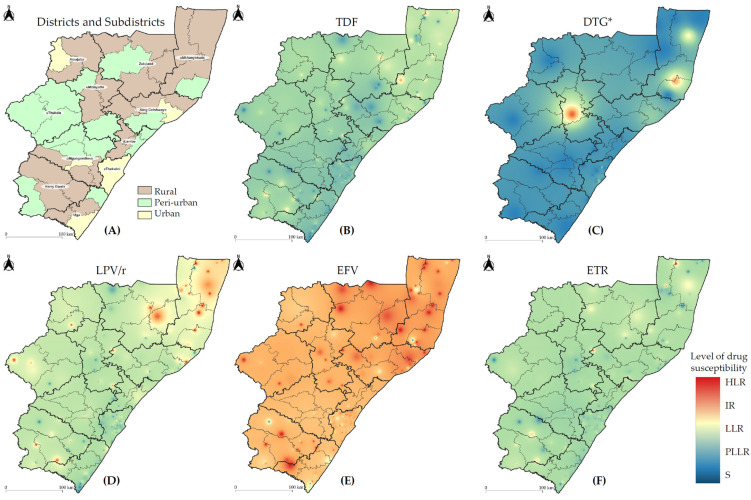
Antiretroviral drug susceptibility levels across KwaZulu-Natal province, South Africa. Districts and subdistricts are categorized as follows: (A) level of urbanization. Inverse distance weighted interpolation maps cumulatively reflect the drug susceptibilities for the following: (B) TDF, tenofovir; (C) DTG, dolutegravir; (D) LPV/r, lopinavir with boosted ritonavir; (E) EFV, efavirenz; (F) ETR, etravirine. Spectral colour change from blue to red reflects the drug susceptibility level as follows: S, susceptible; PLLR, potential low-level resistance; LLR, low-level resistance; IR, intermediate resistance; HLR, high-level resistance. The thin and thick black outlines represent the borders of the 44 subdistricts and 11 districts of KwaZulu-Natal (KZN) province, respectively. The basemap of KZN province was republished under a CC BY license with permission obtained from Carto Builder user Lilishia Gounder, original copyright 2024. Available at: https://pinea.app.carto.com/map/4d4c56c1-f82d-4409-b190-ea9ced309005 (accessed on 18 October 2024). * Please note that HIV-1 integrase testing was performed for 41 genotypes; the remaining 3092 genotypes that did not have integrase test requests were assumed to be susceptible to DTG for the purposes of creating the DTG interpolation map.

References

    1. Cuadros D.F., Huang Q., Musuka G., Dzinamarira T., Moyo B.K., Mpofu A., Makoni T., DeWolfe Miller F., Bershteyn A. Moving beyond hotspots of HIV prevalence to geospatial hotspots of UNAIDS 95-95-95 targets in sub-Saharan Africa. Lancet HIV. 2024;11:e479–e488. doi: 10.1016/S2352-3018(24)00102-4. - DOI - PMC - PubMed
    1. Kiepiela P., Manasa J., Moosa M.Y., Moodley P., Gordon M., Parikh U.M., Sunpath H., de Oliveira T., Ramjee G. HIV drug resistance patterns at the epicentre of the HIV-1 epidemic in Kwazulu-Natal, South Africa 2003–2013. J. AIDS Clin. Res. 2014;5:1000294–1000299. doi: 10.4172/2155-6113.1000299. - DOI
    1. Kim H., Tanser F., Tomita A., Vandormael A., Cuadros D.F. Beyond HIV prevalence: Identifying people living with HIV within underserved areas in South Africa. BMJ Glob. Health. 2021;6:e004089. doi: 10.1136/bmjgh-2020-004089. - DOI - PMC - PubMed
    1. Joint United Nations Program on HIV/AIDS The Path That Ends AIDS: UNAIDS Global AIDS Update 2023 [Internet] 2023. [(accessed on 18 October 2024)]. Available online: https://www.unaids.org/sites/default/files/media_asset/2023-unaids-globa....
    1. Kemp S.A., Kamelian K., Cuadros D.F., Cheng M.T.K., Okango E., Hanekom W., Ndung’u T., Pillay D., Bonsall D., Wong E.B., et al. HIV transmission dynamics and population-wide drug resistance in rural South Africa. Nat. Commun. 2024;15:3644. doi: 10.1038/s41467-024-47254-z. - DOI - PMC - PubMed

Publication types

MeSH terms

LinkOut - more resources