


Accuracy of Three Commercial Wearable Devices for Sleep Tracking in Healthy Adults
- PMID: 39460013
- PMCID: PMC11511193
- DOI: 10.3390/s24206532
Accuracy of Three Commercial Wearable Devices for Sleep Tracking in Healthy Adults
Abstract
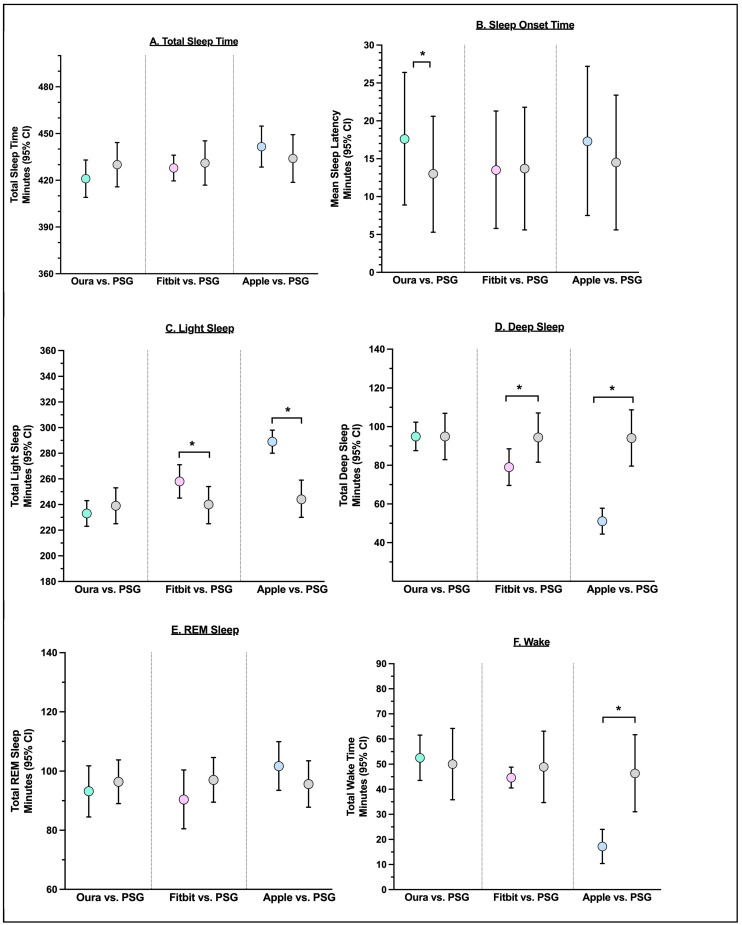
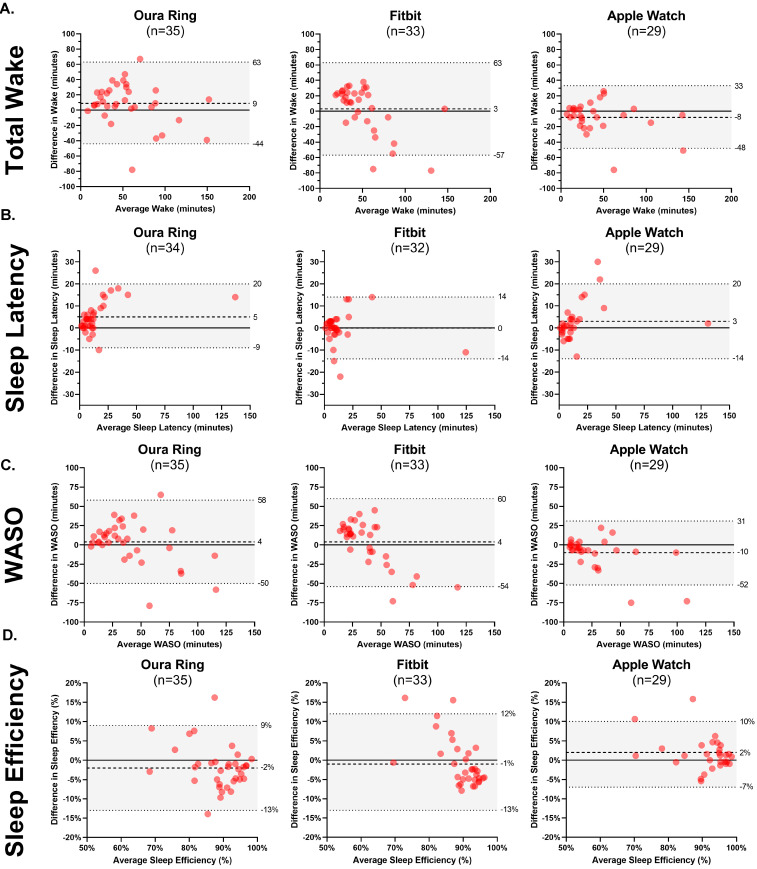
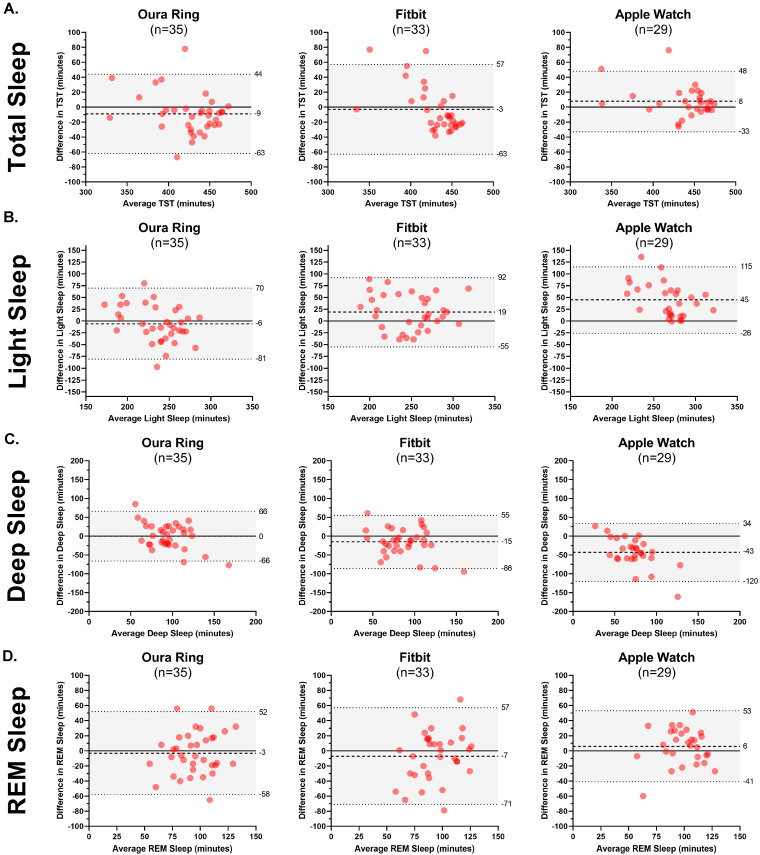
Sleep tracking by consumers is becoming increasingly prevalent; yet, few studies have evaluated the accuracy of such devices. We sought to evaluate the accuracy of three devices (Oura Ring Gen3, Fitbit Sense 2, and Apple Watch Series 8) compared to the gold standard sleep assessment (polysomnography (PSG)). Thirty-five participants (aged 20-50 years) without a sleep disorder were enrolled in a single-night inpatient study, during which they wore the Oura Ring, Fitbit, and Apple Watch, and were monitored with PSG. For detecting sleep vs. wake, the sensitivity was ≥95% for all devices. For discriminating between sleep stages, the sensitivity ranged from 50 to 86%, as follows: Oura ring sensitivity 76.0-79.5% and precision 77.0-79.5%; Fitbit sensitivity 61.7-78.0% and precision 72.8-73.2%; and Apple sensitivity 50.5-86.1% and precision 72.7-87.8%. The Oura ring was not different from PSG in terms of wake, light sleep, deep sleep, or REM sleep estimation. The Fitbit overestimated light (18 min; p < 0.001) sleep and underestimated deep (15 min; p < 0.001) sleep. The Apple underestimated the duration of wake (7 min; p < 0.01) and deep (43 min; p < 0.001) sleep and overestimated light (45 min; p < 0.001) sleep. In adults with healthy sleep, all the devices were similar to PSG in the estimation of sleep duration, with the devices also showing moderate to substantial agreement with PSG-derived sleep stages.
Keywords: Apple Watch; Fitbit; Oura ring; consumer sleep tracking devices; polysomnography; sleep technology; validation.
Conflict of interest statement
Robbins is a member of the Oura Ring Medical Advisory Board and reports consulting fees from Oura Ring Inc., Savoir Beds, Hilton Hotels and Resorts, Castle Hot Springs, byNacht GmbH, and Sonesta Hotels International. Weaver reports consulting fees from Fred Hutchinson Cancer Center and the University of Pittsburgh to support research projects on sleep and circadian rhythms. Czeisler reports grants and contracts to Brigham and Women’s Hospital from Axsome Therapeutics, CDC Foundation, City of San Francisco, Dayzz Live Well, Delta Airlines, Jazz Pharmaceuticals PLC Inc., Puget Sound Pilots, Regeneron Pharmaceuticals/Sanofi during the conduct of the study; reports personal fees from Axsome Therapeutics, Associated Professional Sleep Societies, Bryte Foundation, Clement Law Firm, Institute of Digital Media and Child Development, Klarman Family Foundation, Law Offices of James L Mitchell, Law Office of Yolanda Huang, Massachusetts Medical Society, National Council for Mental Wellbeing, National Sleep Foundation, Puget Sound Pilots, Rabb and Rabb LLC, Stephans Law firm, Reyes Law Firm, Cloward Trial Lawyers, Haglund Kelley LLP., Adam Dvid Law Firm, Law offices of James Mitchell, Paul Byrd Law firm PLLC, Smith Lacine LLP, Covington and Burling LLP, Perdue & kidd, Segal Law Firm, Shaked Law Firm, P.A., Simpson & Simpson, Tencent Holdings Ltd., Teva Pharma Australia, The Armstrong Firm, PLLC, Vanda Pharmaceuticals Inc., With Deep, Inc. and Zehl Law Firm, during the conduct of the study; reports research/education support to Brigham and Women’s Hospital from Abbaszadeh Foundation, Alexandra Drane, Apnimed, Inc., Avadel Pharmaceuticals, Bryte Foundation, Zoll, Illumination Technology, Casey Feldman Foundation, Cephalon, DR Capital, Eisai Co., Ltd., f.lux Software, LLC, Idorsia Pharmaceuticals Ltd., Mary Ann & Stanley Snider via Combined Jewish Philanthropies, Harmony Biosciences LLC, Jazz Pharmaceuticals PLC, Inc., Johnson & Johnson, NeuroCare, Inc., Optum, Peter Brown and Margaret Hamburg, Philips Respironics Inc., Regional Home Care, ResMed Foundation, San Francisco Bar Pilots, Sleep Number Corp., Stuart F. and Diana L. Quan Charitable Fund, Summus, Inc., Axsome Theraputics, Takeda Pharmaceutical Co., Ltd., Teva Pharmaceuticals Industries Ltd., ResMed, Sanofi, Philips, Vanda Pharmaceuticals and Whoop, Inc., during the conduct of the study; and is the incumbent of an endowed professorship provided to Harvard University by Cephalon Inc. during the conduct of the study; report serving as an expert witness in legal cases, including those involving Advanced Power Technologies, Aegis Chemical Solutions LLC, Amtrak, Bombardier, Inc., Lone Star Well Service LLC, Casper Sleep Inc., C&J Energy Services, Delta Airlines/Comair, Enterprise Rent- A-Car, FedEx, Greyhound Lines Puget Sound Pilots, Steel Warehouse, FedEx, Greyhound Lines, Product & Logistics Services LLC, San Francisco Sheriff’s Department, Schlumberger Technology Corp., Union Pacific Railroad, UPS, and Vanda Pharmaceuticals during the conduct of the study; reports having an equity interest in Vanda Pharmaceuticals, With Deep, Inc., and Signos, Inc. during the conduct of the study; and reports receiving royalties from McGraw Hill, Massachusetts Medical Society, and Philips Respironics for the Actiwatch-2 and Actiwatch Spectrum devices during the conduct of the study. Czeisler’ s interests were reviewed and are managed by the Brigham and Women’s Hospital and Mass General Brigham in accordance with their conflict-of-interest policies. Quan has served as a consultant for Teledoc, Bryte Foundation, Jazz Pharmaceuticals, Summus, Apnimed, and Whispersom.
Figures
References
-
- Troester M., Quan S.F., Berry R., American Academy of Sleep Medicine . The AASM Manual for the Scoring of Sleep and Associated Events: Rules, Terminology and Technical Specifications. AASM; Darien, IL, USA: 2023. [(accessed on 10 June 2024)]. version 3.0. Available online: www.aasmnet.org.
-
- Hirshkowitz M., Whiton K., Albert S.M., Alessi C., Bruni O., DonCarlos L., Hazen N., Herman J., Katz E.S., Kheirandish-Gozal L., et al. National Sleep Foundation’s sleep time duration recommendations: Methodology and results summary. Sleep Health J. Natl. Sleep Found. 2015;1:40–43. doi: 10.1016/j.sleh.2014.12.010. - DOI - PubMed
-
- Watson N.F., Badr M.S., Belenky G., Bliwise D.L., Buxton O.M., Buysse D., Dinges D.F., Gangwisch J., Grandner M.A., Kushida C., et al. Recommended Amount of Sleep for a Healthy Adult: A Joint Consensus Statement of the American Academy of Sleep Medicine and Sleep Research Society. J. Clin. Sleep Med. 2015;11:591–592. doi: 10.5665/sleep.4716. - DOI - PMC - PubMed
-
- Zheng N.S., Annis J., Master H., Han L., Gleichauf K., Ching J.H., Nasser M., Coleman P., Desine S., Ruderfer D.M., et al. Sleep patterns and risk of chronic disease as measured by long-term monitoring with commercial wearable devices in the All of Us Research Program. Nat. Med. 2024;30:2648–2656. doi: 10.1038/s41591-024-03155-8. - DOI - PMC - PubMed
-
- Centers for Disease Control and Prevention (CDC) Perceived insufficient rest or sleep-four states, 2006. MMWR Morb. Mortal. Wkly. Rep. 2008;57:200–203. - PubMed
MeSH terms
Grants and funding
LinkOut - more resources
Full Text Sources
Medical
