


Symptomatic Response After Laparoscopic Cholecystectomy for Symptomatic Gallbladder Polyps: A Patient Questionnaire
- PMID: 39463636
- PMCID: PMC11512126
- DOI: 10.7759/cureus.70223
Symptomatic Response After Laparoscopic Cholecystectomy for Symptomatic Gallbladder Polyps: A Patient Questionnaire
Abstract
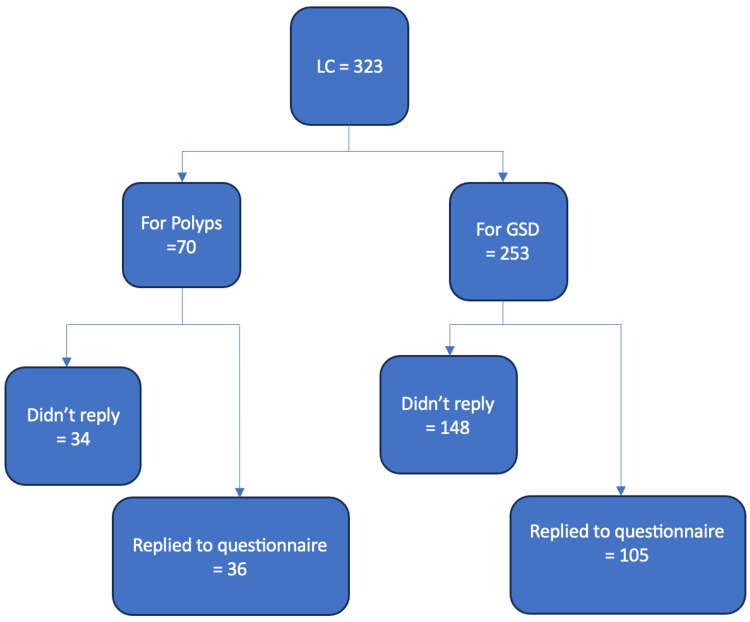
Aim To assess the effect of laparoscopic cholecystectomy (LC) in relieving the biliary type symptoms in patients with gallbladder polyps (GBPs) and to determine the positive and negative predictive values (PPV, NPV) of abdominal ultrasound (US) for the pre-operative detection. Methods The data were retrieved from our tertiary hepatobiliopancreatic (HPB) center database for all patients who had an LC as a treatment for symptomatic GBPs between 2013 and 2022. The pre-operative US and postoperative histology reports were reviewed. Patients were contacted and asked to fill in a questionnaire using the Accurx® software (Accurx UK) asking them about the degree of symptom relief following their surgery. Subsequently, the responses were correlated with polyp size, and the data collected was used to determine the PPV and NPV of the US examination for the identification of GBPs. Results Seventy patients had GBPs reported on pre-operative US and/or postoperative histology reports. Thirty-six patients (51.4 %) replied to our questionnaire. Twenty-four patients (66.6 %) reported complete relief of pain post-operatively, eight (22.2%) had a significant improvement of symptoms but still had ongoing mild discomfort, two (5.5%) are still experiencing discomfort which has not reduced following their cholecystectomy and two patients (5.5%) were unsure of the degree of improvement. Overall, 89 % of the patients reported a complete or major improvement in their symptoms after LC. Nine patients with putative GBPs on their pre-operative US had negative final histology while 26 patients whose initial US report showed only gallstones (GSs), had GBPs confirmed by their histology report. The prevalence of GBPs in our snapshot cohort is 21.6%, with a PPV of US of 83.02%, an NPV of 90.37%, and an accuracy for detecting GBPs of 89.16%. Conclusion Although LC continues to be the gold standard for the management of symptomatic gallstone disease, assessing the benefit of symptomatic GBPs is presently lacking. This study has demonstrated that the majority of patients with symptomatic GBPs experience a complete resolution or major improvement of their symptoms following surgery. Furthermore, a significant number of patients undergoing surgery for putative GSs will have GBPs demonstrated following histological examination, suggesting that these two conditions either coexist or the pre-operative assessment by US is not sufficiently reliable. Randomized controlled trials are needed to define the cohorts who require surgery or are most likely to benefit.
Keywords: benign gallbladder diseases; gallbladder polyp; gallbladder ultrasound; laparoscopic cholecystectomy; post-cholecystectomy.
Copyright © 2024, Mahmoud Askar et al.
Conflict of interest statement
Human subjects: Consent was obtained or waived by all participants in this study. Animal subjects: All authors have confirmed that this study did not involve animal subjects or tissue. Conflicts of interest: In compliance with the ICMJE uniform disclosure form, all authors declare the following: Payment/services info: All authors have declared that no financial support was received from any organization for the submitted work. Financial relationships: All authors have declared that they have no financial relationships at present or within the previous three years with any organizations that might have an interest in the submitted work. Other relationships: All authors have declared that there are no other relationships or activities that could appear to have influenced the submitted work.
Figures
References
-
- Management of incidentally detected gallbladder polyps: Society of Radiologists in Ultrasound Consensus Conference Recommendations. Kamaya A, Fung C, Szpakowski JL, et al. Radiology. 2022;305:277–289. - PubMed
LinkOut - more resources
Full Text Sources
Miscellaneous