


Clinical impact of the implementation of monocyte distribution width (MDW) measurement on time to anti-infective administration in sepsis patients in the emergency department: a before/after cohort study
- PMID: 39465419
- PMCID: PMC11514793
- DOI: 10.1186/s13054-024-05141-5
Clinical impact of the implementation of monocyte distribution width (MDW) measurement on time to anti-infective administration in sepsis patients in the emergency department: a before/after cohort study
Abstract
Background: Timely recognition of sepsis in emergency department (ED) is challenging. We evaluated the impact of implementing the biomarker monocyte distribution width (MDW) at bedside, on the time to anti-infective administration.
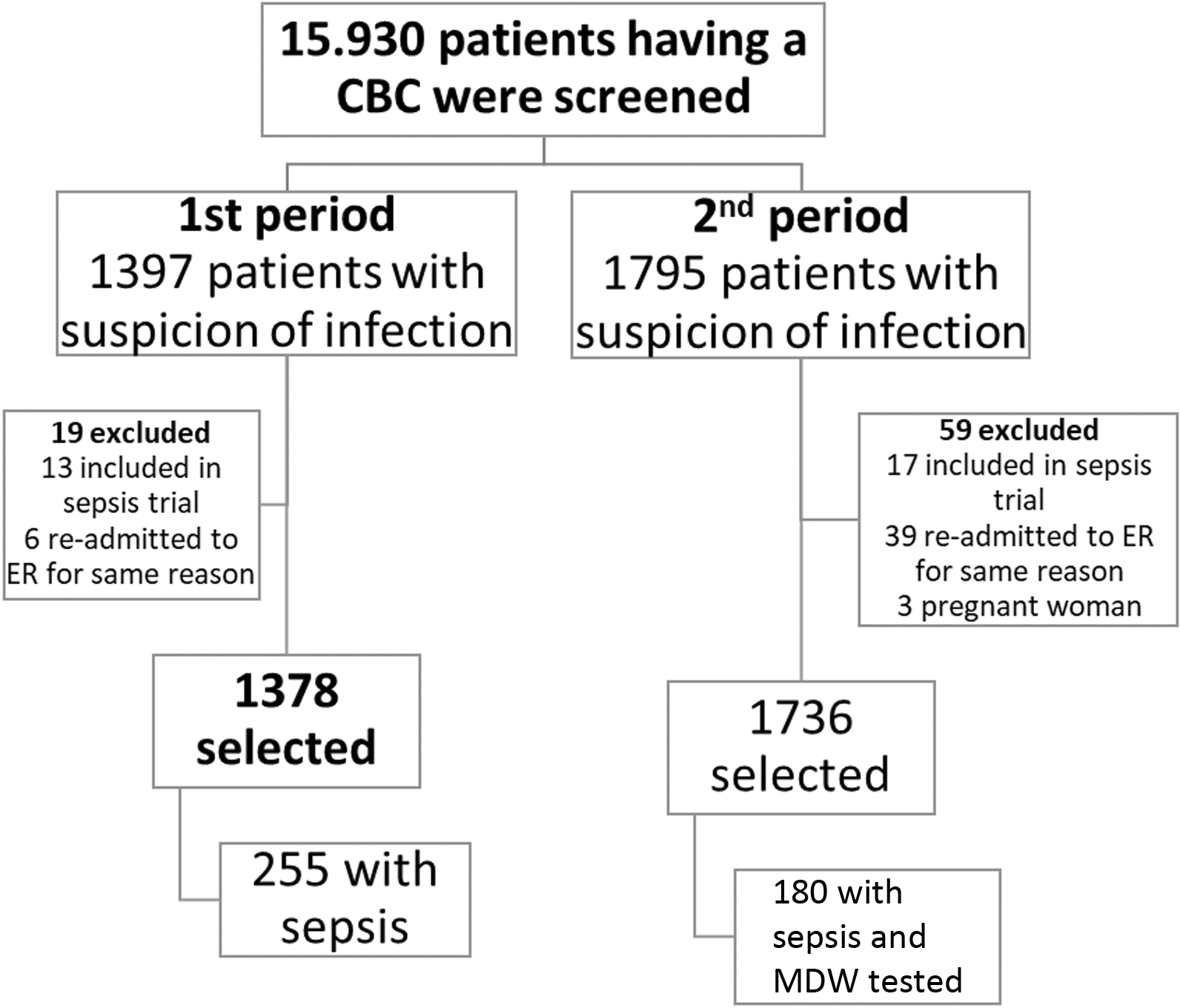
Methods: We conducted a before-and-after cohort study in the ED of an academic hospital in Paris, to compare sepsis patients care and outcomes, before and after the implementation of point of care (POC) MDW measurement in the ED. During post-implementation period (period-2), MDW was measured with complete blood count by ED nurses with results given in 2 min: if above 21.5 units, ED physicians were asked to consider sepsis and to start an anti-infectious as soon as possible. Primary endpoint was time to anti-infectious administration (TTA) from ED arrival, and secondary endpoints were TTA from sepsis onset (TTAS), length of stay, mortality, and hospitalization rates.
Results: In total, 255 patients (period-1) and 180 patients (period-2) with sepsis were included. The TTA was 5.4 h (3.5-7.7) period-1 and 4.9 h (IQR 2.5-7.1) in period-2 (p = 0.06). MDW implementation significantly reduced the median TTAS from to 3.7 h (IQR 1.5-5.8) in period-1, to 2.2 h (IQR 0.5-4.5) in period-2 (p < 0.001). Mortality rates remained similar between the two periods (18% vs. 16% respectively, p = 0.4), as did hospitalization rates (93% vs. 91%, p = 0.4) and ED length of stay (7.2 h (5.3-9.8) vs 7.0 (5.4-9.4), p = 0.7).
Conclusion: Implementing POC MDW measurement in the ED protocols enhances the timeliness of anti-infective administration from sepsis onset, meeting current sepsis management guidelines.
© 2024. The Author(s).
Conflict of interest statement
MCA, TS, EH, IC and ML have no competing interest. PH—received consultant fees and lecture honorarium from Beckman Coulter.
Figures
References
-
- Usman OA, Usman AA, Ward MA. Comparison of SIRS, qSOFA, and NEWS for the early identification of sepsis in the Emergency Department. Am J Emerg Med. 2019;37(8):1490–7. - PubMed
Publication types
MeSH terms
Substances
LinkOut - more resources
Full Text Sources
Medical
