


Positive association between constipation and mild cognitive impairment in elders: A cross-sectional study
- PMID: 39465768
- PMCID: PMC11460931
- DOI: 10.1097/MD.0000000000039943
Positive association between constipation and mild cognitive impairment in elders: A cross-sectional study
Abstract
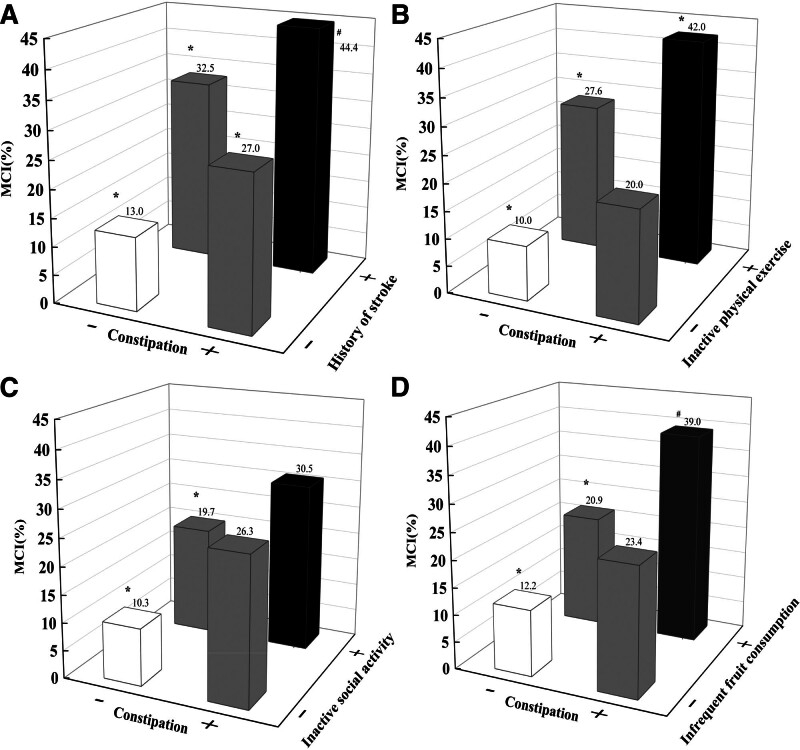
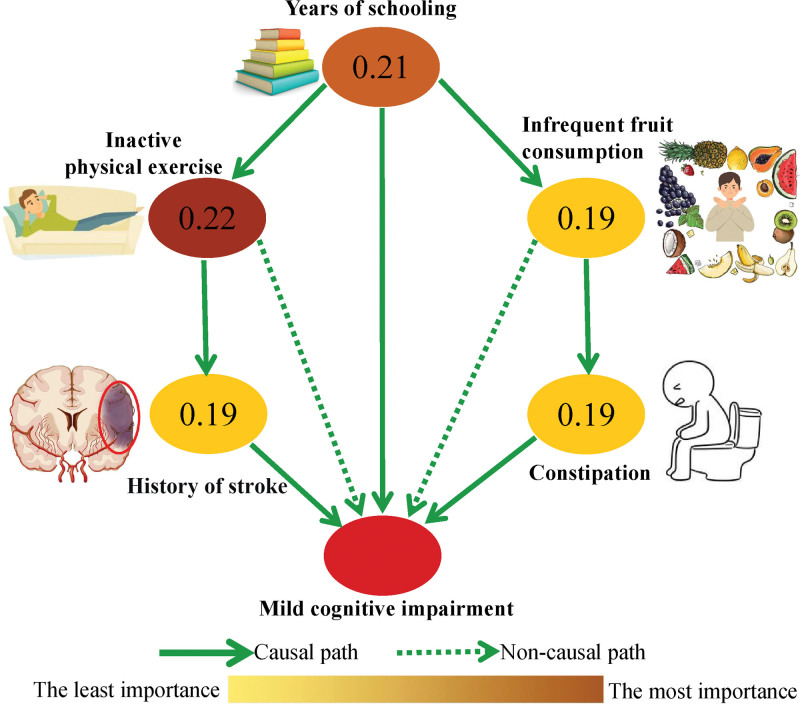
This study aimed to examine the association between constipation and mild cognitive impairment (MCI); and further elucidate the possible mechanisms involved. A cross-sectional study was conducted among community-dwelling elders (N = 789) in Nanning, China. Trained research staffs collected detailed information through questionnaires and physical examinations. A Bayesian network model was used to explore the hypothesized causal path. Synergistic effects of constipation with infrequent fruit consumption, inactive physical exercise, or history of stroke were observed in the risks of MCI occurrence. The Bayesian network model analyses showed 3 hypothesized causal-association paths leading to MCI occurrence. Among these, constipation, history of stroke, and years of schooling were directly related to the occurrence of MCI. Years of schooling indirectly affected MCI through infrequent fruit consumption and constipation; or through inactive physical exercises and history of stroke. This study demonstrates a direct association between constipation and increased risks of MCI.
Copyright © 2024 the Author(s). Published by Wolters Kluwer Health, Inc.
Conflict of interest statement
The authors have no conflicts of interest to disclose.
Figures
References
-
- Gauthier S, Webster C, Servaes S, Morais JA, Rosa-Neto P. World Alzheimer report 2022-Life after diagnosis: Navigating treatment, care and support. London: Alzheimer’s Disease International; 2022.
-
- Jia L, Du Y, Chu L, et al. . Prevalence, risk factors, and management of dementia and mild cognitive impairment in adults aged 60 years or older in China: a cross-sectional study. Lancet Public Health. 2020;5:e661–71. - PubMed
-
- Gauthier S, Reisberg B, Zaudig M, et al. .; International Psychogeriatric Association Expert Conference on mild cognitive impairment. Mild cognitive impairment. Lancet. 2006;367:1262–70. - PubMed
Publication types
MeSH terms
Grants and funding
LinkOut - more resources
Full Text Sources
Medical
