


International Multicenter Retrospective Study From the Ultra-rare Sarcoma Working Group on Low-grade Fibromyxoid Sarcoma, Sclerosing Epithelioid Fibrosarcoma, and Hybrid Forms: Outcome of Primary Localized Disease
- PMID: 39466087
- PMCID: PMC11634151
- DOI: 10.1097/PAS.0000000000002330
International Multicenter Retrospective Study From the Ultra-rare Sarcoma Working Group on Low-grade Fibromyxoid Sarcoma, Sclerosing Epithelioid Fibrosarcoma, and Hybrid Forms: Outcome of Primary Localized Disease
Abstract
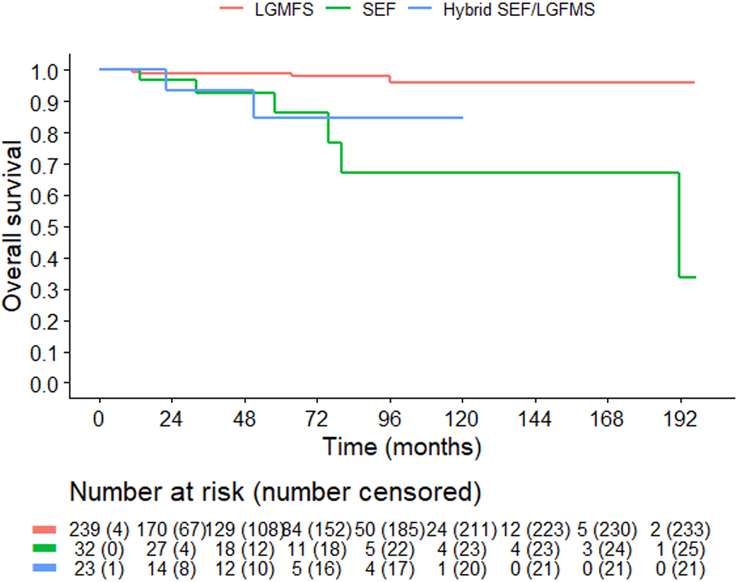
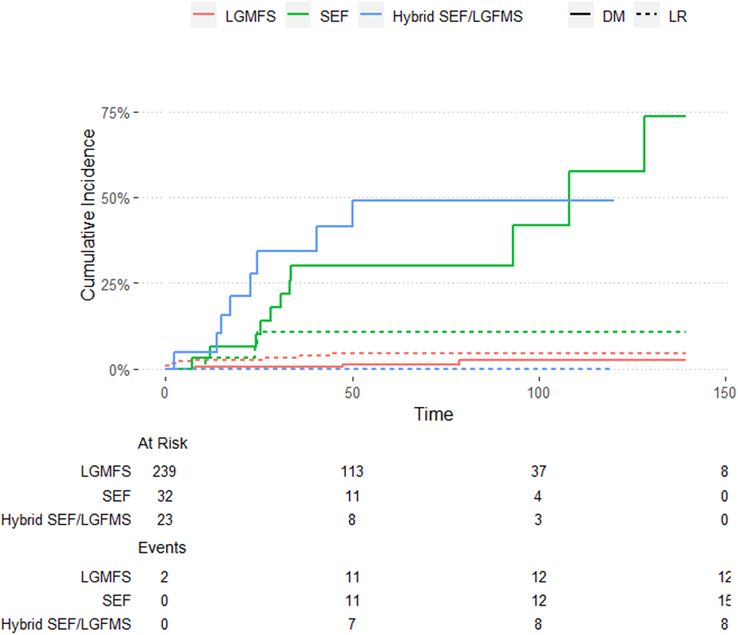
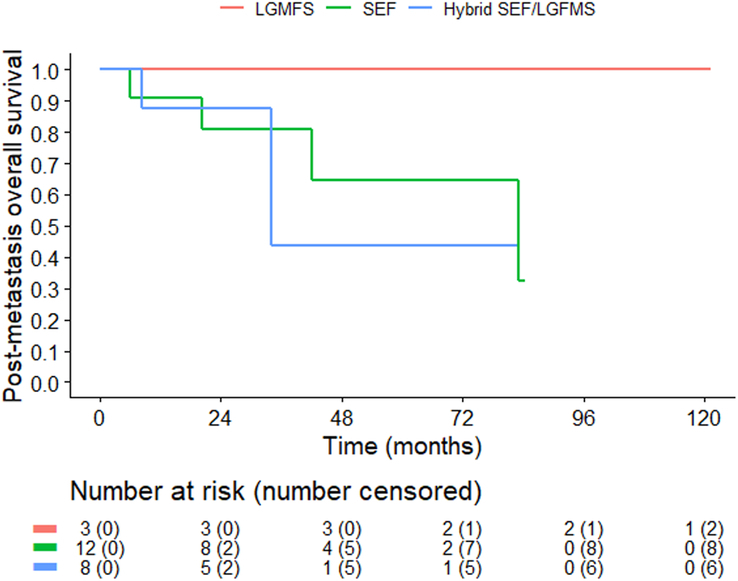
The aim of the study was to report the outcome of primary localized low-grade fibromyxoid sarcoma (LGFMS), sclerosing epithelioid fibrosarcoma (SEF), and hybrid LGFMS/SEF (H-LGFMS/SEF). Patients with primary localized LGFMS, SEF, or H-LGFMS/SEF, surgically treated with curative intent from January 2000 to September 2022, were enrolled from 14 countries and 27 institutions. Pathologic inclusion criteria were predefined by expert pathologists. The primary endpoint was overall survival (OS). Secondary endpoints were crude cumulative incidence (CCI) of local recurrence (LR), CCI of distant metastases (DM), and post-metastases OS (p-OS). Two hundred ninety-four patients (239 LGFMS, 32 SEF, and 23 H-LGFMS/SEF) were identified. At a median(m-) follow-up (FU) of 57.1 months, 12/294 patients died. The 5- and 10-year OS were 99.0% and 95.9% in LGFMS, 86.2% and 67.0% in SEF, and 84.8% and 84.8% in H-LGFMS/SEF, respectively. Predictors of worse OS included pathology, age at surgery, systemic therapy, and radiotherapy. LR developed in 13/294 (4.4%) patients. The observed m-time to LR was 10.7 months. The 5- and 10-yr CCI-LR were 4.7% in LGFMS and 6.6% in SEF, respectively. There were no LR events in H-LGFMS/SEF. The sole predictor of higher risk of LR was histology. DM developed in 23/294 (7.8%) patients. The observed m-time to DM was 28.2 months. The 5- and 10-yr CCI-DM were 1.3% and 2.7% in LGMFS, 29.9% and 57.7% in SEF, 48.9% and 48.9% in H-LGFMS/SEF, respectively. Predictors of higher risk of DM were histology, systemic therapy, and radiotherapy. Primary localized LGFMS treated with complete surgical resection has an excellent prognosis, while about 50% of H-LGFMS/SEF and SEF develop DM within 5 to 10 years. Very long-term FU is needed to understand absolute cure rates.
Copyright © 2024 The Author(s). Published by Wolters Kluwer Health, Inc.
Conflict of interest statement
Conflicts of Interest and Source of Funding: The authors have disclosed that they have no significant relationships with, or financial interest in, any commercial companies pertaining to this article.
Figures
References
-
- WHO Classification of Tumours Editorial Board . Soft Tissue and Bone Tumours. International Agency for Research on Cancer; 2020. (WHO Classification of Tumours series, 5th ed. Vol. 3).
-
- Bejarano PA, Padhya TA, Smith R, et al. . Hyalinizing spindle cell tumor with giant rosettes—a soft tissue tumor with mesenchymal and neuroendocrine features. An immunohistochemical, ultrastructural, and cytogenetic analysis. Arch Pathol Lab Med. 2000;124:1179–1184. - PubMed
-
- Panagopoulos I, Storlazzi CT, Fletcher CDM, et al. . The chimeric FUS/CREB3l2 gene is specific for low-grade fibromyxoid sarcoma. Genes Chromosomes Cancer. 2004;40:218–228. - PubMed
-
- Arbajian E, Puls F, Magnusson L, et al. . Recurrent EWSR1-CREB3L1 gene fusions in sclerosing epithelioid fibrosarcoma. Am J Surg Pathol. 2014;38:801–808. - PubMed
Publication types
MeSH terms
Grants and funding
LinkOut - more resources
Full Text Sources
