


Mini-open versus percutaneous surgical repair for acute Achilles tendon rupture: a systematic review and meta-analysis
- PMID: 39466410
- PMCID: PMC11703899
- DOI: 10.1007/s00264-024-06362-7
Mini-open versus percutaneous surgical repair for acute Achilles tendon rupture: a systematic review and meta-analysis
Abstract
Purpose: To compare the clinical outcomes and complications of mini-open (MOT) and percutaneous techniques (PT) in the surgical repair of acute Achilles tendon rupture (AATR).
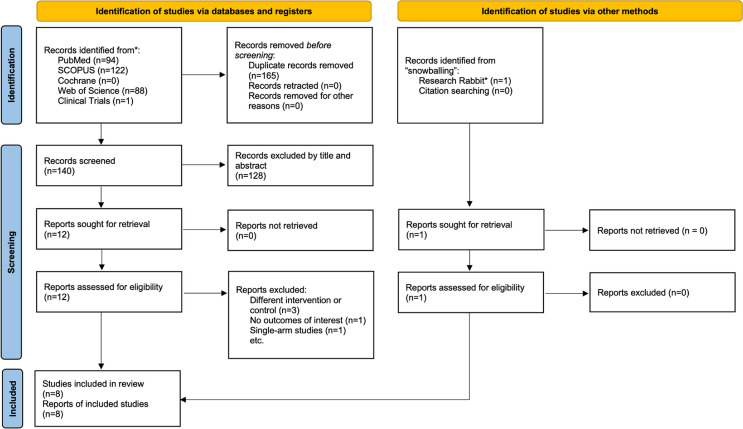
Methods: We systematically searched PubMed, Scopus, Web of Science, Clinical Trials, and the Cochrane Library for studies comparing MOT with PT for AATR. We assessed functional outcomes, complication rates, and operation time. Statistical analyses were performed using RevMan Web. Odds ratios (ORs) and mean difference (MD) with 95% confidence intervals (CIs) were pooled with a fixed-effects model for dichotomous and continuous endpoints, respectively. Heterogeneity was evaluated with I2 statistics.
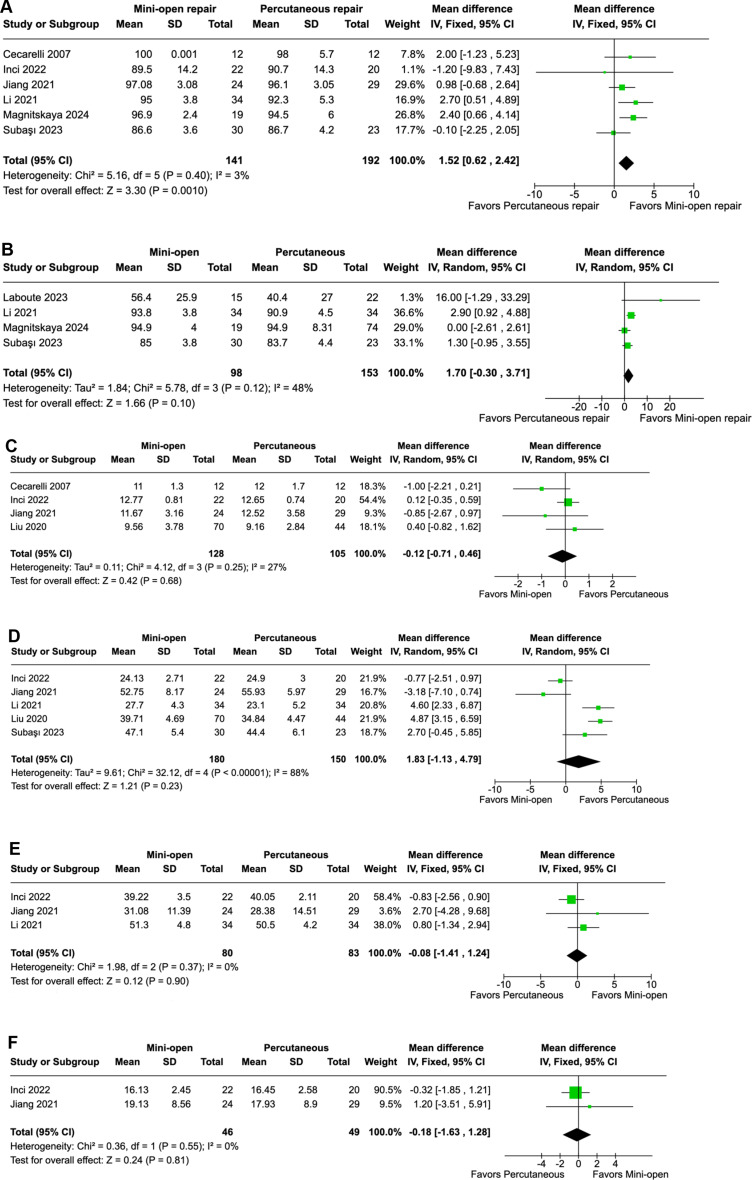
Results: Eight studies, comprising 484 patients, were included, of whom 226 (46%) underwent MOT. MOT was associated with a significantly lower re-rupture rate (1.48% vs. 6.11%; OR 0.28; 95% CI 0.09-0.86; p = 0.03; I2 = 6%) and sural nerve injury rate (0.57% vs. 5.64%; OR 0.24; 95% CI 0.07-0.81; p = 0.02; I2 = 0%). No significant differences were observed in venous thrombosis (OR 0.81; 95% CI 0.17-3.94; p = 0.33; I2 = 0%), wound infection (OR 0.56; 95% CI 0.12-2.62; p = 0.46; I2 = 0%), or operation time (MD 1.83 min; 95% CI -1.13-4.79; p = 0.23; I2 = 88%). Functional outcomes showed higher American Orthopaedic Foot and Ankle Society (AOFAS) Ankle-Hindfoot scores in the MOT group (MD 1.52 points; 95% CI 0.62-2.42; p = 0.001; I2 = 3%), while (Achilles Tendon Total Rupture Score) ATRS, time to return to activities, and ankle plantar and dorsiflexion were comparable.
Conclusions: MOT for AATR repair seems to reduce re-ruptures and sural nerve injuries while improving AOFAS scores, with no significant differences in other complications compared to PT. These findings suggest that the MOT may offer a safer and equally effective alternative to PT for AATR.
Keywords: AOFAS; Achilles; Limited open; Meta-analysis; Mini-open; Percutaneous.
© 2024. The Author(s).
Conflict of interest statement
Declarations. Ethical approval: This is a meta-analysis; no ethical approval was required to commence the study. Consent to participate: Not applicable as this is a meta-analysis. Consent for publication: All the authors consent to publish this paper Competing interests: All authors report no relationships that could be construed as a conflict of interest.
Figures

References
-
- Subaşı İÖ, Çepni Ş, Tanoğlu O et al (2023) A clinical comparison of two different surgical techniques in the treatment of acute Achilles tendon ruptures: limited-open approach vs. percutaneous approach. Ulus Travma Ve Acil Cerrahi Derg Turk J Trauma Emerg Surg TJTES 29:935–943. 10.14744/tjtes.2023.90839 - DOI - PMC - PubMed
-
- Svedman S, Marcano A, Ackermann PW et al (2024) Acute Achilles tendon ruptures between 2002–2021: sustained increased incidence, surgical decline and prolonged delay to surgery-a nationwide study of 53 688 ruptures in Sweden. BMJ Open Sport Exerc Med 10:e001960. 10.1136/bmjsem-2024-001960 - DOI - PMC - PubMed
Publication types
MeSH terms
LinkOut - more resources
Full Text Sources
