


Dexmedetomidine Ameliorates Myocardial Ischemia-Reperfusion Injury by Inhibiting MDH2 Lactylation via Regulating Metabolic Reprogramming
- PMID: 39467114
- PMCID: PMC11672254
- DOI: 10.1002/advs.202409499
Dexmedetomidine Ameliorates Myocardial Ischemia-Reperfusion Injury by Inhibiting MDH2 Lactylation via Regulating Metabolic Reprogramming
Abstract
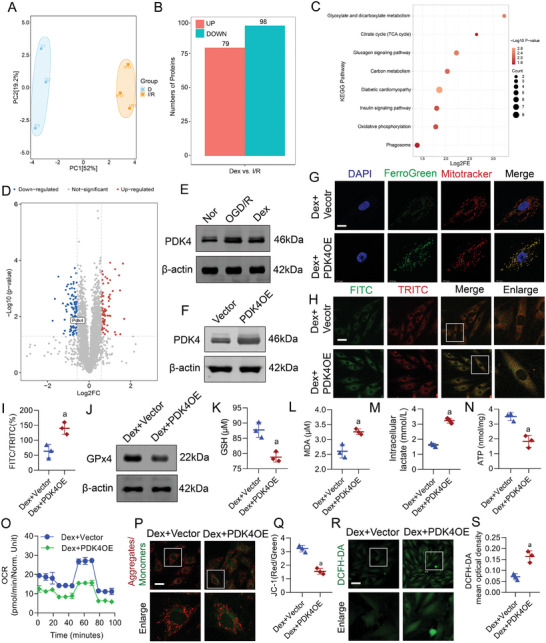
Myocardial ischemia-reperfusion injury (MIRI) significantly worsens the outcomes of patients with cardiovascular diseases. Dexmedetomidine (Dex) is recognized for its cardioprotective properties, but the related mechanisms, especially regarding metabolic reprogramming, have not been fully clarified. A total of 60 patients with heart valve disease are randomly assigned to Dex or control group. Blood samples are collected to analyze cardiac injury biomarkers and metabolomics. In vivo and vitro rat models of MIRI are utilized to assess the effects of Dex on cardiac function, lactate production, and mitochondrial function. It is found that postoperative CK-MB and cTNT levels are significantly lower in the Dex group. Metabolomics reveals that Dex regulates metabolic reprogramming and reduces lactate level. In Dex-treated rats, the myocardial infarction area is reduced, and myocardial contractility is improved. Dex inhibits glycolysis, reduces lactate, and improves mitochondrial function following MIRI. Lactylation proteomics identifies that Dex reduces the lactylation of Malate Dehydrogenase 2(MDH2), thus alleviating myocardial injury. Further studies reveal that MDH2 lactylation induces ferroptosis, leading to MIRI by impairing mitochondrial function. Mechanistic analyses reveal that Dex upregulates Nuclear Receptor Subfamily 3 Group C Member 1(NR3C1) phosphorylation, downregulates Pyruvate Dehydrogenase Kinase 4 (PDK4), and reduces lactate production and MDH2 lactylation. These findings provide new therapeutic targets and mechanisms for the treatment for MIRI.
Keywords: dexmedetomidine; ferroptosis; lactylation; metabolic reprogramming; myocardial ischemia‐reperfusion injury.
© 2024 The Author(s). Advanced Science published by Wiley‐VCH GmbH.
Conflict of interest statement
The authors declare no conflict of interest.
Figures




References
-
- Tsao C. W., Aday A. W., Almarzooq Z. I., Alonso A., Beaton A. Z., Bittencourt M. S., Boehme A. K., Buxton A. E., Carson A. P., Commodore‐Mensah Y., Elkind M. S. V., Evenson K. R., Eze‐Nliam C., Ferguson J. F., Generoso G., Ho J. E., Kalani R., Khan S. S., Kissela B. M., Knutson K. L., Levine D. A., Lewis T. T., Liu J., Loop M. S., Ma J., Mussolino M. E., Navaneethan S. D., Perak A. M., Poudel R., Rezk‐Hanna M., et al., Circulation 2022, 145, e153. - PubMed
-
- Bulluck H., Hausenloy D. J., Heart 2015, 101, 1067. - PubMed
-
- Heusch G., Nat. Rev. Cardiol. 2020, 17, 773. - PubMed
MeSH terms
Substances
Grants and funding
- 82300561/National Natural Science Foundation of China
- 82270523/National Natural Science Foundation of China
- 82305006/National Natural Science Foundation of China
- CSTB2023NSCQ-MSX0713/Natural Science Foundation of Chongqing
- YXQN202452/Chongqing Medical Young Talents Program
- YXQN202415/Chongqing Medical Young Talents Program
- High-Level Military Technological Innovation Talent Program
- CSTC2024YCJH-BGZXM0011/Chongqing Talent Program: Innovative Leading Talents
- CSTB2024NSCQ- LZX0079/Chongqing Natural Science Foundation Innovation and Development Joint Fund (Chongqing Education Commission)
- Sprint Program of Joint Medical Research of Chongqing Science and Chongqing Health Commission
LinkOut - more resources
Full Text Sources
Research Materials
Miscellaneous