. 2024 Oct 29;12(12):e0039324.
doi: 10.1128/spectrum.00393-24. Online ahead of print.

Maternal consumption of yoghurt activating the aryl hydrocarbon receptor increases group 3 innate lymphoid cells in murine offspring

Affiliations

Maternal consumption of yoghurt activating the aryl hydrocarbon receptor increases group 3 innate lymphoid cells in murine offspring

Grégory Pimentel et al. Microbiol Spectr. .

Abstract

Indole derivatives are microbial metabolites of the tryptophan pathway involved in gut immune homeostasis. They bind to the aryl hydrocarbon receptor (AhR), thereby modulating development of intestinal group 3 innate lymphoid cells (ILC3) and subsequent interleukin-22 production. In mice, indole derivatives of the maternal microbiota can reach the milk and drive early postnatal ILC3 development. Apart from the gut microbiota, lactic acid bacteria (LAB) also produce indole compounds during milk fermentation. Using germ-free mice, the aim of our study was to test if maternal intake of a dairy product enriched in AhR-activating indoles produced by fermentation could boost maturation of the intestinal innate immune system in the offspring. A set of 631 LAB strains were genetically screened for their potential to produce indole compounds. Among these, 125 strains were tested in combination with standard strains to produce yoghurts that were screened for their ability to activate AhR in vitro using the HepG2-AhR-Luc cell line. The most active yoghurt and a control yoghurt were formulated as pellets and fed to germ-free dams during pregnancy and lactation. Analysis of the offspring on postnatal day 14 using flow cytometry revealed an increase in the frequency of small intestinal lamina propria NKp46 +ILC3 s in the pups born to dams that had consumed the purified diet containing an AhR-active yoghurt (AhrY-diet) compared to control yoghurt (ConY-diet). Selection of LABs based on their ability to produce a fermented dairy able to activate AhR appears to be an effective approach to produce a yoghurt with immunomodulatory properties.

Importance: Key progresses in the sequencing and functional annotation of microbial organisms have revolutionized research in the fields of human metabolism and food biotechnology. In particular, the gut microbiome is now recognized as an important mediator of the impact of nutrition on human metabolism. Annotated genomes of a large number of bacteria are now available worldwide, which selectively transform food through fermentation to produce specific bioactive compounds with the potential to modulate human health. A previous research has demonstrated that the maternal microbiota shapes the neonatal immune system. Similarly, this report shows that lactic acid bacteria can be selected to produce fermented food that can also modulate postnatal intestinal immunity.

Keywords: aryl hydrocarbon receptor; lactic acid bacteria; newborn immunity.


Conflict of interest statement

The authors declare no conflict of interest.

Figures
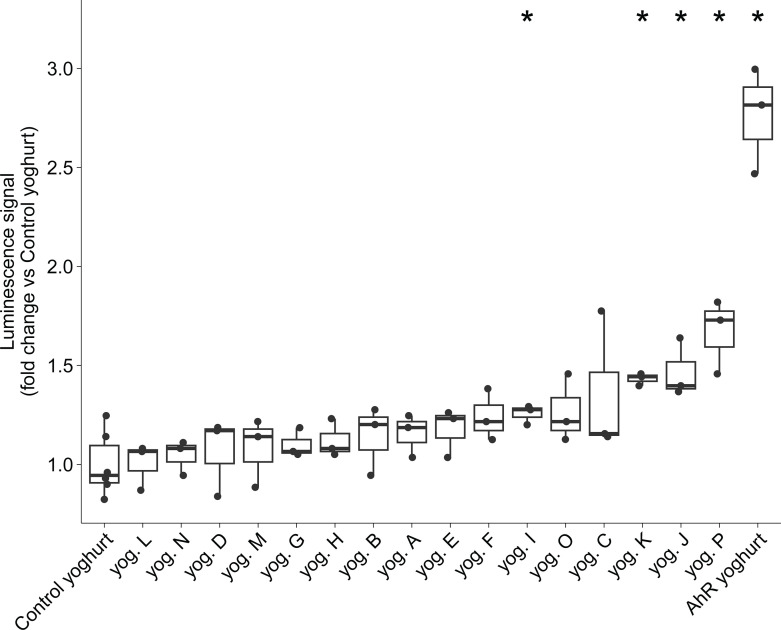
Fig 1
Fig 1
In vitro AhR activation assay of 16 test yoghurts compared to the conventional control yoghurt. A total of 125 bacterial strains were tested to produce yoghurts that were then screened for their ability to activate AhR in vitro using the HepG2–AhR–Luc cell line. Two strains were then selected to produce the AhR yoghurt. The figure presents the ability of the top 16 strains and the AhR yoghurt to activate AhR in vitro compared to the control yoghurt (Wilcoxon test P < 0.05 as a threshold).
Fig 2
Fig 2
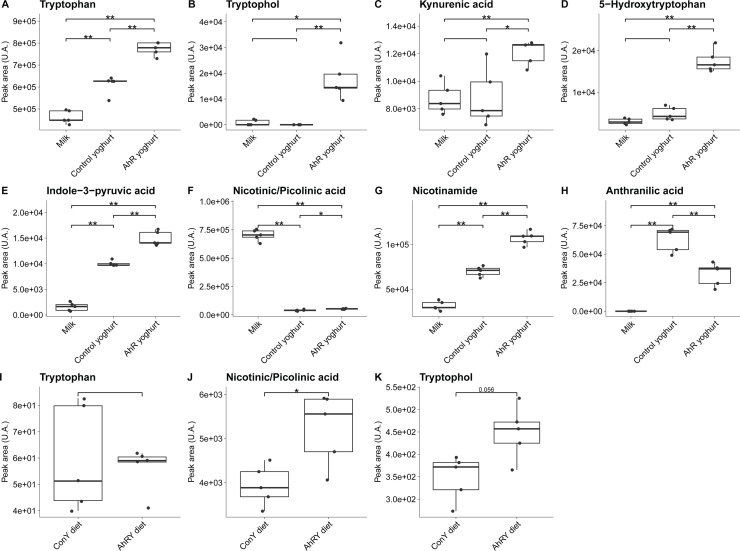
Indole derivatives discriminating the test and control products. Targeted UHPLC-MS metabolomics was used to evaluate the relative contents of 38 indole derivatives and compounds belonging to the tryptophan pathway. (A–H) Eight compounds showed significant differences between the AhR yoghurt and the control yoghurt. Their relative concentration is also shown in the milk used to prepare the yoghurts. (I) Tryptophan did not show significant differences between the AhrY-diet and the ConY-diet. (J, K) Two compounds showed significant differences between the test diet (AhrY-diet) and the control diet (ConY-diet). Statistical significance is based on the Wilcoxon test with P < 0.05.
Fig 3
Fig 3
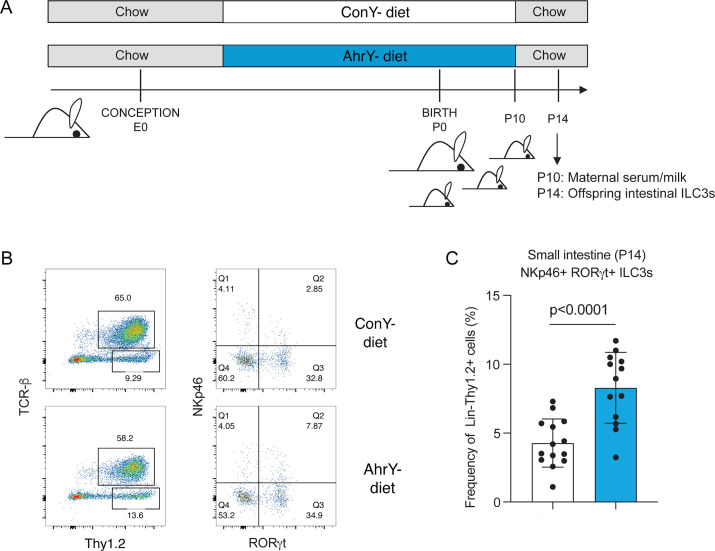
Feeding germ-free dams with the AhrY-diet increases intestinal group 3 innate lymphoid cells in the offspring. (A) Time pregnant germ-free C57BL/6 dams were fed purified diets containing the AhR yoghurt (AhrY-diet) or the control yoghurt (ConY-diet) starting on day 7 post conception until postnatal day 10. The offspring in each group was analyzed on postnatal day 14 using flow cytometry of the intestinal lamina propria. (B) Representative dot plots pre-gated on CD19 (left) and CD19TCRβThy1.2+ (right) small intestinal lamina propria lymphocytes. (C) Relative frequency of small intestinal NKp46+RORgt + ILC3 among CD19TCRβThy1.2+ at postnatal day 14. Data represent mean ± SD, n = 14 pups (ConY-diet), n = 13 pups (AhrY-diet) pooled from two independent experiments.
Fig 4
Fig 4
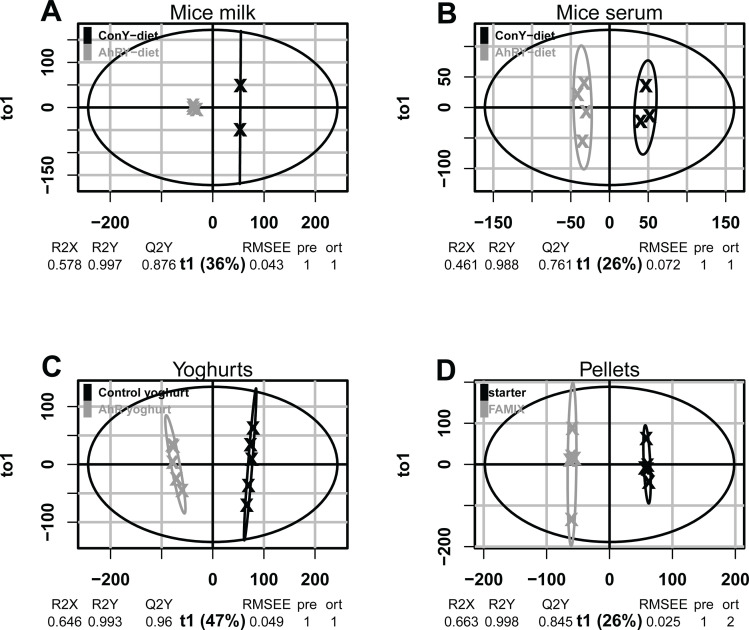
Untargeted LC-MS metabolomics discriminates the test products from the control products as well as the milk and serum of germ-free dams having ingested them. (A) Orthogonal projections to latent structures discriminant analysis (OPLS-DA) run with 6,662 compounds and discriminating milk from germ-free dams fed the AhrY-diet and ConY-diet. (B) OPLS-DA run with 7,255 compounds and discriminating serum from germ-free dams fed the AhrY-diet and ConY-diet. (C) OPLS-DA run with 12,734 compounds and discriminating the AhR yoghurt from the control yoghurt. (D) OPLS-DA run with 15,271 compounds and discriminating the AhrY-diet from the ConY-diet. Q2Y, predictive ability parameter; R2Y, goodness-of-fit parameter; RMSEE, square root of the mean error between the actual and the predicted responses; pre and ort, number of predictive and orthogonal components respectively; t1, OPLS-DA predictive component; to1, OPLS-DA orthogonal component.

References

    1. Li KJ, Brouwer-Brolsma EM, Burton KJ, Vergères G, Feskens EJM. 2020. Prevalence of fermented foods in the Dutch adult diet and validation of a food frequency questionnaire for estimating their intake in the NQplus cohort. BMC Nutr 6:69. doi: 10.1186/s40795-020-00394-z - DOI - PMC - PubMed
    1. Campbell-Platt G. 1994. Fermented foods — a world perspective. Food Res Int 27:253–257. doi: 10.1016/0963-9969(94)90093-0 - DOI
    1. Garnier N, Valamoti SM. 2016. Prehistoric wine-making at Dikili Tash (Northern Greece): integrating residue analysis and archaeobotany. J Archaeol Sci 74:195–206. doi: 10.1016/j.jas.2016.03.003 - DOI
    1. Carrigan MA, Uryasev O, Frye CB, Eckman BL, Myers CR, Hurley TD, Benner SA. 2015. Hominids adapted to metabolize ethanol long before human-directed fermentation. Proc Natl Acad Sci U S A 112:458–463. doi: 10.1073/pnas.1404167111 - DOI - PMC - PubMed
    1. Naghmouchi K, Belguesmia Y, Bendali F, Spano G, Seal BS, Drider D. 2020. Lactobacillus fermentum: a bacterial species with potential for food preservation and biomedical applications. Crit Rev Food Sci Nutr 60:3387–3399. doi: 10.1080/10408398.2019.1688250 - DOI - PubMed