Meta-Analysis
. 2024 Oct 29;15(1):9317.
doi: 10.1038/s41467-024-53516-7.

Discovery and prioritization of genetic determinants of kidney function in 297,355 individuals from Taiwan and Japan

Affiliations
Meta-Analysis

Discovery and prioritization of genetic determinants of kidney function in 297,355 individuals from Taiwan and Japan

Hung-Lin Chen et al. Nat Commun. .

Abstract

Current genome-wide association studies (GWAS) for kidney function lack ancestral diversity, limiting the applicability to broader populations. The East-Asian population is especially under-represented, despite having the highest global burden of end-stage kidney disease. We conducted a meta-analysis of multiple GWASs (n = 244,952) on estimated glomerular filtration rate and a replication dataset (n = 27,058) from Taiwan and Japan. This study identified 111 lead SNPs in 97 genomic risk loci. Functional enrichment analyses revealed that variants associated with F12 gene and a missense mutation in ABCG2 may contribute to chronic kidney disease (CKD) through influencing inflammation, coagulation, and urate metabolism pathways. In independent cohorts from Taiwan (n = 25,345) and the United Kingdom (n = 260,245), polygenic risk scores (PRSs) for CKD significantly stratified the risk of CKD (p < 0.0001). Further research is required to evaluate the clinical effectiveness of PRSCKD in the early prevention of kidney disease.


Conflict of interest statement

The authors declare no competing interests.

Figures
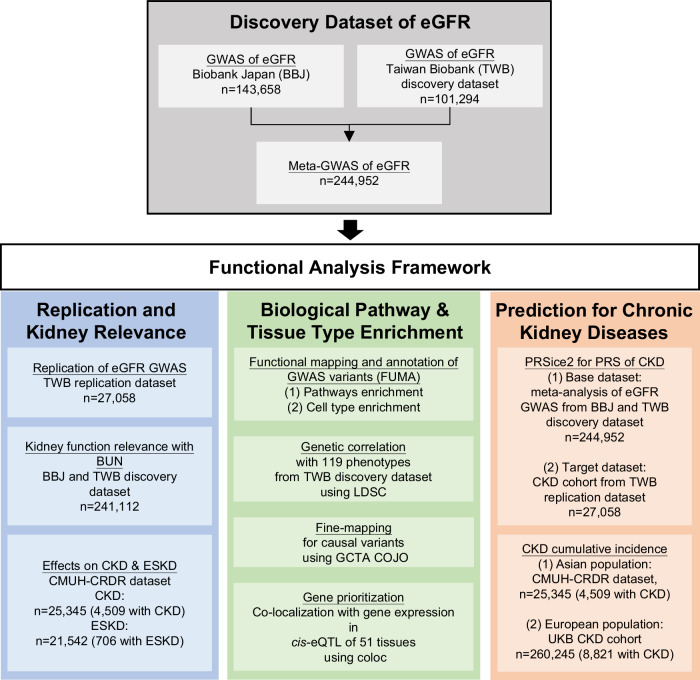
Fig. 1
Fig. 1. Flowchart of the study design.
A meta-analysis of an eGFR GWAS was conducted using the BBJ and TWB. Replication was performed using an independent TWB-derived replication dataset. The relevance of the eGFR to kidney function was validated through the associations of the eGFR with BUN, CKD, and ESKD in the TWB and BBJ. Pathways and tissue types were enriched through the FUMA platform. Genetic correlation analysis of 119 traits was conducted using LD score regression. Fine mapping of causal variants was performed using GCTA-COJO, and gene prioritization with tissue-specific cis-eQTLs was conducted using the R package “coloc.” The PRS for CKD was derived using PRSice-2 and tested using patient data obtained from a Taiwanese hospital cohort (CMUH-CRDR CKD) and community-based data obtained from a UK cohort (UKB CKD). BBJ Biobank Japan, BUN blood urea nitrogen, cis-eQTL cis-expression quantitative trait locus, CKD chronic kidney disease, CMUH-CRDR Clinical Research Data Repository of China Medical University Hospital, eGFR estimated glomerular filtration rate, ESKD end-stage kidney disease, FUMA Functional Mapping and Annotation of Genome-Wide Association Studies, GCTA-COJO genome-wide complex trait analysis–conditional and joint analysis, GWAS genome-wide association study, LDSC linkage disequilibrium score regression, PRS polygenic risk score, SNP single-nucleotide polymorphism, TWB Taiwan Biobank, UKB UK Biobank.
Fig. 2
Fig. 2. A circular Manhattan plot from a meta-analysis of eGFR-derived GWASs (TWB, n = 101,294; BBJ, n = 143,658; total n = 244,952).
The green band corresponds to –log10(P) for association with eGFR in the meta-analysis by chromosomal position. The blue band corresponds to –log10(P) for association with eGFR in the TWB-derived discovery dataset by chromosomal position. The orange band corresponds to –log10(P) for association with eGFR in the BBJ dataset by chromosomal position. The solid red line indicates genome-wide significance (P = 5 × 10–8). Genes labeled in black indicate SNPs exclusively identified in the meta-analysis, whereas genes labeled in blue indicate SNPs identified in the meta-analysis and additionally detected in the TWB or BBJ or both. A total of 5790 SNPs had P values of <5 × 10−8, of which 4732 had a consistent effect direction. The lowest P value was observed for rs62435145 near UNCX on chromosome 7 (P = 5.23 × 10−67 Supplementary Data 2). All statistical tests employed two-sided P values. BBJ Biobank Japan, eGFR estimated glomerular filtration rate, GWAS genome-wide association study, SNP single-nucleotide polymorphism, TWB Taiwan Biobank.
Fig. 3
Fig. 3. Replication of eGFR-associated SNPs in an independent replication dataset derived from the TWB (n = 27,058).
Data regarding 5342 out of 5790 eGFR-associated SNPs were available in the TWB-derived replication dataset. Of these eGFR-associated SNPs, 3899 were replicated in the TWB-derived replication dataset (two-sided P < 0.05, consistent effect direction), plotted as blue dots (“Yes” indicated by blue dots, with a consistent effect, two-sided P < 0.05; “Inconclusive” indicated by gray dots, two-sided P ≥ 0.05). The blue line represents the best fit of the blue dots. Pearson’s r is 0.97 (two-sided P < 0.0001). The data present the effect estimates, and error bars correspond to 95% CIs. Further details are provided in Supplementary Data 4. BBJ Biobank Japan, eGFR estimated glomerular filtration rate, SNP single-nucleotide polymorphism, TWB Taiwan Biobank.
Fig. 4
Fig. 4. Tissue-specific analysis of eGFR GWASs.
Functional analysis of an eGFR-derived GWAS was conducted using GTEx version 8 (54 tissue types) in MAGMA. Kidney medulla and kidney cortex tissues had P values of <0.05 (above the dashed line). All statistical tests employed two-sided P values. Further details are provided in Supplementary Data 9. eGFR estimated glomerular filtration rate, GTEx Genotype-Tissue Expression, GWAS genome-wide association study, MAGMA Multimarker Analysis of GenoMic Annotation.
Fig. 5
Fig. 5. Fine mapping of credible sets of exonic and regulatory SNPs.
a Fine mapping of exonic SNPs. The triangles represent exonic SNPs, and their sizes correspond to their CADD scores. The red triangles indicate exonic SNPs with a credible set size of <5 or a PP of >99%. b Fine mapping of regulatory SNPs. Each color corresponds to a unique tissue type, as indicated by Roadmap Epigenomics data. The labels indicate credible set sizes of ≤10 and PPs of >95%. All statistical tests employed two-sided P values. Further details are provided in Supplementary Data 13. CADD combined annotation-dependent depletion, PP posterior probability, SNP single-nucleotide polymorphism.
Fig. 6
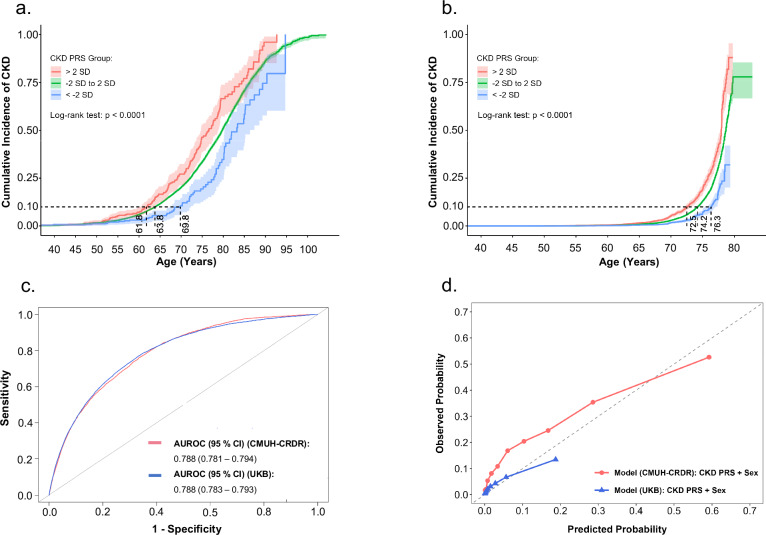
Fig. 6. Cumulative incidence of CKD based on PRS stratification with a Taiwanese dataset obtained from the CMUH-CRDR and a White British dataset obtained from the UKB.
The high-PRS group exhibited a higher cumulative incidence of CKD than did the low-PRS group across age in the a external Taiwanese dataset (CMUH-CRDR, n = 25,345, P = 2.06 × 10−7) and b White British dataset (UKB, n = 260,245, P = 2.60 × 10−29). The data present the PRS and error bars correspond to 95% CIs. All statistical tests employed two-sided P values. The dashed line represents a CKD cumulative incidence of 10%, which is an estimate of the global prevalence of CKD. c The AUROC of the CKD PRS model is 0.788 in both the CMUH-CRDR and UKB datasets. d The calibration curve of our PRSCKD model indicates that the predicted probability was closely aligned with the observed probability when the predicted probability ranged between 0.4 and 0.5 in the CMUH-CRDR dataset and between 0.0 and 0.2 in the UKB dataset. AUROC area under the receiver-operating characteristic curve, CI confidence interval, CKD chronic kidney disease, CMUH-CRDR Clinical Research Data Repository of China Medical University Hospital, PRS polygenic risk score, SD standard deviation, UKB UK Biobank.

References

    1. Collaboration GBDCKD. Global, regional, and national burden of chronic kidney disease, 1990-2017: a systematic analysis for the Global Burden of Disease Study 2017. Lancet395, 709–733 (2020). - PMC - PubMed
    1. Chertow, G. M. et al. Effects of dapagliflozin in stage 4 chronic kidney disease. J. Am. Soc. Nephrol.32, 2352–2361 (2021). - PMC - PubMed
    1. Heerspink, H. J. L. et al. Dapagliflozin in patients with chronic kidney disease. New Engl. J. Med383, 1436–1446 (2020). - PubMed
    1. Jafar, T. H. FDA approval of dapagliflozin for chronic kidney disease: a remarkable achievement? Lancet398, 283–284 (2021). - PubMed
    1. Savage, N. Tapping into the drug discovery potential of AI. Biopharm. Deal. B37–B39 https://www.nature.com/articles/d43747-021-00045-7 (2021).

Publication types

MeSH terms

Substances