. 2024 Oct 29;14(1):25907.
doi: 10.1038/s41598-024-77375-w.

Tracing the path of Quorum sensing molecules in cystic fibrosis mucus in a biomimetic in vitro permeability platform

Affiliations

Tracing the path of Quorum sensing molecules in cystic fibrosis mucus in a biomimetic in vitro permeability platform

Olga Valentina Garbero et al. Sci Rep. .

Abstract

P. aeruginosa employs specific quorum sensing (QS) mechanisms to orchestrate biofilm formation, enhancing resistance to host defences. In physiological conditions, QS molecules permeate the lung environment and cellular membrane to reach the cytoplasmic Aryl Hydrocarbon Receptor (AhR) that is pivotal for activating the immune response against infection. In pathological conditions like cystic fibrosis (CF) this interkingdom communication is altered, favouring P. aeruginosa persistence and chronic infection. Here, we aim to investigate the molecular journey of QS molecules from CF-like environments to the cytoplasm by quantifying via HPLC-MS the permeability of selected QS molecules (quinolones, lactones, and phenazines) through in vitro models of the two main biological lung barriers: CF-mucus and cellular membrane. While QS molecules not activating AhR exhibit intermediate permeability through the cellular membrane model (PAMPA) (1.0-4.0 × 10⁻⁶ cm/s), the AhR-activating molecule (pyocyanin) shows significantly higher permeability (8.6 ± 1.4 × 10⁻⁶ cm/s). Importantly, combining the CF mucus model with PAMPA induces a 50% decrease in pyocyanin permeability, indicating a strong mucus-shielding effect with pathological implications in infection eradication. This study underscores the importance of quantitatively describing the AhR-active bacterial molecules, even in vitro, to offer new perspectives for understanding P. aeruginosa virulence mechanisms and for proposing new antibacterial therapeutic approaches.


Conflict of interest statement

The authors declare no competing interests.

Figures
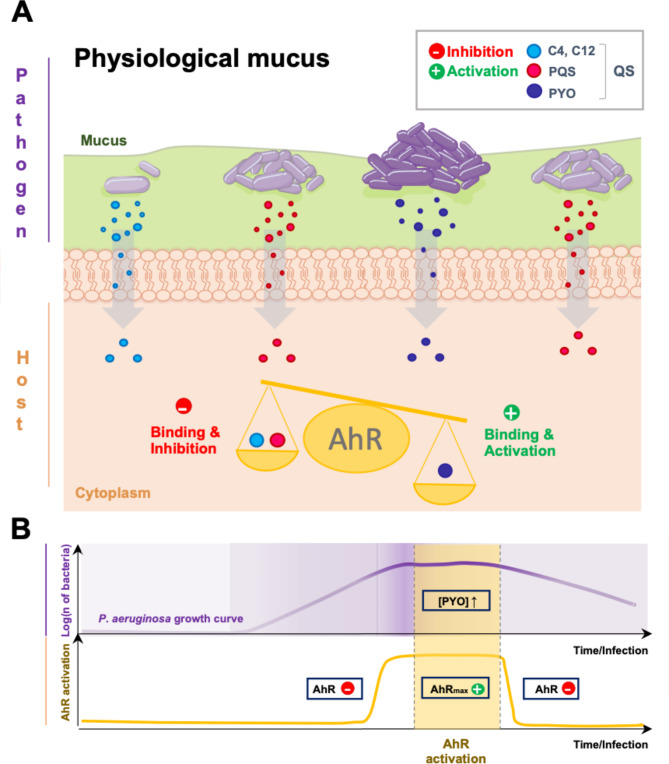
Fig. 1
Fig. 1
Relevance of AhR in the host–pathogen interkingdom signalling. In physiological condition, QS molecules permeate through the mucus environment and the cellular membrane to bind AhR (A). To avoid unnecessary triggering on the immune reaction, the AhR is activated by QS associated with the late-phase growth of P. aeruginosa (e.g., phenazine pyocyanin) while it is inhibited by other QS molecules, like quinolones and lactones, that precede terminal production of virulence factors, (B).
Fig. 2
Fig. 2
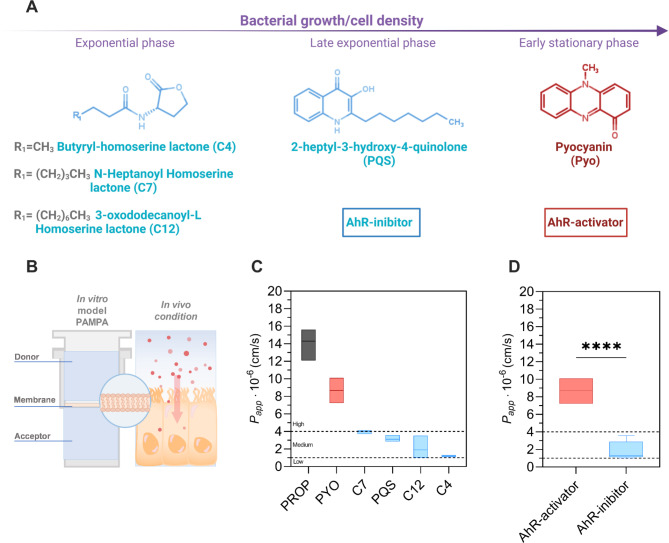
Permeability evaluation of AhR-activating and AhR-inhibiting QS molecules (A) AhR-inhibitors (blue) and AhR-activators (red) QS molecules produced by P. aeruginosa at different stages of infection. (B) The PAMPA 96-well plate enables in vitro simulation of the cell membrane of the host that QS molecules must cross to reach the cytoplasmic receptor. The graphical insert represents the PAMPA working process, where the donor and acceptor compartments are separated by a semipermeable phospholipid membrane as a model of the phospholipid cellular barrier. (C) Apparent permeabilities (Papp) of the QS molecules: pyocyanin (PYO), N‑Heptanoyl‑Homoserine lactone (C7), 2‑heptyl‑3‑hydroxy‑4‑quinolone (PQS), 3‑oxododecanoyl‑L‑Homoserine‑lactone (C12), butyryl‑homoserine lactone (C4). Propranolol (PROP) was used as a control for testing membrane integrity. The thresholds of low-to-medium and medium-to-high permeability (1.0 × 10− 6 cm/s and at 4.0 × 10− 6 cm/s, respectively) are represented by the dashed lines (****p < 0.0001). (D) Apparent permeability of the QS molecules able to bind and activate (red) or inhibit (blue) the AhR according to the literature,.
Fig. 3
Fig. 3
In vitro evaluation of the effect of CF-mucus on QS molecules diffusion. (A) Plate enables to assess in vitro the impact of mucus on the diffusion of QS molecules. The concentrations in the acceptors were measured using HPLC-MS after five hours; (B) Diffusion (%) of the QS molecules. Correlation plots between diffusion and (C) partition coefficient (cLogP), (D) solubility (cLogS), (E) and Van der Waals volume (VDW Volume) of the tested QS molecules. (F) 3D chemical space defined by cLogP, cLogS, and VDW Volume. A colour range is used to display diffusion rates of the QS molecules.
Fig. 4
Fig. 4
Evaluation of the permeability of QS molecules in the integrated biomimicking in vitro permeability platform. (A) The PAMPA 96-well plate coupled with the CF mucus model enables the in vitro simulation of the two barriers that QS molecules must cross to reach the cytoplasmic receptor: the cell membrane and the mucus. (B) Apparent permeability (Papp) of Quorum sensing in absence (orange) and presence of the CF mucus model (green). Propranolol (PROP) was the internal standard. (C) Apparent permeability of the QS molecules able to activate (red) or inhibit (blue) the AhR in absence (orange) and presence of the CF mucus model (green). (D,E) In the pathological condition of CF, the presence of a thickened mucosal barrier can greatly influence the permeability of QS, therefore impacting their binding with AhR.
Fig. 5
Fig. 5
Characterisation of the interaction between the AhR-activating pyocyanin and mucins in the CF-mucus model. (A) Pyocyanin solutions at 800 µM in acidic (pH 4) and neutral conditions (PB pH 7.4) (B) Color transition from blue to purple of pyocyanin solution (800 µM) deposited onto a tube containing the CF mucus model with slight acid pH (pH 5). (C) UV–Vis absorption spectra of pyocyanin in acidic conditions (pH 2), neutral conditions (pH 7.4) and in mucus (pH 5). (D) The positive charge form of protonated pyocyanin (blue) interacts with the negative charges of the mucins (COO). This interaction significantly impacts the permeability of pyocyanin compared to other QS molecules.

References

    1. Li, Z. et al. Infection and lung disease progression in children with cystic fibrosis. 293, 581–588 (2017). - PubMed
    1. Murray, M. P., Pentland, J. L., Turnbull, K., MacQuarrie, S. & Hill, A. T. Sputum colour: a useful clinical tool in non-cystic fibrosis bronchiectasis. Eur. Respir. J.34, 361–364 (2008). - PubMed
    1. Burns, J. L. et al. Longitudinal assessment of Pseudomonas aeruginosa in young children with cystic fibrosis. J. Infect. Dis.183, 444–452 (2001). - PubMed
    1. Murray, T. S., Egan, M. & Kazmierczak, B. I. Pseudomonas aeruginosa chronic colonization in cystic fibrosis patients. Curr. Opin. Pediatr.19, 83–88 (2007). - PubMed
    1. Ramsey, A. K. A. et al. Page 1 of 38 1–38 (2014).

MeSH terms