


Predicting Health-Related Quality of Life Among Chinese Residents: Latent Class Analysis Based on Panel Survey Data
- PMID: 39473437
- PMCID: PMC11520728
- DOI: 10.2147/RMHP.S475022
Predicting Health-Related Quality of Life Among Chinese Residents: Latent Class Analysis Based on Panel Survey Data
Abstract
Purpose: This study aimed to identify distinct trends among Chinese residents based on their health-related quality of life (HR-QoL) outcomes and to analyze the demographic characteristics that contribute to these trends.
Materials and methods: The study conducted latent class analysis using baseline data obtained from a survey of health service utilization behaviors (from July to December 2016) among residents of Hubei Province, China (N = 1517). Latent classes were used to implement the HR-QoL grouping of different trends among the respondents. Multinomial logistic regression analysis was used to identify demographic characteristic factors affecting HR-QoL in the trend groups.
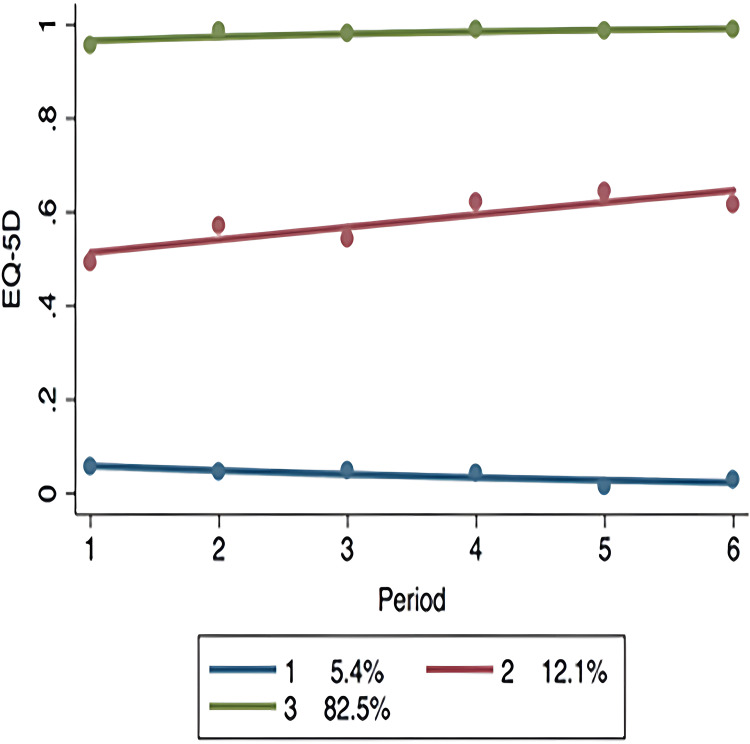
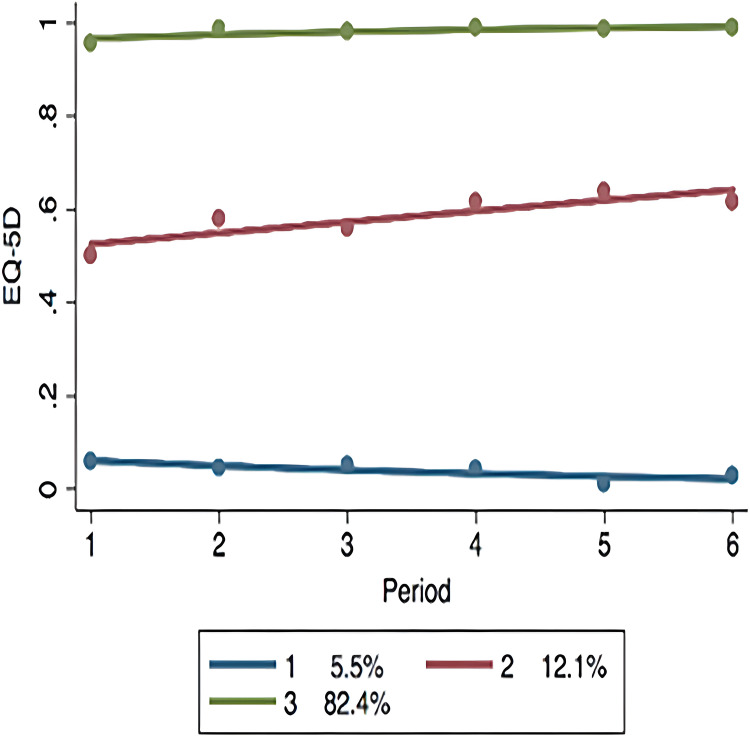
Results: A three-class model emerged as the most suitable grouping classification for HR-QoL among Chinese residents: the low HR-QoL class, exhibiting a downward trend (5.5%); the medium HR-QoL class, exhibiting an upward trend (12.1%); and the stable HR-QoL class, exhibiting high HR-QoL (82.4%). Participants in the medium class were more likely to be without chronic diseases, aged 45-64 years, and employed than those in the low class. Conversely, urban participants had a higher likelihood of belonging to the low class. Participants in the stable class were more likely to be without chronic diseases, aged 15-44 years or 45-64 years, and employed than those in the low class. Conversely, urban participants had a higher likelihood of belonging to the low class.
Conclusion: Three latent trend classes of HR-QoL were observed, which exhibited distinct characteristics. Residents without chronic diseases, residents under 65 years of age, and employed residents had better HR-QoL than individuals in other classes, while urban residents had poorer HR-QoL than individuals in other classes.
Keywords: Chinese resident; health-related quality of life; latent class analysis.
Plain language summary
Health-related quality of life (HR-QoL) is an essential predictor of healthcare utilization, mortality, morbidity, and poor health. The rapid pace of modernization has corresponded with changes in the HR-QoL of the population. However, more empirical research is needed on the changes in HR-QoL among the Chinese population. In this study, we identified different trends in HR-QoL among Chinese residents and the demographic factors influencing HR-QoL among these trends. This study highlighted variations in longitudinal HR-QoL trends among Chinese residents. HR-QoL for Chinese residents is divided into three classes: low, exhibiting a downward trend; medium, exhibiting an upward trend; and stable, exhibiting high HR-QoL. Residents without chronic diseases, residents under the age of 65, and employed residents had better HR-QoL than other classes of individuals, while urban residents had worse HR-QoL than other classes of individuals. Understanding these HR-QoL trends could aid the development of targeted interventions for Chinese residents and improve their health and quality of life.
© 2024 Li et al.
Conflict of interest statement
The authors have declared that no competing interests exist.
Figures
References
-
- Seppälä T, Mäntyselkä P, Saxen U, Kautiainen H, Järvenpää S, Korhonen PE. Weight change and health related quality of life: population-based longitudinal study of the effects of health related quality of life on the success of weight management. J Community Health. 2014;39(2):349–354. doi: 10.1007/s10900-013-9768-8 - DOI - PubMed
LinkOut - more resources
Full Text Sources
