


Safety and efficacy of peroral endoscopic myotomy for treating achalasia in pediatric and geriatric patients: A meta-analysis
- PMID: 39473543
- PMCID: PMC11514429
- DOI: 10.4253/wjge.v16.i10.566
Safety and efficacy of peroral endoscopic myotomy for treating achalasia in pediatric and geriatric patients: A meta-analysis
Abstract
Background: As a less invasive technique, peroral endoscopic myotomy (POEM) has recently been widely accepted for treating achalasia with an excellent safety profile, durability, and efficacy in adults. In pediatric and geriatric patients, the treatment is more difficult.
Aim: To discuss the clinical outcomes of POEM in pediatric and geriatric patients with achalasia.
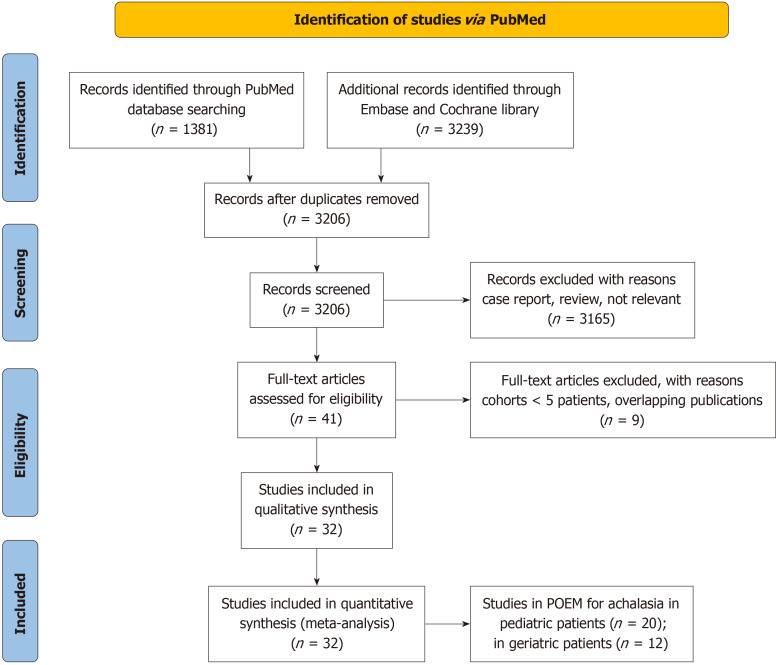
Methods: We conducted a comprehensive search of PubMed, Embase and Cochrane Library databases from inception to July 2024. The primary outcomes were technical and clinical success. Secondary outcomes of interest included adverse events and gastroesophageal reflux disease (GERD). The pooled event rates were calculated by comprehensive meta-analysis software.
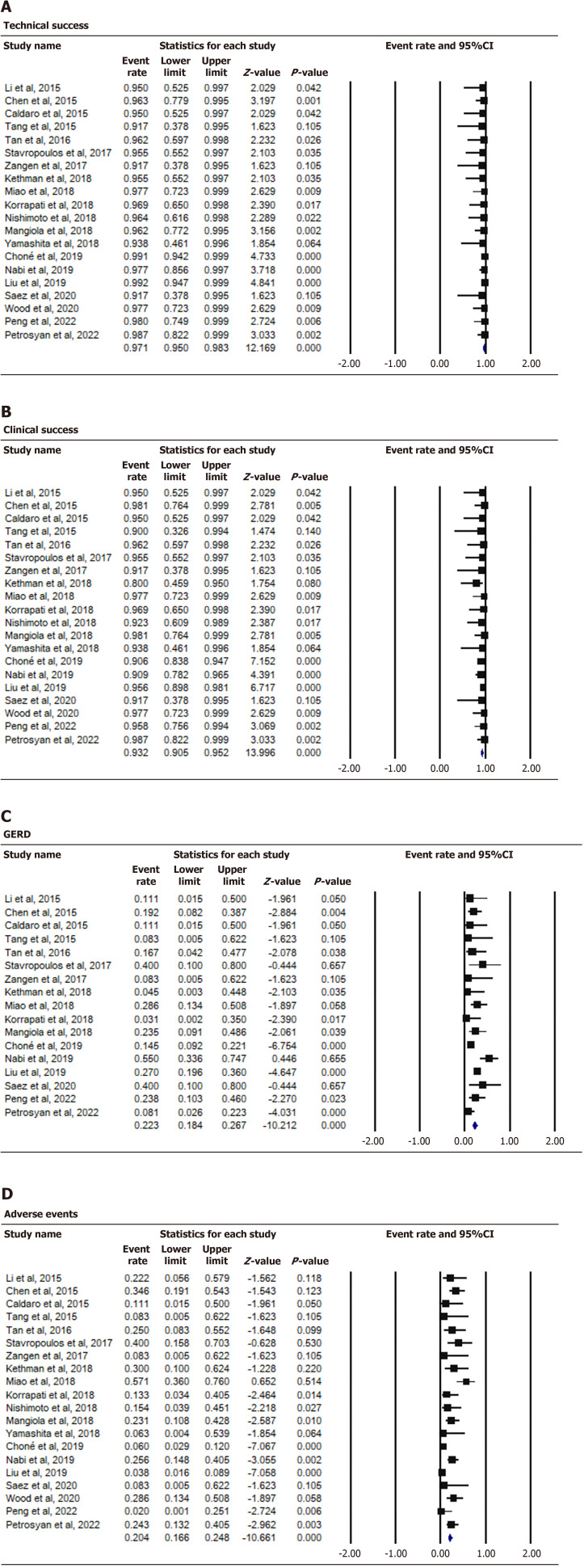
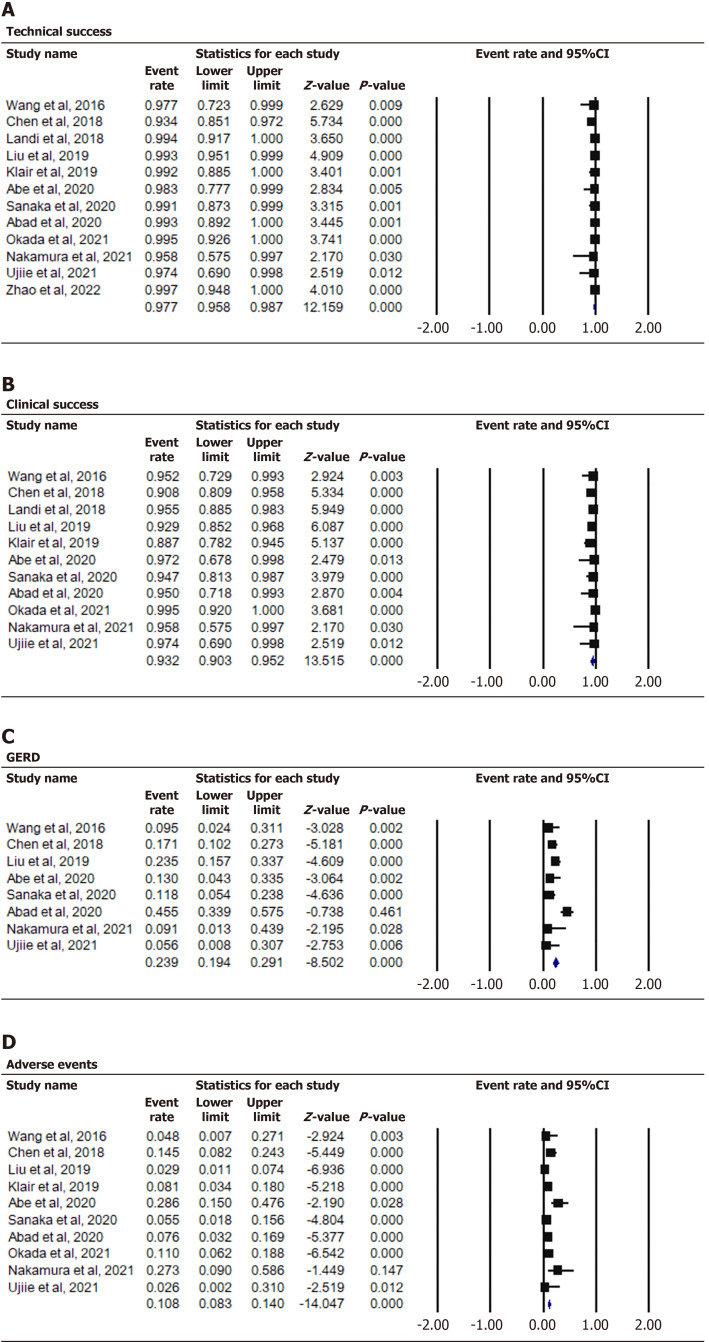
Results: A total of 32 studies with 547 pediatric patients and 810 geriatric patients were included in this study. The pooled event rates of technical success, clinical success, GERD and adverse events of POEM for treating achalasia in pediatric patients were 97.1% [95% confidence interval (CI): 95.0%-98.3%; I² = 0%; P < 0.000], 93.2% (95%CI: 90.5%-95.2%; I² = 0%; P < 0.000), 22.3% (95%CI: 18.4%-26.7%; I² = 43.874%; P < 0.000) and 20.4% (95%CI: 16.6%-24.8%; I² = 67.217%; P < 0.000), respectively. Furthermore, in geriatric patients, the pooled event rates were 97.7% (95%CI: 95.8%-98.7%; I² = 15.200%; P < 0.000), 93.2% (95%CI: 90.3%-95.2%; I² = 0%; P < 0.000), 23.9% (95%CI: 19.4%-29.1%; I² = 75.697%; P < 0.000) and 10.8% (95%CI: 8.3%-14.0%; I² = 62.938%; P < 0.000], respectively.
Conclusion: Our findings demonstrated that POEM was an effective and safe technique for pediatric and geriatric patients with achalasia.
Keywords: Achalasia; Geriatric; Meta-analysis; Pediatric; Peroral endoscopic myotomy.
©The Author(s) 2024. Published by Baishideng Publishing Group Inc. All rights reserved.
Conflict of interest statement
Conflict-of-interest statement: The authors declare that they have no conflict of interest.
Figures
References
-
- Savarino E, Bhatia S, Roman S, Sifrim D, Tack J, Thompson SK, Gyawali CP. Achalasia. Nat Rev Dis Primers. 2022;8:28. - PubMed
-
- Zaninotto G, Bennett C, Boeckxstaens G, Costantini M, Ferguson MK, Pandolfino JE, Patti MG, Ribeiro U Jr, Richter J, Swanstrom L, Tack J, Triadafilopoulos G, Markar SR, Salvador R, Faccio L, Andreollo NA, Cecconello I, Costamagna G, da Rocha JRM, Hungness ES, Fisichella PM, Fuchs KH, Gockel I, Gurski R, Gyawali CP, Herbella FAM, Holloway RH, Hongo M, Jobe BA, Kahrilas PJ, Katzka DA, Dua KS, Liu D, Moonen A, Nasi A, Pasricha PJ, Penagini R, Perretta S, Sallum RAA, Sarnelli G, Savarino E, Schlottmann F, Sifrim D, Soper N, Tatum RP, Vaezi MF, van Herwaarden-Lindeboom M, Vanuytsel T, Vela MF, Watson DI, Zerbib F, Gittens S, Pontillo C, Vermigli S, Inama D, Low DE. The 2018 ISDE achalasia guidelines. Dis Esophagus. 2018;31 - PubMed
-
- Marlais M, Fishman JR, Fell JM, Haddad MJ, Rawat DJ. UK incidence of achalasia: an 11-year national epidemiological study. Arch Dis Child. 2011;96:192–194. - PubMed
LinkOut - more resources
Full Text Sources
Research Materials
