Reasons for Use and Perceived Effects of Medical Cannabis: A Cross-Sectional Statewide Survey
- PMID: 39474237
- PMCID: PMC11521456
- DOI: 10.1159/000540593
Reasons for Use and Perceived Effects of Medical Cannabis: A Cross-Sectional Statewide Survey
Abstract
Introduction: Medical cannabis (MC) is available upon certification for one of several qualifying conditions in Florida, USA. Previous studies suggested that some people seek cannabis for medical conditions/symptoms beyond those legally permitted. However, data remain limited on patient motives for seeking MC and their experiences around its impact on their health. We aimed to compare reported qualifying conditions for MC certification with the most frequently self-reported reasons for using MC while assessing the alignment between the two and understanding the perceived impacts of MC on self-reported conditions and symptoms.
Methods: We conducted a cross-sectional study using survey data from the Medical Marijuana and Me (M3) Data Bank of individuals receiving MC in Florida, USA, in 2022. Participants were recruited via convenience sampling from nine MC clinics/clinic networks across Florida and were asked to fill out an online survey. The study measures included sociodemographic variables, self-reported health conditions, self-reported main reasons for using MC, self-reported qualifying conditions for MC certification, and self-reported perceived impact of MC on health conditions. We cross-tabulated reported qualifying conditions and reasons for MC use and reported the perceived impact per condition.
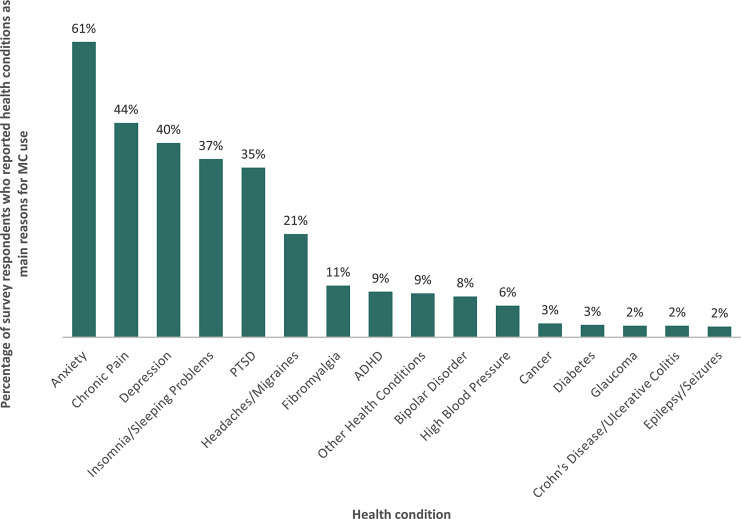
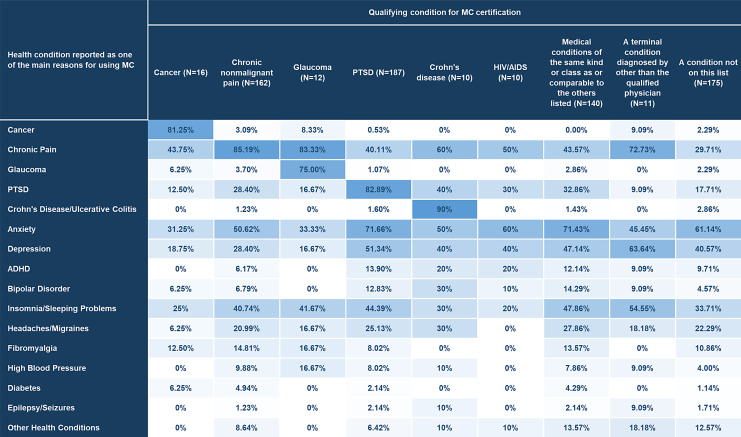
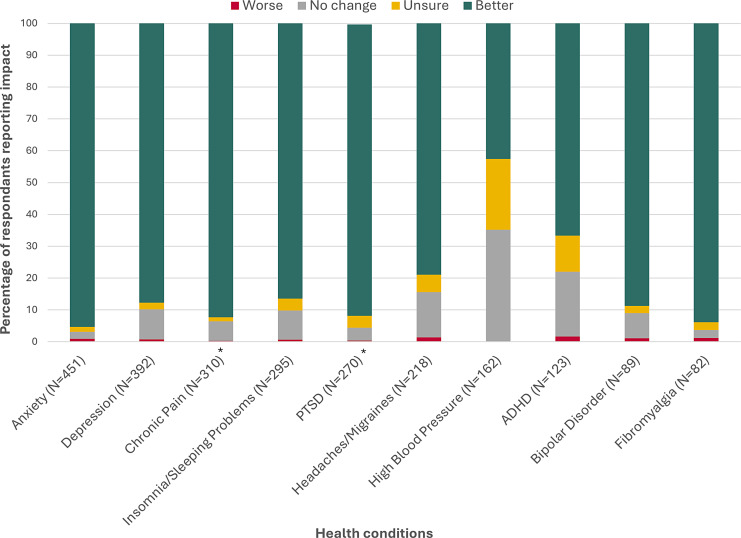
Results: A total of 632 participants completed the survey, of whom 396 (62.66%) were female and 471 (74.53%) were non-Hispanic white. The median (IQR) age was 45 (35, 58). The most frequently reported qualifying conditions were post-traumatic stress disorder (PTSD) (n = 187, 29.59%), a condition not on the qualifying conditions list (n = 175, 27.69%), medical conditions of the same kind/comparable to those listed (n = 140, 22.15%), and chronic nonmalignant pain (n = 62, 25.63%). The top ten most frequently reported reasons for using MC were anxiety (n = 383, 60.60%), chronic pain (n = 278, 43.99%), depression (n = 252, 39.87%), PTSD (n = 220, 34.81%), headaches/migraine (n = 134, 21.20%), fibromyalgia (n = 67, 10.60%), attention-deficit hyperactivity disorder (ADHD) (n = 59, 9.34%), bipolar disorder (n = 53, 8.39%), high blood pressure (n = 41, 6.49%), and cancer (n = 18,2.85%). Of respondents, 70-90% with each qualifying condition reported it as one of the main reasons for using MC. Most respondents reported improvement of anxiety (n = 430/451, 95.34%), depression (n = 381/392, 97.20%), chronic pain (n = 305/310, 98.39%), insomnia/sleeping problems (n = 225/295, 86.44%), PTSD (n = 247/270, 91.48%), headaches/migraine (n = 172/218, 78.90%), ADHD (n = 82/123, 66.67%), bipolar disorder (n = 79/89, 88.76%), and fibromyalgia (n = 77/82, 93.90%). Most respondents were unsure/reported no change in blood pressure (n = 93/162, 57.41%). A small percentage reported perceived worsening impacts on their conditions.
Conclusion: Qualifying conditions and self-reported reasons for using MC aligned for most respondents. Yet, a notable proportion of respondents sought MC for broader treatment effects beyond those delineated by the officially recognized qualifying conditions in Florida, USA. Most patients perceived positive effects, including those with limited available evidence on efficacy.
Keywords: Cannabis use behaviors; Marijuana as a therapeutic; Medical cannabis; Medical marijuana.
Plain language summary
In Florida, USA, medical cannabis (MC) is accessible for certified individuals with specific health conditions. Previous research found that many people seek MC for conditions beyond the officially approved ones. We aimed to understand the alignment between qualifying conditions per statute, the reasons patients reported for using MC, and the perceived impacts on health conditions and symptoms. In a 2022 survey of 632 MC users, the top reported qualifying conditions were post-traumatic stress disorder (PTSD), medical condition comparable to listed conditions, and chronic nonmalignant pain. The top ten self-reported reasons for using MC were anxiety, chronic pain, depression, PTSD, headaches/migraine, fibromyalgia, attention-deficit hyperactivity disorder (ADHD), bipolar disorder, high blood pressure, and cancer. Many patients reported multiple reasons for MC use, including typically one reason that matched their reported qualifying condition. Most respondents noted improvements in anxiety, depression, chronic pain, insomnia, PTSD, headaches/migraine, ADHD, bipolar disorder, and fibromyalgia. These findings suggest that in addition to the officially recognized qualifying conditions, people often use MC for a broader range of conditions and symptoms, some of which are not included in the current statute and/or without evidence of efficacy.
© 2024 The Author(s). Published by S. Karger AG, Basel.
Conflict of interest statement
The authors have no conflicts of interest to declare.
Figures
References
-
- Drug scheduling [internet]. [cited 2023 Nov 28]. Available from: https://www.dea.gov/drug-information/drug-scheduling
-
- State medical cannabis laws [Internet]. [cited 2023 Nov 28]. Available from: https://www.ncsl.org/health/state-medical-cannabis-laws
-
- National Academies of Sciences E Division H and M, practice B on PH and PH, agenda C on the HE of MAER and R . Cannabis: prevalence of use, regulation, and current policy landscape [internet]. National Academies Press (US); 2017. [cited 2020 Feb 29]. Available from: https://www.ncbi.nlm.nih.gov/books/NBK425763/
-
- Statutes & Constitution . View statutes: online sunshine. [Internet]. Available from: http://www.leg.state.fl.us/statutes/index.cfm?App_mode=Display_Statute&U...
LinkOut - more resources
Full Text Sources