


Incidence of Respiratory Syncytial Virus in Community-Dwelling Adults Aged 18-64 Years Over 2 Seasons, 2022-2024, in a North American Community
- PMID: 39474445
- PMCID: PMC11521338
- DOI: 10.1093/ofid/ofae597
Incidence of Respiratory Syncytial Virus in Community-Dwelling Adults Aged 18-64 Years Over 2 Seasons, 2022-2024, in a North American Community
Abstract
Background: The incidence of respiratory syncytial virus (RSV)-acute respiratory infection (ARI) in community-dwelling adults after the Omicron variant of the COVID-19 pandemic is unknown. Our aim was to assess the incidence of RSV-ARI in adults aged 18 to 64 years over 2 consecutive RSV seasons (October-April 2022-2024) in 4 US states.
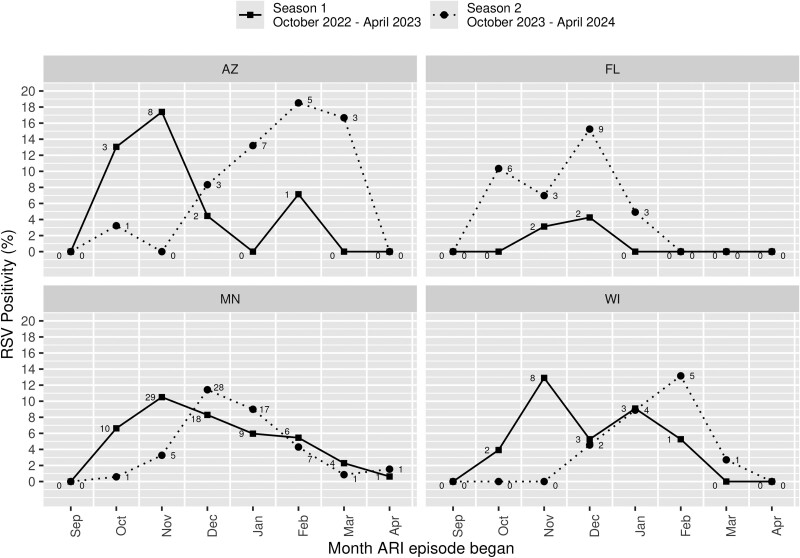
Methods: This community-based prospective cohort study comprised 7501 participants in Minnesota, Wisconsin, Florida, and Arizona. We calculated RSV-ARI and RSV-lower respiratory tract disease (LRTD) incidence and attack rates. We reported unadjusted incidence by age group, gender, race and ethnicity, Charlson Comorbidity Index, socioeconomic status, residential state, and rural/urban setting.
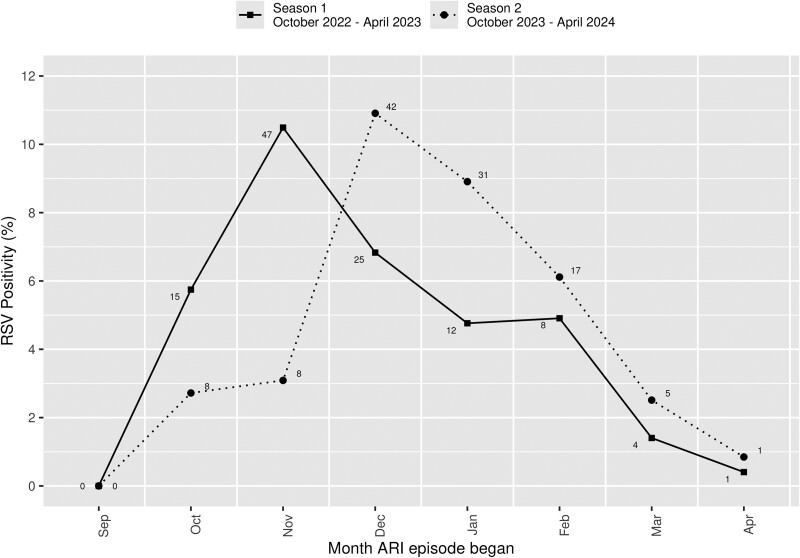
Results: Seasons 1 and 2 had 2250 and 2377 ARI episodes, respectively, with an RSV-ARI positivity rate of 5.5% for season 1 and 5.8% for season 2 among those tested. In season 1, the overall incidence of RSV-ARI was 27.71 (95% CI, 22.82-33.34) per 1000 person-years (1.49% attack rate). Almost half (49.0%) had RSV-LRTD, with an incidence of 13.53 (95% CI, 10.19-17.61) per 1000 person-years (0.73% attack rate). In season 2, the RSV-ARI and RSV-LRTD incidence rates were 26.39 (95% CI, 21.73-31.75) per 1000 person-years (1.51% attack rate) and 12.43 (95% CI, 9.31-16.26) per 1000 person-years (0.72% attack rate). RSV-ARI incidence peaked in November 2022 and December 2023.
Conclusions: Our observations suggest that RSV-ARI incidence and seasonal pattern are shifting to prepandemic RSV epidemiology.
Keywords: acute respiratory infection; incidence; lower respiratory tract disease; respiratory syncytial virus.
© The Author(s) 2024. Published by Oxford University Press on behalf of Infectious Diseases Society of America.
Conflict of interest statement
Potential conflicts of interest. M. J. B. is on the scientific advisory board for DiaSorin Molecular and has received honoraria for educational presentations sponsored by DiaSorin and Qiagen. J.-Y. P. and P. S. are employees of GSK and hold shares in the company as part of their employee remuneration. M. O. is a contractor by GSK. All other authors report no potential conflicts.
Figures
References
-
- Havers FP, Whitaker M, Pham H, et al. 2209. RSV-associated hospitalizations in adults aged ≥18 years and the impact of the COVID-19 pandemic in the United States, October 2018–February 2022. Open Forum Infect Dis 2022; 9(suppl 2):ofac492.1828.
LinkOut - more resources
Full Text Sources
Miscellaneous
