Noise & mottle suppression methods for cumulative Cherenkov images of radiation therapy delivery
- PMID: 39474803
- PMCID: PMC11639195
- DOI: 10.1088/1361-6560/ad8c93
Noise & mottle suppression methods for cumulative Cherenkov images of radiation therapy delivery
Abstract
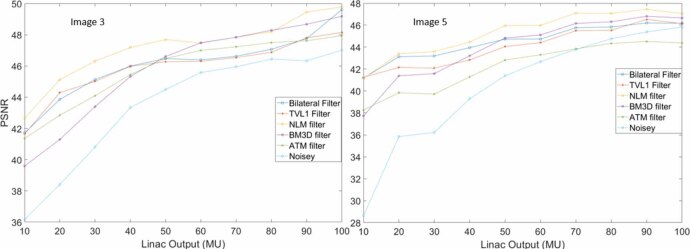
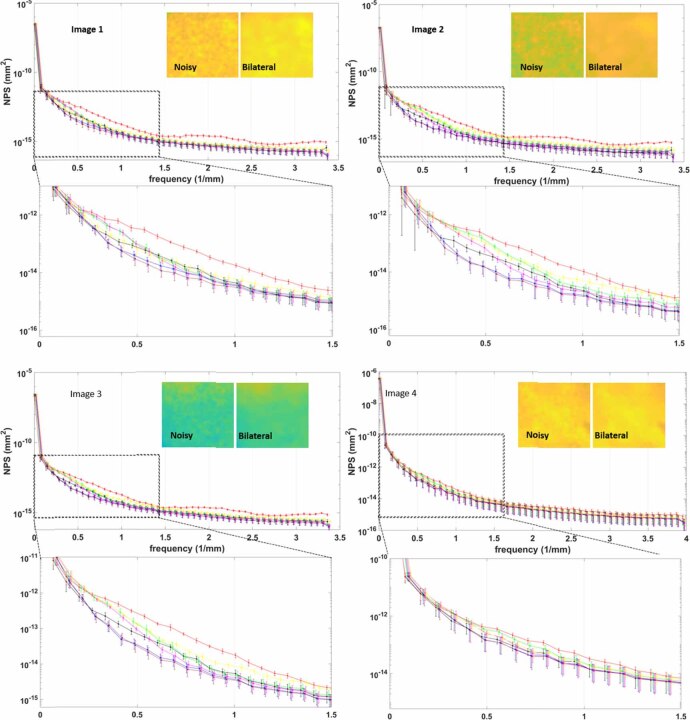
Purpose.Cherenkov imaging during radiotherapy provides a real time visualization of beam delivery on patient tissue, which can be used dynamically for incident detection or to review a summary of the delivered surface signal for treatment verification. Very few photons form the images, and one limitation is that the noise level per frame can be quite high, and mottle in the cumulative processed images can cause mild overall noise. This work focused on removing or suppressing noise via image postprocessing.Approach.Images were analyzed for peak-signal-to-noise and spatial frequencies present, and several established noise/mottle reduction algorithms were chosen based upon these observations. These included total variation minimization (TV-L1), non-local means filter (NLM), block-matching 3D (BM3D), alpha (adaptive) trimmed mean (ATM), and bilateral filtering. Each were applied to images acquired using a BeamSite camera (DoseOptics) imaged signal from 6x photons from a TrueBeam linac delivering dose at 600 MU min-1incident on an anthropomorphic phantom and tissue slab phantom in various configurations and beam angles. The standard denoised images were tested for PSNR, noise power spectrum (NPS) and image sharpness.Results.The average peak-signal-to-noise ratio (PSNR) increase was 17.4% for TV-L1. NLM denoising increased the average PSNR by 19.1%, BM3D processing increased it by12.1% and the bilateral filter increased the average PSNR by 19.0%. Lastly, the ATM filter resulted in the lowest average PSNR increase of 10.9%. Of all of these, the NLM and bilateral filters produced improved edge sharpness with, generally, the lowest NPS curve.Conclusion.For cumulative image Cherenkov data, NLM and the bilateral filter yielded optimal denoising with the TV-L1 algorithm giving comparable results. Single video frame Cherenkov images exhibit much higher noise levels compared to cumulative images. Noise suppression algorithms for these frame rates will likely be a different processing pipeline involving these filters incorporated with machine learning.
Keywords: Cherenkov; adaptive-trimmed mean; bilateral; block matching; denoising; non-local means; total variation.
Creative Commons Attribution license.
Conflict of interest statement
Authors B Pogue, M Jermyn & P Bruza acknowledge financial involvement through ownership and employment with DoseOptics LLC.
Figures




References
-
- Buades A, Coll B, Morel J M. A review of image denoising algorithms, with a new one. Multiscale Model. Simul. 2005;4:490–530. doi: 10.1137/040616024. - DOI
-
- Carles M, et al. Slanted Edge MTF. 2011 (available at: https://imagej.net/ij/plugins/se-mtf/index.html)
MeSH terms
Grants and funding
LinkOut - more resources
Full Text Sources
Research Materials
Miscellaneous