


Epidemiology of Inflammatory Bowel Disease across the Ages in the Era of Advanced Therapies
- PMID: 39475082
- PMCID: PMC11522978
- DOI: 10.1093/ecco-jcc/jjae082
Epidemiology of Inflammatory Bowel Disease across the Ages in the Era of Advanced Therapies
Abstract
Background and aims: The incidence of inflammatory bowel diseases [IBD] has risen over the past decade to become a global issue. The objectives of this review were to describe the incidence and/or prevalence of IBD in the era of advanced therapies, and to describe the association between environmental risk factors and both pathogenesis and disease course across the ages.
Methods: We performed a search of English language publications listed in PubMed regarding the epidemiology of IBD and key environmental factors implicated in IBD from January 2000 to December 2023.
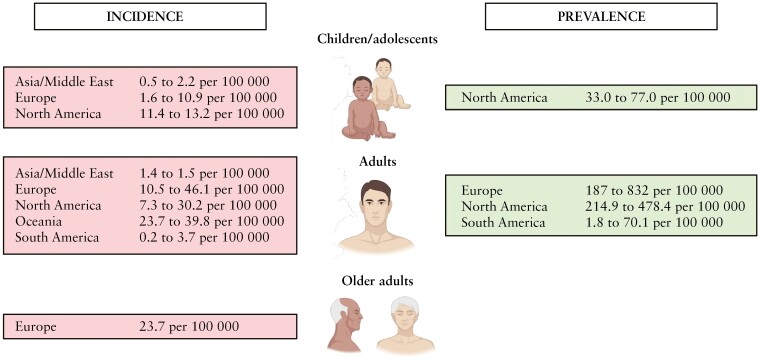
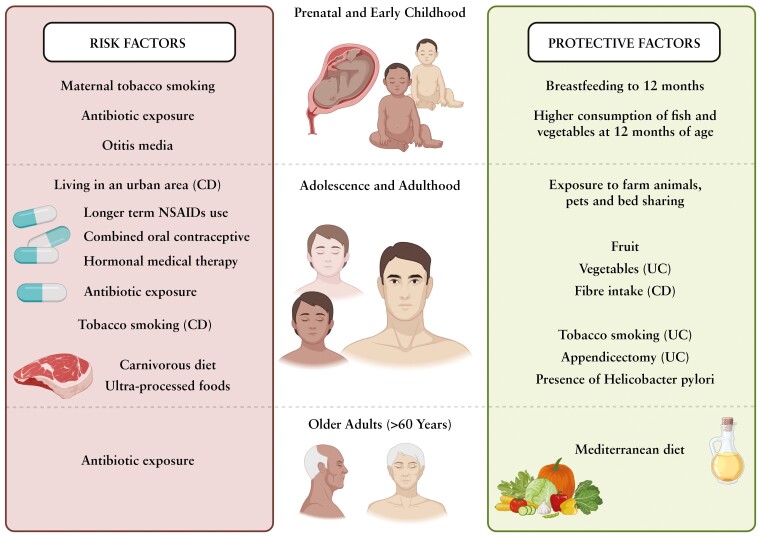
Results: Annual incidence rates varied by geographical region with IBD estimates ranging from 10.5 to 46.14 per 100 000 in Europe, 1.37 to 1.5 per 100 000 in Asia and the Middle East, 23.67 to 39.8 per 100 000 in Oceania, 0.21 to 3.67 per 100 000 in South America, and 7.3 to 30.2 per 100 000 in North America. The burden of IBD among children and adolescents, and older people is rising globally. Key environmental factors implicated in IBD pathogenesis include exposure to tobacco smoking, antibiotics, non-steroidal anti-inflammatory drugs, oral contraceptives, infections, and ultra-high processed foods. Breastfeeding and a high-quality diet rich in fruit, vegetables, fish, and other fibre sources are important protective factors. Smoking has consistently been shown to negatively impact disease outcomes for Crohn's disease.
Conclusion: The epidemiology of IBD has undergone considerable change in recent decades, with an increase in the burden of disease worldwide. Optimally studying and targeting environmental triggers in IBD may offer future opportunities for disease modification.
Keywords: Epidemiology; inflammatory bowel disease; risk factors.
© The Author(s) 2024. Published by Oxford University Press on behalf of European Crohn’s and Colitis Organisation.
Conflict of interest statement
BC has received lecture and/or consulting fees from Abbvie, Amgen, Celltrion, Ferring, Galapagos, Janssen, Lilly, Pfizer, and Takeda. SH has received speaker, consultant, and advisory board member fees and/or has received travel grants from Pfizer, Janssen, AbbVie, Takeda, Ferring, Lilly, Galapagos, and Pharmacosmos.
LPB reports consulting fees from Abbvie, Abivax, Adacyte, Alimentiv, Amgen, Applied Molecular Transport, Arena, Banook, Biogen, BMS, Celltrion, Connect Biopharm, Cytoki Pharma, Enthera, Ferring, Fresenius Kabi, Galapagos, Genentech, Gilead, Gossamer Bio, GSK, IAC Image Analysis, Index Pharmaceuticals, Inotrem, Janssen, Lilly, Medac, Mopac, Morphic, MSD, Nordic Pharma, Novartis, Oncodesign Precision Medicine, ONO Pharma, OSE Immunotherapeuthics, Pandion Therapeuthics, Par' Immune, Pfizer, Prometheus, Protagonist, Roche, Samsung, Sandoz, Sanofi, Satisfay, Takeda, Telavant, Theravance, Thermo Fischer, Tigenix, Tillots, Viatris, Vectivbio, Ventyx, Ysopia. Grant support from Celltrion, Fresenius Kabi, Medac, MSD, Takeda. Lecture fees from Abbvie, Alfasigma, Amgen, Arena, Biogen, Celltrion, Ferring, Galapagos, Genentech, Gilead, Janssen, Lilly, Kern Pharma, Medac, MSD, Nordic Pharma, Pfizer, Sandoz, Takeda, Tillots, Viatris. Support travel from Abbvie, Alfasigma, Amgen, Celltrion, Connect Biopharm, Ferring, Galapagos, Genentech, Gilead, Gossamer Bio, Janssen, Lilly, Medac, Morphic, MSD, Pfizer, Sandoz, Takeda, Thermo Fischer, Tillots.
Figures
References
Publication types
MeSH terms
Substances
Grants and funding
LinkOut - more resources
Full Text Sources
Miscellaneous
