The crucial role of bioimage analysts in scientific research and publication
- PMID: 39475207
- PMCID: PMC11698046
- DOI: 10.1242/jcs.262322
The crucial role of bioimage analysts in scientific research and publication
Abstract
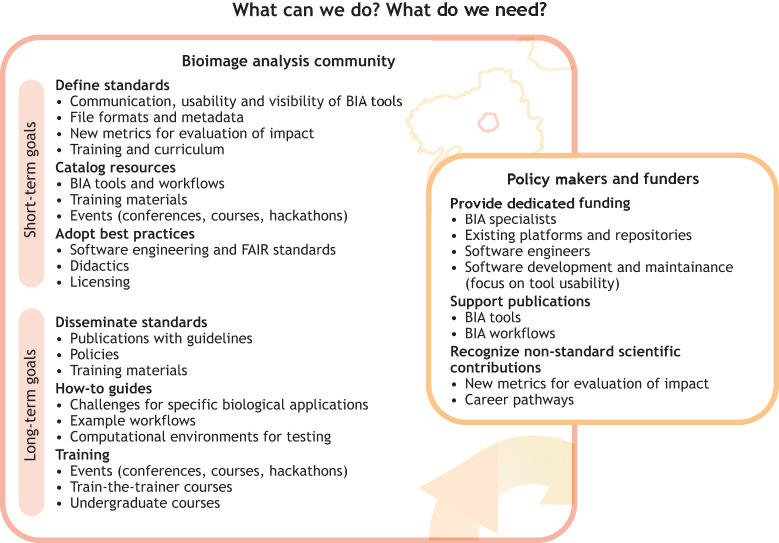
Bioimage analysis (BIA), a crucial discipline in biological research, overcomes the limitations of subjective analysis in microscopy through the creation and application of quantitative and reproducible methods. The establishment of dedicated BIA support within academic institutions is vital to improving research quality and efficiency and can significantly advance scientific discovery. However, a lack of training resources, limited career paths and insufficient recognition of the contributions made by bioimage analysts prevent the full realization of this potential. This Perspective - the result of the recent The Company of Biologists Workshop 'Effectively Communicating Bioimage Analysis', which aimed to summarize the global BIA landscape, categorize obstacles and offer possible solutions - proposes strategies to bring about a cultural shift towards recognizing the value of BIA by standardizing tools, improving training and encouraging formal credit for contributions. We also advocate for increased funding, standardized practices and enhanced collaboration, and we conclude with a call to action for all stakeholders to join efforts in advancing BIA.
Keywords: Bioimage analysis; Bioimage analysts; Bioimaging; Training.
© 2024. Published by The Company of Biologists Ltd.
Conflict of interest statement
Competing interests The authors declare no competing or financial interests.
Figures


References
-
- Afiaz, A., Ivanov, A. A., Chamberlin, J., Hanauer, D., Savonen, C. L., Goldman, M. J., Morgan, M., Reich, M., Getka, A., Holmes, A.et al. (2024). Best practices to evaluate the impact of biomedical research software-metric collection beyond citations. Bioinformatics 40, btae469. 10.1093/bioinformatics/btae469 - DOI - PMC - PubMed
MeSH terms
Grants and funding
- University of Leeds
- Beckman Center for Light Sheet Microscopy
- P41 EB031772/EB/NIBIB NIH HHS/United States
- Ministerio de Ciencia, Innovación y Universidades
- Federal Ministry of Education and Research
- CC1069/MRC_/Medical Research Council/United Kingdom
- BB/V006169/1/BB_/Biotechnology and Biological Sciences Research Council/United Kingdom
- 337531/Academy of Finland
- U01CA200059-06/NH/NIH HHS/United States
- WT_/Wellcome Trust/United Kingdom
- U54 CA268069/CA/NCI NIH HHS/United States
- UM1 HG011536/HG/NHGRI NIH HHS/United States
- SciLifeLab
- 101057970/Horizon Europe
- Helmholtz Association
- 2020-225720/Chan Zuckerberg Initiative
- CC1069/WT_/Wellcome Trust/United Kingdom
- University of Helsinki
- CC1069/CRUK_/Cancer Research UK/United Kingdom
- PID2023-152631OB-I00/Agencia Estatal de Investigación
- European Regional Development Fund
- Morgridge Institute for Research
- ScaDS.AI/Sächsisches Staatsministerium für Wissenschaft, Kultur und Tourismus
- VR-RFI 2019-00217/National Microscopy Infrastructure
- Silicon Valley Community Foundation
- P41 GM135019/GM/NIGMS NIH HHS/United States
- The University of Edinburgh
- EP/S024336/1/Engineering and Physical Sciences Research Council
- Biocenter Finland
- U01 CA200059/CA/NCI NIH HHS/United States
- ANR-10-INBS-04/French National Research Agency
- National Bioinformatics Infrastructure Sweden
- University of Zurich
LinkOut - more resources
Full Text Sources
Miscellaneous