


Transcriptome Analysis of Chinese Cabbage Infected with Plasmodiophora Brassicae in the Primary Stage
- PMID: 39477989
- PMCID: PMC11525481
- DOI: 10.1038/s41598-024-76634-0
Transcriptome Analysis of Chinese Cabbage Infected with Plasmodiophora Brassicae in the Primary Stage
Abstract
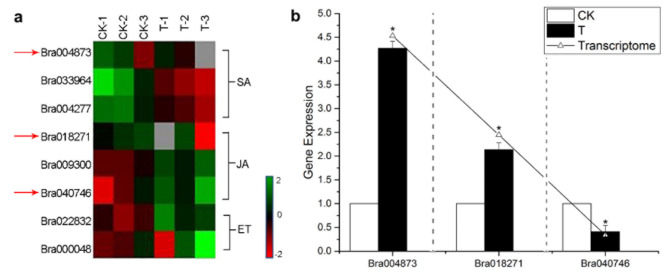
Clubroot disease caused by the infection of Plasmodiophora brassicae is widespread in China, and significantly reduces the yield of Chinese cabbage (Brassica rapa L. ssp. pekinensis). However, the resistance mechanism of Chinese cabbage against clubroot disease is still unclear. It is important to exploit the key genes that response to early infection of P. brassicae. In this study, it was found that zoospores were firstly invaded hair roots on the 8th day after inoculating with 1 × 10⁷ spores/mL P. brassicae. Transcriptome analysis found that the early interaction between Chinese cabbage and P. brassicae caused the significant expression change of some defense genes, such as NBS-LRRs and pathogenesis-related genes, etc. The above results were verified by quantitative reverse-transcription polymerase chain reaction (qRT-PCR). Otherwise, peroxidase (POD) salicylic acid (SA) and jasmonic acid (JA) were also found to be important signal molecules in the resistance to clubroot disease in Chinese cabbage. This study provides important clues for understanding the resistance mechanism of Chinese cabbage against clubroot disease.
© 2024. The Author(s).
Conflict of interest statement
The authors declare no competing interests.
Figures



References
-
- Ingram, D. S. & Tommerup, I. C. The life history of Plasmodiophora brassicae Woron. Proc. R. Soc. Lond. 180, 103–112, doi: (1997). 10.1098/rspb.1972.0008
-
- Naiki, T. & Dixon, G. R. The effects of chemicals on developmental stages of Plasmodiophora brassicae (clubroot). Plant Pathol.36, 316–327. 10.1111/j.1365-3059.1987.tb02238.x (2007). - DOI
MeSH terms
Substances
Grants and funding
LinkOut - more resources
Full Text Sources
Research Materials
Miscellaneous
