


Feasibility of augmented reality using dental arch-based registration applied to navigation in mandibular distraction osteogenesis: a phantom experiment
- PMID: 39478554
- PMCID: PMC11523659
- DOI: 10.1186/s12903-024-05105-9
Feasibility of augmented reality using dental arch-based registration applied to navigation in mandibular distraction osteogenesis: a phantom experiment
Abstract
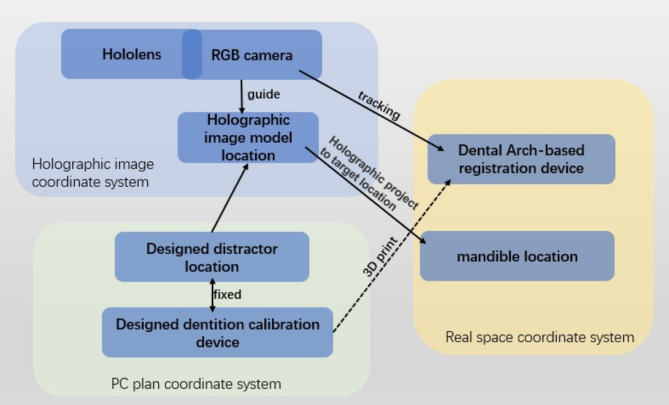
Objective: Distraction osteogenesis is a primary treatment for severe mandibular hypoplasia. Achieving the ideal mandible movement direction through precise distraction vector control is still a challenge in this surgery. Therefore, the aim of this study was to apply Optical See-Through (OST) Augmented Reality (AR) technology for intraoperative navigation during mandibular distractor installation and analyze the feasibility to evaluate the effectiveness of AR in a phantom experiment.
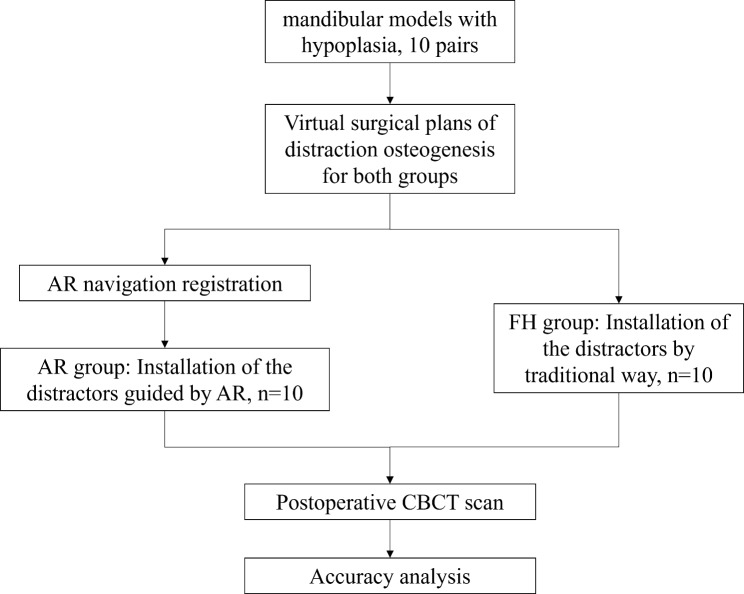
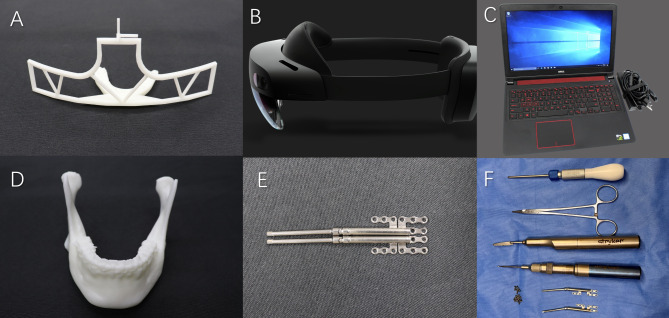
Methods: Phantom was made of 3D-printed mandibular models based on preoperative CT scans and dental arch scans of real patients. Ten sets of 3D-printed mandible models were included in this study, with each set consisting of two identical mandible models assigned to the AR group and free-hand group. 10 sets of mandibular distraction osteogenesis surgical plans were designed using software, and the same set of plans was shared between the AR and free-hand groups. Surgeons performed bilateral mandibular distraction osteogenesis tasks under the guidance of AR navigation, or the reference of the preoperative surgical plan displayed on the computer screen. The differences in angular errors of distraction vectors and the distance errors of distractor positions under the guidance of the two methods were analyzed and compared.
Results: 40 distractors were implanted in both groups, with 20 cases in each. In intra-group comparisons between the left and right sides, the AR group exhibited a three-dimensional spatial angle error of 1.88 (0.59, 2.48) on the left and 2.71 (1.33, 3.55) on the right, with P = 0.085, indicating no significant bias in guiding surgery on both sides of the mandible. In comparisons between the AR group and the traditional free-hand (FH) group, the average angle error was 1.94 (1.30, 2.93) in the AR group and 5.06 (3.61, 9.22) in the free-hand group, with P < 0.0001, resulting in a 61.6% improvement in accuracy. The average displacement error was 1.53 ± 0.54 mm in the AR group and 3.56 ± 1.89 mm in the free-hand group, with P < 0.0001, indicating a 57% improvement in accuracy.
Conclusion: Augmented Reality technology for intraoperative navigation in mandibular distraction osteogenesis is accurate and feasible. A large randomized controlled trial with long-term follow-up is needed to confirm these findings.
Trial registration: The project has been registered with the Chinese Clinical Trial Registry, with registration number ChiCTR2300068417. Date of Registration: 17 February 2023.
Keywords: Augmented reality; Distraction osteogenesis; Mixed reality; Surgical navigation.
© 2024. The Author(s).
Conflict of interest statement
The authors declare that there are no conflicts of interest in relation to the subject matter or materials discussed in this manuscript. No financial support was received for this study or preparation of this article.
This manuscript is original and there is no conflict of interest to disclose. Neither the entire paper nor any part of its content has been accepted or published elsewhere. All authors have seen the manuscript and approved to submit to your journal.
The authors declare no competing interests.
Figures
References
-
- McCarthy JG, Schreiber J, Karp N, Thorne CH, Grayson BH. Lengthening the human mandible by gradual distraction. Plast Reconstr Surg, 1992;89(1):1–8; discussion 9–10. Retrieved from https://www.ncbi.nlm.nih.gov/pubmed/1727238 - PubMed
-
- McCarthy JG, Staffenberg DA, Wood RJ, Cutting CB, Grayson BH, Thorne CH. Introduction of an intraoral bone-lengthening device. Plast Reconstr Surg. 1995;96(4):978–81. 10.1097/00006534-199509001-00034. - PubMed
-
- Rossini G, Vinci B, Rizzo R, Pinho TMD, Deregibus A. Mandibular distraction osteogenesis: a systematic review of stability and the effects on hard and soft tissues. Int J Oral Maxillofac Surg. 2016;45(11):1438–44. 10.1016/j.ijom.2016.08.012. - PubMed
-
- Kim MJ, Seo J, Kim DK, Baek SH. Three-dimensional virtual-surgery simulation-assisted asymmetric bilateral mandibular distraction osteogenesis for a patient with bilateral condylar fractures. Am J Orthod Dentofac Orthop. 2017;151(1):186–200. 10.1016/j.ajodo.2015.11.033. - PubMed
-
- Verlinden CR, van de Vijfeijken SE, Tuinzing DB, Becking AG, Swennen GR. Complications of mandibular distraction osteogenesis for acquired deformities: a systematic review of the literature. Int J Oral Maxillofac Surg. 2015;44(8):956–64. 10.1016/j.ijom.2014.12.008. - PubMed
MeSH terms
Grants and funding
- 2021AC18031/Guangxi Science and Technology Base and Talents Special Project
- 2021AC18031/Guangxi Science and Technology Base and Talents Special Project
- 2021AC18031/Guangxi Science and Technology Base and Talents Special Project
- 2021AC18031/Guangxi Science and Technology Base and Talents Special Project
- 2021AC18031/Guangxi Science and Technology Base and Talents Special Project
- 2021AC18031/Guangxi Science and Technology Base and Talents Special Project
- 2021AC18031/Guangxi Science and Technology Base and Talents Special Project
- 82360187/National Natural Science Foundation of China under Grant
- 82360187/National Natural Science Foundation of China under Grant
- 82360187/National Natural Science Foundation of China under Grant
- 82360187/National Natural Science Foundation of China under Grant
- 82360187/National Natural Science Foundation of China under Grant
- 82360187/National Natural Science Foundation of China under Grant
- 82360187/National Natural Science Foundation of China under Grant
- S2021085/Guangxi Medical and health suitable technology development and popularization applications project
- S2021085/Guangxi Medical and health suitable technology development and popularization applications project
- S2021085/Guangxi Medical and health suitable technology development and popularization applications project
- S2021085/Guangxi Medical and health suitable technology development and popularization applications project
- S2021085/Guangxi Medical and health suitable technology development and popularization applications project
- S2021085/Guangxi Medical and health suitable technology development and popularization applications project
- S2021085/Guangxi Medical and health suitable technology development and popularization applications project
- 2021004/Nanning Qingxiu District Science and Technology Plan
- 2021004/Nanning Qingxiu District Science and Technology Plan
- 2021004/Nanning Qingxiu District Science and Technology Plan
- 2021004/Nanning Qingxiu District Science and Technology Plan
- 2021004/Nanning Qingxiu District Science and Technology Plan
- 2021004/Nanning Qingxiu District Science and Technology Plan
- 2021004/Nanning Qingxiu District Science and Technology Plan
LinkOut - more resources
Full Text Sources
Research Materials
Miscellaneous
