


Sex differences in the impact of lower respiratory tract infections on older adults' health trajectories: a population-based cohort study
- PMID: 39482598
- PMCID: PMC11529179
- DOI: 10.1186/s12879-024-10131-7
Sex differences in the impact of lower respiratory tract infections on older adults' health trajectories: a population-based cohort study
Abstract
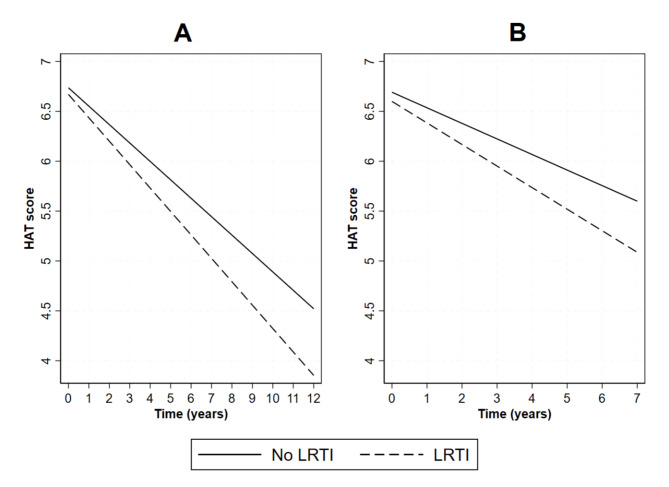
Background: Lower respiratory tract infections (LRTIs) are a major global health concern, particularly among older adults, who have an increased risk of poorer health outcomes that persist beyond the acute infectious episode. We aimed to investigate the mid-term (up to 7 years) and long-term (up to 12 years) effects of LRTIs on the objective health status trajectories of older adults, while also considering potential sex differences.
Methods: Cohort data of adults aged ≥ 60 years from the Swedish National study of Aging and Care in Kungsholmen (SNAC-K) collected between 2001 and 2016 was analyzed. Information on LRTIs was obtained from the Swedish National Patient Register, and objective health status was assessed using the Health Assessment Tool (HAT) which incorporates indicators of mild and severe disability, cognitive and physical functioning, and multimorbidity. The LRTI-exposed and -unexposed participants were matched using propensity score matching based on an expansive list of potential confounders. Mixed linear models were used to analyze the association between LRTIs and changes in HAT scores.
Results: The study included 2796 participants, 567 of whom were diagnosed with a LRTI. LRTIs were independently associated with an excess annual decline of 0.060 (95% CI: -0.107, -0.013) in the HAT score over a 7-year period. The associations were stronger among males, who experienced an excess annual decline of 0.108 (95% CI: -0.177, -0.039) in up to 7-years follow-up, and 0.097 (95% CI: -0.173, -0.021) in up to 12-years follow-up. The associations were not statistically significant among females in either follow-up period.
Conclusion: LRTIs, even years after the acute infectious period, seem to have a prolonged negative effect on the health of older adults, particularly among males. Preventative public health measures aimed at decreasing LRTI cases among older adults could help in preserving good health and functioning in old age.
Keywords: Geriatric Health Assessment; Lower respiratory tract infections; Older adults; Pneumonia; Sex stratification.
© 2024. The Author(s).
Conflict of interest statement
Eleana Tsoumani, Agnes Brandtmüller and Stina Salomonsson work for MSD (Merck Sharp & Dohme). The other authors declare no conflict of interest.
Figures
References
-
- Organization WH, Global Health E. 2020: Deaths by Cause, Age, Sex, by Country and by Region, 2000–2019 Geneva2020 [ https://www.who.int/data/gho/data/themes/mortality-and-global-health-est...
MeSH terms
LinkOut - more resources
Full Text Sources
