


Perivascular space enlargement accelerates in ageing and Alzheimer's disease pathology: evidence from a three-year longitudinal multicentre study
- PMID: 39482759
- PMCID: PMC11526621
- DOI: 10.1186/s13195-024-01603-8
Perivascular space enlargement accelerates in ageing and Alzheimer's disease pathology: evidence from a three-year longitudinal multicentre study
Abstract
Background: Perivascular space (PVS) enlargement in ageing and Alzheimer's disease (AD) and the drivers of such a structural change in humans require longitudinal investigation. Elucidating the effects of demographic factors, hypertension, cerebrovascular dysfunction, and AD pathology on PVS dynamics could inform the role of PVS in brain health function as well as the complex pathophysiology of AD.
Methods: We studied PVS in centrum semiovale (CSO) and basal ganglia (BG) computationally over three to four annual visits in 503 participants (255 females; meanage = 70.78 ± 5.78) of the ongoing observational multicentre "DZNE Longitudinal Cognitive Impairment and Dementia Study" (DELCODE) cohort. We analysed data from subjects who were cognitively unimpaired (n = 401), had amnestic mild cognitive impairment (n = 71), or had AD (n = 31). We used linear mixed-effects modelling to test for changes of PVS volumes in relation to cross-sectional and longitudinal age, as well as sex, years of education, hypertension, white matter hyperintensities, AD diagnosis, and cerebrospinal-fluid-derived amyloid (A) and tau (T) status (available for 46.71%; A-T-/A + T-/A + T + n = 143/48/39).
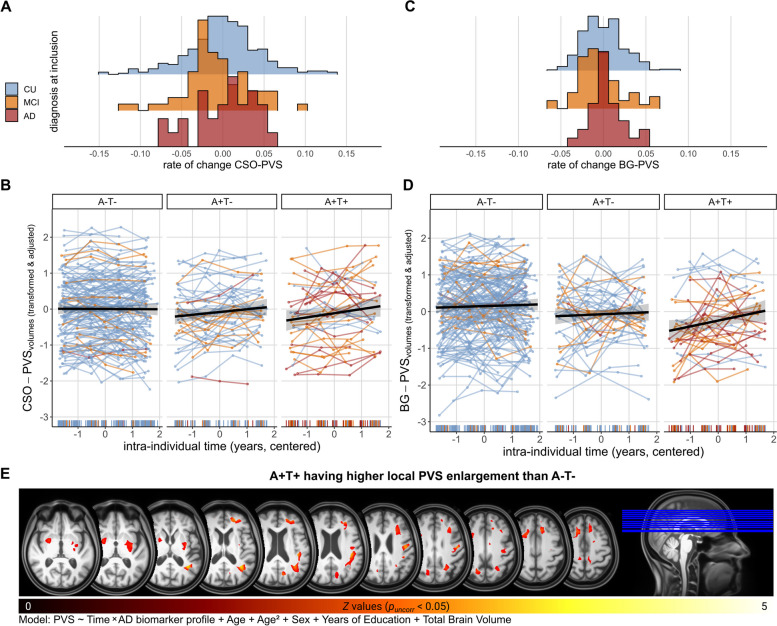
Results: PVS volumes increased significantly over follow-ups (CSO: B = 0.03 [0.02, 0.05], p < 0.001; BG: B = 0.05 [0.03, 0.07], p < 0.001). PVS enlargement rates varied substantially across subjects and depended on the participant's age, white matter hyperintensities volumes, and amyloid and tau status. PVS volumes were higher across elderly participants, regardless of region of interest (CSO: B = 0.12 [0.02, 0.21], p = 0.017; BG: B = 0.19 [0.09, 0.28], p < 0.001). Faster BG-PVS enlargement related to lower baseline white matter hyperintensities volumes (ρspearman = -0.17, pFDR = 0.001) and was more pronounced in individuals who presented with combined amyloid and tau positivity versus negativity (A + T + > A-T-, pFDR = 0.004) or who were amyloid positive but tau negative (A + T + > A + T-, pFDR = 0.07). CSO-PVS volumes increased at a faster rate with amyloid positivity as compared to amyloid negativity (A + T-/A + T + > A-T-, pFDR = 0.021).
Conclusion: Our longitudinal evidence supports the relevance of PVS enlargement in presumably healthy ageing as well as in AD pathology. We further discuss the region-specific involvement of white matter hyperintensities and neurotoxic waste accumulation in PVS enlargement and the possibility of additional factors contributing to PVS progression. A comprehensive understanding of PVS dynamics could facilitate the understanding of pathological cascades and might inform targeted treatment strategies.
Trial registration: German Clinical Trials Register DRKS00007966. Registered 04.05.2015 - retrospectively registered, https://drks.de/search/en/trial/DRKS00007966 .
Keywords: Alzheimer’s disease; Alzheimer’s pathology; Enlarged perivascular spaces; Longitudinal analysis; Multicentre study; Virchow–Robin spaces.
© 2024. The Author(s).
Conflict of interest statement
The authors declare no competing interests.
Figures
References
-
- Troili F, Cipollini V, Moci M, Morena E, Palotai M, Rinaldi V, et al. Perivascular unit: this must be the place. The anatomical crossroad between the immune, vascular and nervous system. Front Neuroanat. 2020;14. Available from: https://www.frontiersin.org/article/10.3389/fnana.2020.00017/full. - DOI - PMC - PubMed
-
- Del Brutto OH, Mera RM, Costa AF, Rumbea DA, Recalde BY, Del Brutto VJ. Patterns of progression of cerebral small vessel disease markers in older adults of Amerindian ancestry: a population-based, longitudinal prospective cohort study. Aging Clin Exp Res. 2022;34(11):2751–9. 10.1007/s40520-022-02223-8. - DOI - PMC - PubMed
Publication types
MeSH terms
LinkOut - more resources
Full Text Sources
Medical
Research Materials
