[Preprint]. 2024 Oct 23:2024.10.23.619881.
doi: 10.1101/2024.10.23.619881.

Pre-existing H1N1 immunity reduces severe disease with bovine H5N1 influenza virus

Affiliations

Pre-existing H1N1 immunity reduces severe disease with bovine H5N1 influenza virus

Valerie Le Sage et al. bioRxiv. .

Abstract

The emergence of highly pathogenic H5N1 avian influenza in dairy cattle herds across the United States has caused multiple mild human infections. There is an urgent need to understand the risk of spillover into humans. Here, we show that pre-existing immunity from the 2009 H1N1 pandemic influenza virus provided protection from mortality and severe clinical disease to ferrets intranasally infected with bovine H5N1. H1N1 immune ferrets exhibited a differential tissue tropism with little bovine H5N1 viral dissemination to organs outside the respiratory tract and significantly less H5N1 virus found in nasal secretions and the respiratory tract. Additionally, ferrets with H1N1 prior immunity produced antibodies that cross-reacted with H5N1 neuraminidase protein. Taken together, these results suggest that mild disease in humans may be linked to prior immunity to human seasonal influenza viruses.

Keywords: H1N1pdm09; Influenza virus; bovine H5N1; pathogenesis; pre-existing immunity.


Conflict of interest statement

Competing interest statement The Icahn School of Medicine at Mount Sinai has filed patent applications relating to influenza virus vaccines and therapeutic vaccines which list Florian Krammer as co-inventor. Several of these patents have been licensed and Florian Krammer has received royalty payments from commercial entities. Florian Krammer has consulted for Merck, Pfizer, Seqirus, GSK and Curevac and is currently consulting for Gritstone, 3rd Rock Ventures and Avimex and he is a co-founder and scientific advisory board member of CastleVax. The Krammer laboratory is also collaborating with Dynavax on influenza virus vaccine development and with VIR on influenza therapeutics. All other authors declare no competing financial and/or non-financial interests in relation to the work described.

Figures
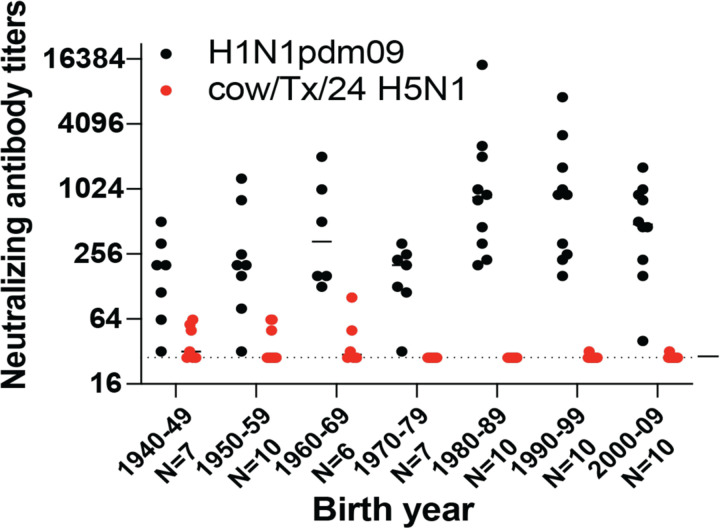
Figure 1.
Figure 1.. Neutralizing antibody titers of H1N1 and bovine H5N1 in human sera by birth year cohort.
Sera collected from the indicated number of healthy individuals in 2020–2021 with birth years ranging from 1940–2009 were tested for neutralizing antibodies against 2009 H1N1 pandemic virus (H1N1pdm09) and cow/Tx/24 H5N1. Each dot represents the neutralizing antibody titer of a single individual to neutralize 100 TCID50 of H1N1pdm09 (black) or cow/Tx/24 H5N1 (red) on MDCK cells. The line indicates the geometric mean value for a given birth decade and the dotted line represents the limit of detection for the assay.
Figure 2.
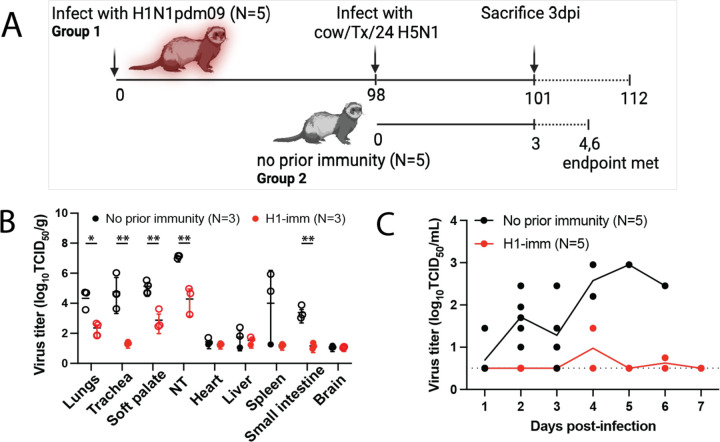
Figure 2.. Effects of prior H1N1 immunity on bovine H5N1 virus replication in ferrets.
A. Schematic of experimental timeline. Two groups of ferrets were intranasally infected with cow/Tx/24 H5N1; group 1 had been infected with H1N1pdm09 98 days prior (N=5) and group 2 were immunologically naïve (N=5). Three animals from each group were sacrificed at day 3 post-infection. The remaining ferrets from group 1 and 2 were monitored until day 14 post-infection or until the endpoint criteria were reached. Schematic was created in BioRender. B. Tissues from cow/Tx/24 H5N1 infected ferrets with no prior immunity (black, N=3) or H1N1pdm09 prior immunity (red, N=3) were collected at day 3 post-infection. Mean +/− SD of viral titers are shown with each circle representing an individual ferret. Unpaired t-test analysis was used to determine statistically significant differences (lungs p=0.0124; trachea p<0.0080; soft palate p=0.0072; nasal turbinates (NT) p=0.0061; small intestine p=0.0014). Open circles indicate those values that are above the limit of detection. C. Viral titers from nasal secretions of each individual ferret are represented by each circle with a line indicating the mean for each group. Nasal wash samples were collected on the indicated days post-infection (N=5 on days 1–3; N=2 on day 4 until end of the study). The dashed line represents the limit of detection.
Figure 3.
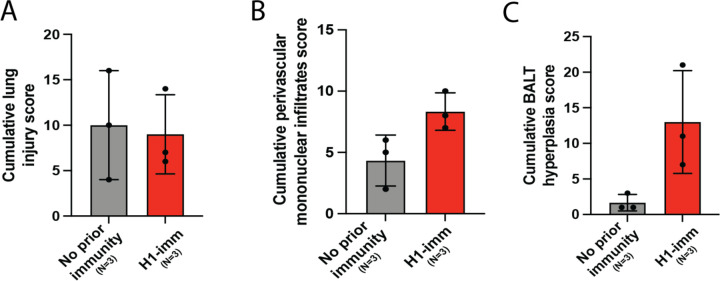
Figure 3.. Pre-existing H1N1 immunity increases lung immune infiltrates.
Five lung sections for ferrets with no prior (gray) or pre-existing H1N1pdm09 (red) immunity were blindly scored for A. lung injury, B. perivascular mononuclear infiltrates and C. BALT hyperplasia. Each dot represents the cumulative score of each of the five sections for each ferret.
Figure 4.
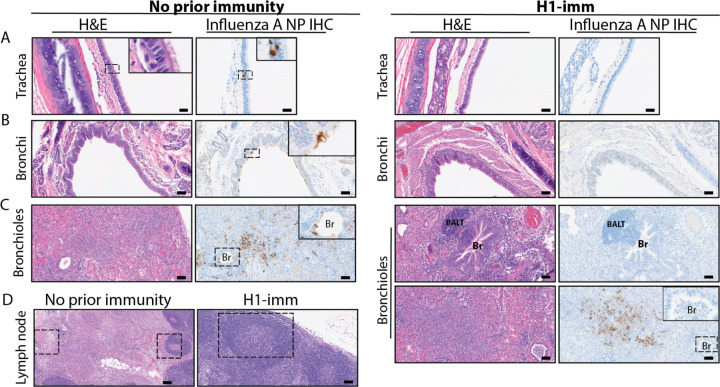
Figure 4.. Pre-existing H1N1 immunity reduces the presence of viral antigen and increases immune infiltrates.
Ferrets with no prior immunity (left panels) or H1N1pdm09 pre-existing immunity (right panels) were infected with 104 TCID50 of cow/Tx/24 H5N1 and sacrificed on day 3 post-infection. H&E and influenza A virus nucleoprotein IHC were performed for the trachea (A, images taken at 400x with 20mm scale bars), bronchi (B, all images taken at 200x with 50mm scale bars) and bronchiole (BR) (C, all images taken at 200x with 50mm scale bars). BALT refers to bronchus-associated lymphoid tissue. Hatched squares are areas within parts A-C that are magnified within the inset panel. D. H&E of tracheobronchial lymph node from ferrets with no prior immunity (left panel) or H1N1pdm09 pre-existing immunity (right panel) (images taken at 100x with 100mm scale bars, insets taken at 400x with 20mm scale bars). Hatched squares in part D indicate areas with immune infiltration.
Figure 5.
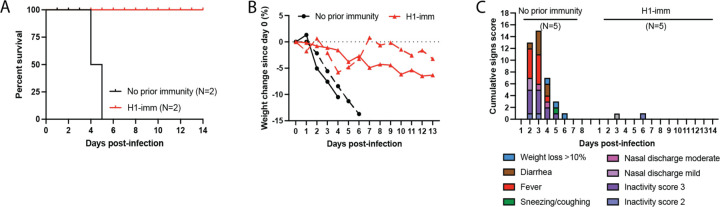
Figure 5.. Prior H1N1 immunity protects from mortality and severe disease in ferrets infected with bovine H5N1 virus.
A. Mortality of ferrets in each group (N=2 per group), with no prior immunity shown in black and H1N1pdm09 pre-existing immunity (H1-imm) in red. B. Percent of weight change for ferrets with no prior immunity (black, N=2) and H1N1pdm09 pre-existing immunity (H1-imm, red, N=2). C. Clinical signs on the indicated days post-infection (N=5 on days 1–3; N=2 on day 4 until end of the study) for ferrets with no prior immunity or H1N1pdm09 pre-existing immunity (H1-imm). Symptoms of infection were monitored each day post-infection and quantified into a cumulative signs score.
Figure 6.
Figure 6.. Ferrets with H1N1pdm09 pre-existing immunity have cross-reactive NA binding antibodies on day of challenge.
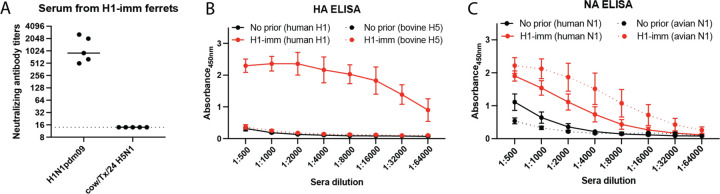
A. Sera collected from the five ferrets with pre-existing H1N1pdm09 immunity on day 98 post-infection were tested for neutralizing antibodies against 2009 H1N1 pandemic virus (H1N1pdm09) and cow/Tx/24 H5N1. Each dot represents the neutralizing antibody titer of a single ferret to neutralize 100 TCID50 of H1N1pdm09 or cow/Tx/24 H5N1 on MDCK cells. The line indicates the geometric mean value for each virus and the dotted line represents the limit of detection for the assay. B. Serum IgG antibodies in ferrets with no prior (black) or with pre-existing H1N1pdm09 immunity (red) against purified HA proteins. The solid lines show ferret serum reactivity to human HA (A/Michigan/45/2015 H1N1) and the dashed lines show ferret serum reactivity to bovine HA (A/dairy cattle/Texas/24008749001/2024 H5N1). Data is presented as mean +/− SD of the absorbance at 450nm for each dilution. C. Serum IgG antibodies in ferrets with no prior (black) or with pre-existing H1N1pdm09 immunity (red) against purified NA proteins. The solid lines show ferret serum reactivity to human NA (A/California/07/2009 H1N1) and the dashed lines show ferret serum reactivity to avian NA (A/mallard/New York/22-008760-007-original/2022 H5N1). Data is presented as mean +/− SD of the absorbance at 450nm for each dilution.

References

    1. HPAI Confirmed Cases in Livestock 2024. [Available from: https://www.aphis.usda.gov/livestock-poultry-disease/avian/avian-influen....
    1. Koopmans MPG, Barton Behravesh C, Cunningham AA, Adisasmito WB, Almuhairi S, Bilivogui P, et al. The panzootic spread of highly pathogenic avian influenza H5N1 sublineage 2.3.4.4b: a critical appraisal of One Health preparedness and prevention. Lancet Infect Dis. 2024. - PubMed
    1. Peacock T, Moncla L, Dudas G, VanInsberghe D, Sukhova K, Lloyd-Smith JO, et al. The global H5N1 influenza panzootic in mammals. Nature. 2024. - PubMed
    1. Uyeki TM, Milton S, Abdul Hamid C, Reinoso Webb C, Presley SM, Shetty V, et al. Highly Pathogenic Avian Influenza A(H5N1) Virus Infection in a Dairy Farm Worker. N Engl J Med. 2024;390(21):2028–9. - PubMed
    1. CDC. Avian Influenza (Bird Flu) [Available from: https://www.cdc.gov/bird-flu/spotlights/ah5n1-response-update.html.

Publication types

LinkOut - more resources