


High correlation of quantitative susceptibility mapping and echo intensity measurements of nigral iron overload in Parkinson's disease
- PMID: 39485510
- PMCID: PMC11870917
- DOI: 10.1007/s00702-024-02856-1
High correlation of quantitative susceptibility mapping and echo intensity measurements of nigral iron overload in Parkinson's disease
Abstract
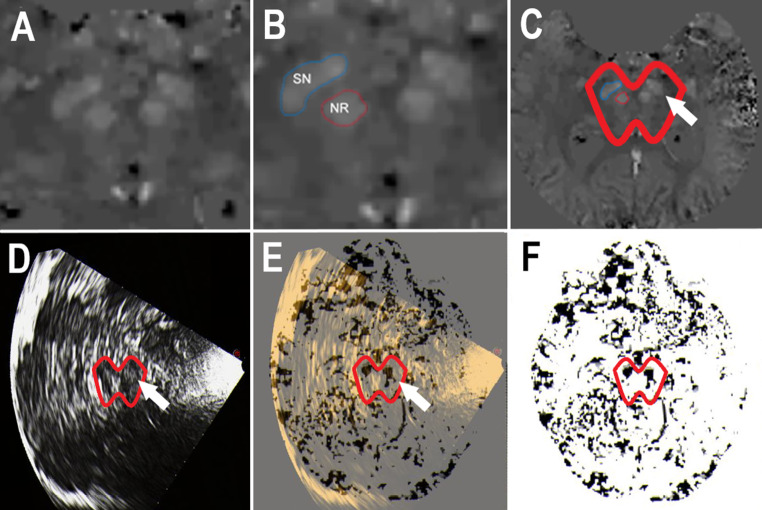
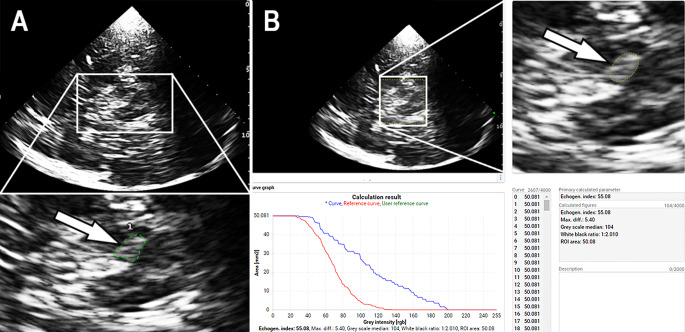
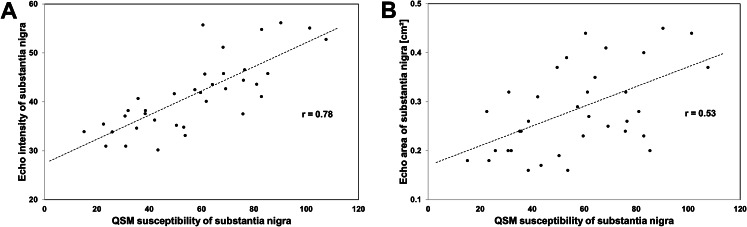
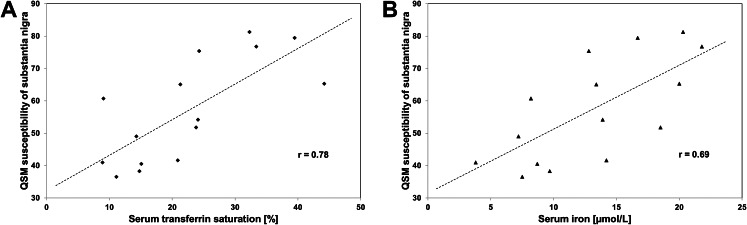
Quantitative susceptibility mapping (QSM) and transcranial sonography (TCS) offer proximal evaluations of iron load in the substantia nigra. Our prospective study aimed to investigate the relationship between QSM and TCS measurements of nigral iron content in patients with Parkinson's disease (PD). In secondary analyses, we wanted to explore the correlation of substantia nigra imaging data with clinical and laboratory findings. Eighteen magnetic resonance imaging and TCS examinations were performed in 15 PD patients at various disease stages. Susceptibility measures of substantia nigra were calculated from referenced QSM maps. Echogenicity of substantia nigra on TCS was measured planimetrically (echogenic area) and by digitized analysis (echo-intensity). Iron-related blood serum parameters were measured. Clinical assessments included the Unified PD Rating Scale and non-motor symptom scales. Substantia nigra susceptibility correlated with echogenic area (Pearson correlation, r = 0.53, p = 0.001) and echo-intensity (r = 0.78, p < 0.001). Individual asymmetry indices correlated between susceptibility and echogenic area measurements (r = 0.50, p = 0.042) and, more clearly, between susceptibility and echo-intensity measurements (r = 0.85, p < 0.001). Substantia nigra susceptibility (individual mean of bilateral measurements) correlated with serum transferrin saturation (Spearman test, r = 0.78, p < 0.001) and, by trend, with serum iron (r = 0.69, p = 0.004). Nigral echogenicity was not clearly related to serum values associated with iron metabolism. Susceptibility and echogenicity measurements were unrelated to PD duration, motor subtype, and severity of motor and non-motor symptoms. The present results support the assumption that iron accumulation is involved in the increase of nigral echogenicity in PD. Nigral echo-intensity probably reflects ferritin-bound iron, e.g. stored in microglia.
Keywords: Magnetic resonance imaging; Parkinson disease; Substantia nigra; Transcranial sonography.
© 2024. The Author(s).
Conflict of interest statement
Declarations. Competing interests: A.K.L., C.L., R.V., H.R.K., S.L., A.M.W., M.W. and M.A.W. do not report competing interests. M.L. has received speaker honoraria for presentations from STADA Pharma. G.K. has received research grants from the French Society of Neuroradiology and the French Society of Radiology. A.S. has received funding from the Deutsche Forschungsgemeinschaft (German Research Association) and the Helmholtz-Association outside the present study. He has received honoraria for presentations/advisory boards/consultations from Esteve, Desitin, Lobsor Pharmaceuticals, STADA, Bial, RG Gesellschaft, Zambon, NovoNordisk and AbbVie outside the present study. He has received royalties from Kohlhammer Verlag and Elsevier Press. He serves as an editorial board member of Stem Cells International. D.D. has received funding from the French Ministry of Health: PHRC grants, French Ministry of Research: ANR, European Preclinical Research: Coen, European Clinical Research: Horizon 2020, the charities: France Parkinson, ARSLA Foundation, Cure Parkinson Trust, the Foundations: University of Lille, Credit Agricole, Bettencourt, de France. He had consultancies: Scientific Advisory Board for Abbvie, Alterity, Orkyn, Air Liquide, Apopharma, Chiesi, Lundbeck, Everpharma and Boston Scientific, PTC Therapeutics, Inflectis, Cajal Neurosciences, AB sciences, Alzprotect, Orion and has equities: InBrain Pharma, InVenis Biotherapies. U.W. has received funding from the German Federal Ministry of Education and Research (BMBF) outside the present study. He has received speaker honoraria and travel grants from Bristol-Myers Squibb, Boehringer Ingelheim Pharma, Daiichi-Sankyo, Ipsen Pharma, Merz Pharmaceuticals, Pfizer Pharma, and an unrestricted research grant from Merz Pharmaceuticals outside the present study. He serves as Joint Editor-in-Chief of the European Journal of Ultrasound (Thieme, Stuttgart, Germany).
Figures
References
MeSH terms
Substances
LinkOut - more resources
Full Text Sources
Medical
