


Factors influencing pregnant women's decision to accept or decline prenatal screening and diagnosis - a qualitative study
- PMID: 39485622
- PMCID: PMC11645329
- DOI: 10.1007/s12687-024-00746-3
Factors influencing pregnant women's decision to accept or decline prenatal screening and diagnosis - a qualitative study
Abstract
Background and objective: Prenatal diagnosis for chromosomal anomalies is frequently used worldwide. It is important that pregnant women receive adequate counselling to make informed decisions regarding prenatal diagnosis. The aim of this study was to explore what factors influence pregnant women's decision-making process when accepting or declining prenatal screening and diagnosis. Methods: A qualitative study using inductive qualitative content analysis. Individual, semi-structured phone interviews were carried out during a five-month period in 2016-2017 with 24 pregnant women in the first trimester, living in a medium-sized Swedish city.
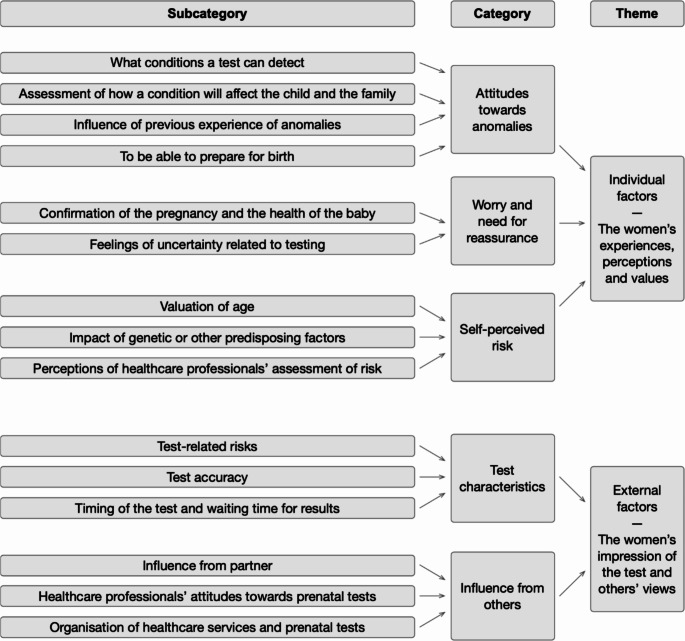
Findings: Two main themes emerged: (1)"Individual factors - The women's experiences, perceptions and values" with three categories "Attitude towards anomalies", "Worry and need for reassurance", "Self-perceived risk" and (2)"External factors - The women's perception of the test and others' views" with two categories "Test characteristics" and "Influence from others". Conclusions: Pregnant women's decision-making process regarding prenatal tests is multidimensional, affected by both individual factors such as experiences, perceptions and values, and external factors such as test characteristics and influence from others. Information about both test characteristics and the conditions tested is of help pregnant women in the decision-making process since it provides a better understanding of how having a child with the condition in question can affect them and their family. It is important that healthcare professionals giving information about and offering prenatal tests for chromosomal anomalies are aware of how their attitudes can influence women's decisions.
Keywords: Chromosome aberrations; Decision making; Genetic counseling; Information; Informed choice; Prenatal diagnosis.
© 2024. The Author(s).
Conflict of interest statement
Declarations. Ethics approval and compliance with ethics guidelines: The study was approved by the Regional Ethical Review Board at the Medical Faculty of Uppsala University (Dnr 2015/227, 2015/227/1, 2015/227/2, 2015/227/3). All procedures followed were in accordance with the Helsinki Declaration of 1975, as revised in 2000. Consent to participate: Verbal informed consent was obtained from all participants prior to the interview. Competing interests: The authors declare no competing interests.
Figures
References
-
- Bakker M, Birnie E, Pajkrt E, Bilardo CM, Snijders RJM (2012) Low uptake of the combined test in the Netherlands–which factors contribute? Prenat. Diagn 32(13):1305–1312 - PubMed
-
- Bryant L, Hewison JD, Green JM (2005) Attitudes towards prenatal diagnosis and termination in women who have a sibling with Down’s syndrome. J Reprod Infant Psychol 23(2):181–198 - DOI
LinkOut - more resources
Full Text Sources
