


Incident dementia in ischaemic stroke patients with early cardiac complications: A propensity-score matched cohort study
- PMID: 39487764
- PMCID: PMC11558657
- DOI: 10.1177/23969873241293573
Incident dementia in ischaemic stroke patients with early cardiac complications: A propensity-score matched cohort study
Abstract
Introduction: The risk of dementia in patients with stroke-heart syndrome (SHS) remains unexplored.
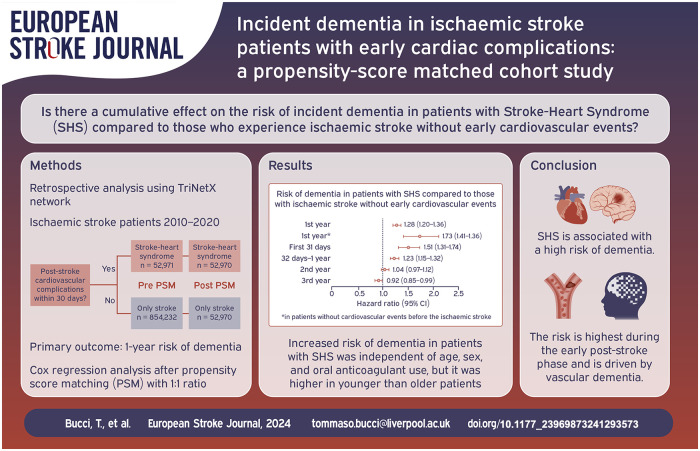
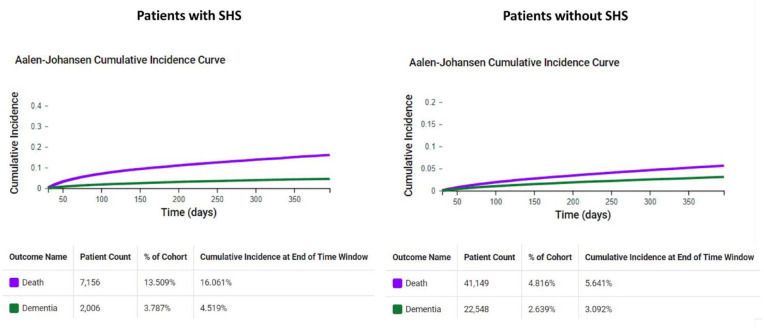
Patients and methods: Retrospective analysis using the TriNetX network, including patients with ischaemic stroke from 2010 to 2020. These patients were categorised into two groups: those with SHS (heart failure, myocardial infarction, ventricular fibrillation, or Takotsubo cardiomyopathy within 30 days post-stroke) and those without SHS. The primary outcome was the 1-year risk of dementia (vascular dementia, dementia in other disease, unspecified dementia, or Alzheimer's disease). The secondary outcome was the 1-year risk of all-cause death. Cox regression analysis after 1:1 propensity score matching (PSM) was performed to calculate the hazard ratios (HRs) and 95% confidence intervals (CIs) for the outcomes.
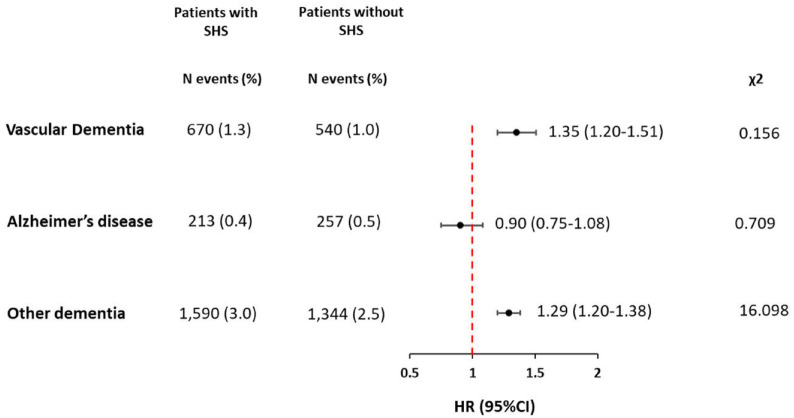
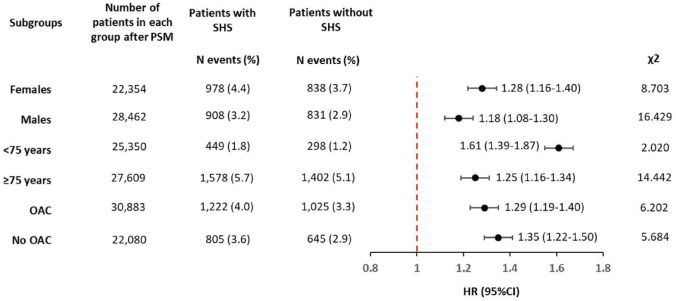
Results: We included 52,971 patients with SHS (66.6 ± 14.6 years, 42.2% females) and 854,232 patients without SHS (64.7 ± 15.4 years, 48.2% females). Following PSM, 52,970 well-balanced patients were considered in each group. Patients with SHS had a higher risk of incident dementia compared to those without SHS (HR 1.28, 95%CI 1.20-1.36). The risk was the highest during the first 31 days of follow-up (HR 1.51, 95%CI 1.31-1.74) and was mainly driven by vascular and mixed forms. The increased risk of dementia in patients with SHS, was independent of oral anticoagulant use, sex and age but it was the highest in those aged <75 years compared to ⩾75 years.
Discussion and conclusion: SHS is associated with increased risk of dementia. Future studies are needed to develop innovative strategies for preventing complications associated with stroke-heart syndrome and improving the long-term prognosis of these patients.
Keywords: Stroke; cardiovascular events; dementia.
Conflict of interest statement
Declaration of conflicting interestsThe author(s) declared the following potential conflicts of interest with respect to the research, authorship, and/or publication of this article: GYHL is a consultant and speaker for BMS/Pfizer, Boehringer Ingelheim, Daiichi-Sankyo, Anthos. No fees are received personally. He is a National Institute for Health and Care Research (NIHR) Senior Investigator and co-PI of the AFFIRMO project on multimorbidity in AF (grant agreement No 899871), TARGET project on digital twins for personalised management of atrial fibrillation and stroke (grant agreement No 101136244) and ARISTOTELES project on artificial intelligence for management of chronic long term conditions (grant agreement No 101080189), which are all funded by the EU’s Horizon Europe Research & Innovation programme. BJRB has received research funding from BMS/Pfizer and Huawei Europe. All other authors report no relevant disclosures.
Figures
References
-
- Buckley BJR, Harrison SL, Hill A, et al. Stroke-heart syndrome: incidence and clinical outcomes of cardiac complications following stroke. Stroke 2022; 53: 1759–1763. - PubMed
-
- Scheitz JF, Nolte CH, Doehner W, et al. Stroke-heart syndrome: clinical presentation and underlying mechanisms. Lancet Neurol 2018; 17: 1109–1120. - PubMed
-
- Sposato LA, Hilz MJ, Aspberg S, et al. Post-stroke cardiovascular complications and neurogenic cardiac injury: JACC state-of-the-art review. J Am Coll Cardiol 2020; 76: 2768–2785. - PubMed
MeSH terms
LinkOut - more resources
Full Text Sources
Medical
Miscellaneous
