


Evaluating the relationship between standing height, body mass index, body fat percentage with risk of inguinal hernia: a Mendelian randomization study
- PMID: 39488648
- PMCID: PMC11531599
- DOI: 10.1038/s41598-024-78122-x
Evaluating the relationship between standing height, body mass index, body fat percentage with risk of inguinal hernia: a Mendelian randomization study
Abstract
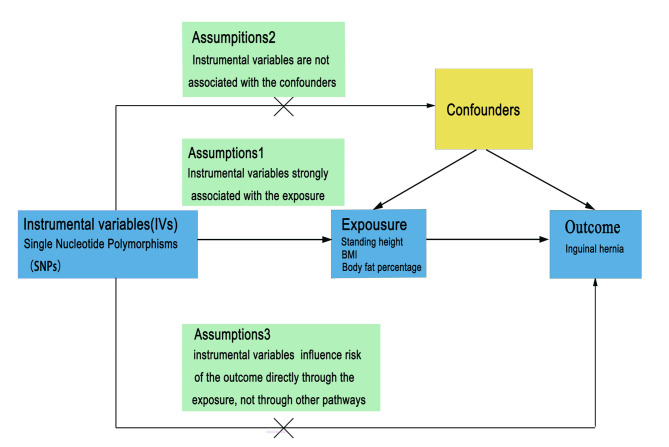
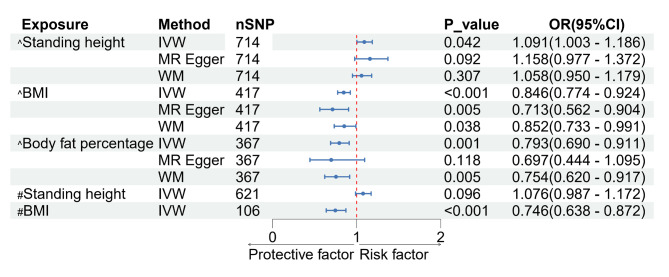
Observational studies have suggested links between standing height, BMI, body fat percentage, and inguinal hernia risk, but with inconsistent results. We conducted Mendelian randomization (MR) method to investigate their causal relationships. Independent SNPs associated with standing height, BMI, and body fat percentage were extracted from GWAS data as instrumental variables (IVs). Two-sample MR initially explored causal relationships between these factors and inguinal hernia risk. Multivariable Mendelian randomization (MVMR) assessed the direct causal effects of exposures on inguinal hernia. Positive findings from the MVMR analysis were independently validated. The inverse-variance weighted Methods (IVW), weighted median(WM), and MR-Egger were used for the MR estimates. Sensitivity analyses were used to examine the stability and reliability of the results. Two-sample MR analysis revealed a suggestive causal association between height and inguinal hernia (OR = 1.091, 95% CI = 1.003-1.186, P = 0.042). BMI (OR = 0.846, 95% CI = 0.774-0.924, P < 0.001) and body fat percentage (OR = 0.793, 95% CI = 0.690-0.911, P = 0.001) were significantly protective factors. After MVMR adjustment, BMI (OR = 0.746,95%CI = 0.638-0.872, P < 0.001) remained protective. Independent validation yielded consistent result. Genetically predicted BMI is a significant protective factor for inguinal hernia, providing valuable guidance for individualized prevention strategies.
Keywords: BMI; Body fat percentage; Inguinal hernia; Mendelian randomization; SNP; Standing height.
© 2024. The Author(s).
Conflict of interest statement
The author(s) declared no potential conflicts of interest with respect to the research, authorship, and/or publication of this article.
Figures

References
-
- Primatesta, P. & Goldacre, M. J. Inguinal hernia repair: Incidence of elective and emergency surgery, readmission and mortality. Int. J. Epidemiol.25, 835–839 (1996). - PubMed
-
- Kingsnorth, A. N. & Leblanc, K. A. J. S. L. Management of Abdominal Hernias. 10.1007/978-1-84882-877-3 (2013).
-
- Everhart, J. et al. ed. Digestive Diseases in the United States: Epidemiology and Impact of Health and Human of of Diabetes and Digestive and Kidney Publication No (1994).
-
- Ruhl, C. E. & Everhart, J. E. Risk factors for inguinal hernia among adults in the US population. Am. J. Epidemiol.165, 1154–1161 (2007). - PubMed
MeSH terms
LinkOut - more resources
Full Text Sources
