Randomized Controlled Trial
. 2024 Nov 2;23(1):393.
doi: 10.1186/s12933-024-02470-1.

Biomarkers of glucose-insulin homeostasis and incident type 2 diabetes and cardiovascular disease: results from the Vitamin D and Omega-3 trial

Affiliations
Randomized Controlled Trial

Biomarkers of glucose-insulin homeostasis and incident type 2 diabetes and cardiovascular disease: results from the Vitamin D and Omega-3 trial

Frank Qian et al. Cardiovasc Diabetol. .

Abstract

Background: Dysglycemia and insulin resistance increase type 2 diabetes (T2D) and cardiovascular disease (CVD) risk, yet associations with specific glucose-insulin homeostatic biomarkers have been inconsistent. Vitamin D and marine omega-3 fatty acids (n-3 FA) may improve insulin resistance. We sought to examine the association between baseline levels of insulin, C-peptide, HbA1c, and a novel insulin resistance score (IRS) with incident cardiometabolic diseases, and whether randomized vitamin D or n-3 FA modify these associations.

Methods: VITamin D and OmegA-3 TriaL (NCT01169259) was a randomized clinical trial testing vitamin D and n-3 FA for the prevention of CVD and cancer over a median of 5.3 years. Incident cases of T2D and CVD (including cardiovascular death, myocardial infarction, stroke, and coronary revascularization) were matched 1:1 on age, sex, and fasting status to controls. Conditional logistic regressions adjusted for demographic, clinical, and adiposity-related factors were used to assess the adjusted odds ratio (aOR) per-standard deviation (SD) and 95%CI of baseline insulin, C-peptide, HbA1c, and IRS (Insulin×0.0295 + C-peptide×0.00372) with risk of T2D, CVD, and coronary heart disease (CHD).

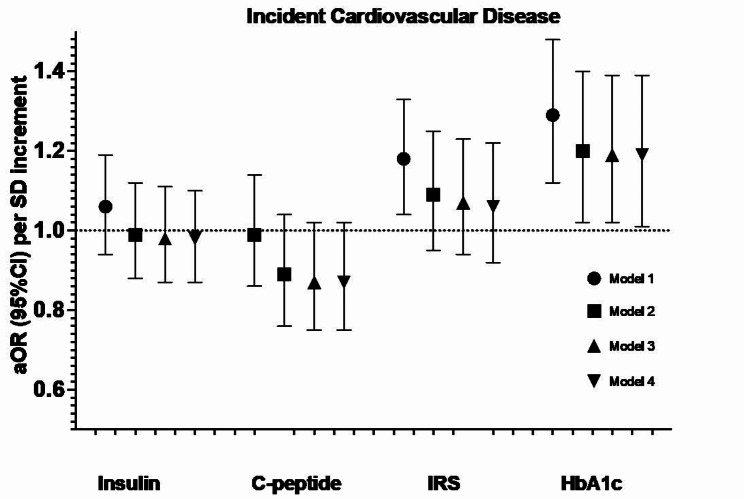
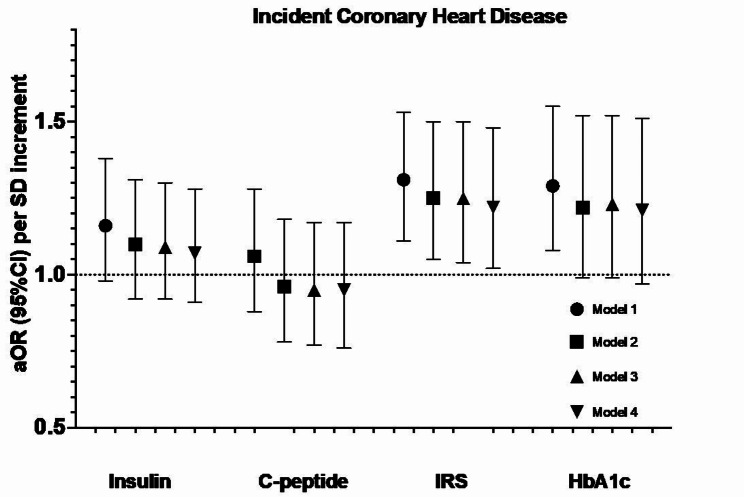
Results: We identified 218 T2D case-control pairs and 715 CVD case-control pairs including 423 with incident CHD. Each of the four biomarkers at baseline was separately associated with incident T2D, aOR (95%CI) per SD increment: insulin 1.46 (1.03, 2.06), C-peptide 2.04 (1.35, 3.09), IRS 1.72 (1.28, 2.31) and HbA1c 7.00 (3.76, 13.02), though only HbA1c remained statistically significant with mutual adjustments. For cardiovascular diseases, we only observed significant associations of HbA1c with CVD (1.19 [1.02, 1.39]), and IRS with CHD (1.25 [1.04, 1.50]), which persisted after mutual adjustment. Randomization to vitamin D and/or n-3 FA did not modify the association of these biomarkers with the endpoints.

Conclusions: Each of insulin, C-peptide, IRS, and HbA1c were associated with incident T2D with the strongest association noted for HbA1c. While HbA1c was significantly associated with CVD risk, a novel IRS appears to be associated with CHD risk. Neither vitamin D nor n-3 FA modified the associations between these biomarkers and cardiometabolic outcomes.

Keywords: Cardiovascular disease; Insulin resistance; Omega-3 fatty acids; Type 2 diabetes; Vitamin D.


Conflict of interest statement

JL, JB, and MJM are Quest Diagnostics employees and/or have stock ownership. SM served as a consultant to Pfizer outside the current work. The other authors declare no relevant conflicts of interest.

Figures
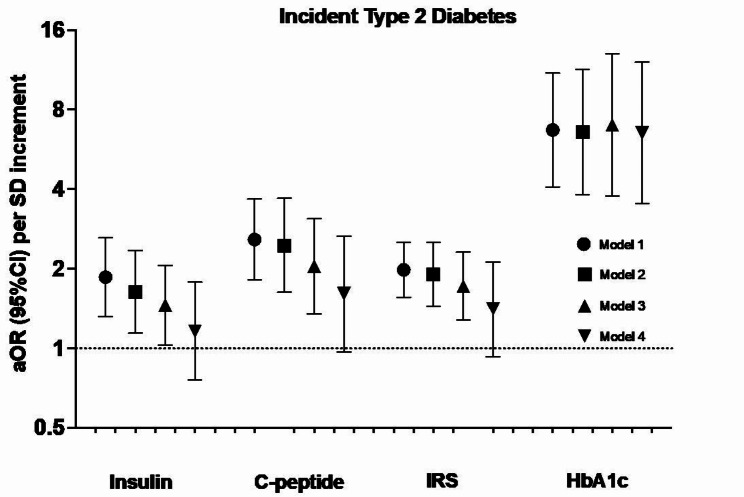
Fig. 1
Fig. 1
Association between glucose-insulin homeostasis biomarkers and incident type 2 diabetes (N = 218 events) in the VITAL trial. Model 1 includes the matching factors age, sex, and fasting status. Model 2 is additionally adjusted for race/ethnicity, smoking status, alcohol consumption, systolic blood pressure, HDL cholesterol, family history of T2D, use of antihypertensives, use of lipid-lowering agents, and randomized treatment arm (omega-3, vitamin D, or placebo). Model 3 is additionally adjusted for BMI. For insulin, C-peptide, and IRS, model 4 is additionally adjusted for HbA1c. For HbA1c, model 4 is additionally adjusted for insulin and C-peptide. aOR: adjusted odds ratio; CI: confidence interval; HbA1c: glycated hemoglobin; IRS: insulin resistance score
Fig. 2
Fig. 2
Association between glucose-insulin homeostasis biomarkers and incident cardiovascular disease (N = 715 events) in the VITAL trial. Cardiovascular disease included non-fatal myocardial infarction, non-fatal stroke, and cardiovascular death. Model 1 includes the matching factors, namely age, sex, and fasting status. Model 2 is additionally adjusted for race/ethnicity, smoking status, alcohol consumption, baseline diabetes status, systolic blood pressure, LDL cholesterol, HDL cholesterol, family history of cardiovascular disease, use of antihypertensives, use of lipid-lowering agents, and randomized treatment arm (omega-3, vitamin D, or placebo). Model 3 is additionally adjusted for BMI. For insulin, C-peptide, and IRS, model 4 additionally adjusts for HbA1c. For HbA1c, model 4 additionally adjusts for insulin and C-peptide. aOR: adjusted odds ratio; CI: confidence interval; HbA1c: glycated hemoglobin; IRS: insulin resistance score
Fig. 3
Fig. 3
Association between glucose-insulin homeostasis biomarkers and incident coronary heart disease (N = 423 events) in the VITAL trial. Coronary heart disease is defined as the composite of non-fatal myocardial infarction, coronary revascularization, and coronary deaths. Model 1 includes the matching factors, namely age, sex, and fasting status. Model 2 is additionally adjusted for race/ethnicity, smoking status, alcohol consumption, baseline diabetes status, systolic blood pressure, LDL cholesterol, HDL cholesterol, family history of cardiovascular disease, use of antihypertensives, use of lipid-lowering agents, and randomized treatment arm (omega-3, vitamin D, or placebo). Model 3 is additionally adjusted for BMI. For insulin, C-peptide, and IRS, model 4 additionally adjusts for HbA1c. For HbA1c, model 4 additionally adjusts for insulin and C-peptide. aOR: adjusted odds ratio; CI: confidence interval; HbA1c: glycated hemoglobin; IRS: insulin resistance score

References

    1. Ormazabal V, Nair S, Elfeky O, Aguayo C, Salomon C, Zuniga FA. Association between insulin resistance and the development of cardiovascular disease. Cardiovasc Diabetol. 2018;17(1):122. - PMC - PubMed
    1. Ruijgrok C, Dekker JM, Beulens JW, Brouwer IA, Coupe VMH, Heymans MW, et al. Size and shape of the associations of glucose, HbA1c, insulin and HOMA-IR with incident type 2 diabetes: the Hoorn Study. Diabetologia. 2018;61(1):93–100. - PMC - PubMed
    1. Kurl S, Zaccardi F, Onaemo VN, Jae SY, Kauhanen J, Ronkainen K, et al. Association between HOMA-IR, fasting insulin and fasting glucose with coronary heart disease mortality in nondiabetic men: a 20-year observational study. Acta Diabetol. 2015;52(1):183–6. - PubMed
    1. Meigs JB, Porneala B, Leong A, Shiffman D, Devlin JJ, McPhaul MJ. Simultaneous consideration of HbA1c and insulin resistance improves Risk Assessment in White individuals at increased risk for future type 2 diabetes. Diabetes Care. 2020;43(8):e90–2. - PMC - PubMed
    1. Patel N, Taveira TH, Choudhary G, Whitlatch H, Wu WC. Fasting serum C-peptide levels predict cardiovascular and overall death in nondiabetic adults. J Am Heart Assoc. 2012;1(6):e003152. - PMC - PubMed

Publication types

MeSH terms

Associated data