


Asthma prescribing trends, inhaler adherence and outcomes: a Real-World Data analysis of a multi-ethnic Asian Asthma population
- PMID: 39489762
- PMCID: PMC11532544
- DOI: 10.1038/s41533-024-00391-w
Asthma prescribing trends, inhaler adherence and outcomes: a Real-World Data analysis of a multi-ethnic Asian Asthma population
Abstract
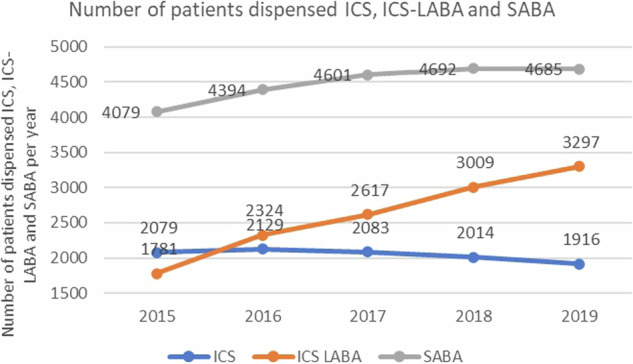
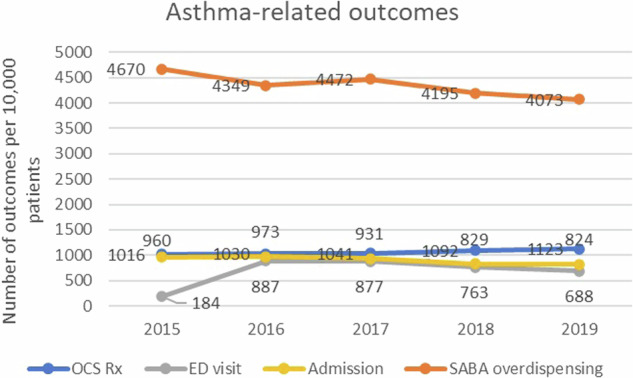
Inhaled corticosteroid (ICS) is the mainstay therapy for asthma, but general adherence is low. There is a paucity of real-world inhaler prescribing and adherence data from Asia and at the population level. To address these gaps, we performed a real-world data analysis of inhaler prescribing pattern and adherence in a multi-ethnic Asian asthma cohort and evaluated the association with asthma outcomes. We performed a retrospective analysis of adult asthma patients (aged ≥18 years) treated in the primary and specialist care settings in Singapore between 2015 to 2019. Medication adherence was measured using the medication possession ratio (MPR), and categorised into good adherence (MPR 0.75-1.2), poor adherence (MPR 0.75) or medication oversupply (MPR > 1.2). All statistical analyses were performed using R Studio. 8023 patients, mean age 57 years, were evaluated between 2015 and 2019. Most patients were receiving primary care (70.4%) and on GINA step 1-3 therapies (78.2%). ICS-long-acting beta-2 agonist (ICS-LABA) users increased over the years especially in the primary care, from 33% to 52%. Correspondingly, inpatient admission and ED visit rates decreased over the years. Between 2015 and 2019, the proportion of patients with poor adherence decreased from 12.8% to 10.5% (for ICS) and from 30.0% to 26.8% (for ICS-LABA) respectively. Factors associated with poor adherence included minority ethnic groups (Odds ratio of MPR 0.75-1.2: 0.73-0.93; compared to Chinese), presence of COPD (OR 0.75, 95% CI 0.59-0.96) and GINA step 4 treatment ladder (OR 0.71, 95% CI 0.61-0.85). Factors associated with good adherence were male gender (OR 1.14, 95% CI 1.01-1.28), single site of care (OR 1.22 for primary care and OR 1.76 for specialist care), GINA step 2 treatment ladder (OR 1.28, 95% CI 1.08-1.50). Good adherence was also associated with less frequent inpatient admission (OR 0.91, 95% CI 0.84-0.98), greater SABA overdispensing (OR 1.66, 95% CI 1.47-1.87) and oral corticosteroids use (OR 1.10, 95% CI 1.05-1.14). Inhaled corticosteroid (ICS) adherence has improved generally, however, poor adherence was observed for patients receiving asthma care in both primary and specialist care, and those from the minority ethnicities.
© 2024. The Author(s).
Conflict of interest statement
Ming Ren Toh reports no conflict of interest. Gerald Xuan Zhong Ng reports no conflict of interest. Ishita Goel reports no conflict of interest. Shao Wei Lam reports no conflict of interest. Jun Tian Wu reports no conflict of interest. Chun Fan Lee reports no conflict of interest. Marcus Eng Hock Ong reports no conflict of interest. David Bruce Matchar reports no conflict of interest. Ngiap Chuan Tan reports no conflict of interest. Chian Min Loo reports no conflict of interest. Mariko Siyue Koh reports grant support from Astra-Zeneca, and honoraria for lectures and advisory board meetings paid to her hospital (Singapore General Hospital) from GlaxoSmithKline, Astra-Zeneca, Novartis, Sanofi, Boehringer Ingelheim and Roche outside the submitted work.
Figures


References
-
- Network GBoDC. Global Burden of Disease Study 2019 (GBD 2019) (Institute for Health Metrics and Evaluation (IHME), 2020).
Publication types
MeSH terms
Substances
LinkOut - more resources
Full Text Sources
Medical
