


Does adherence to exacerbation action plans matter? Insights from two COPD self-management studies
- PMID: 39492899
- PMCID: PMC11530782
- DOI: 10.1016/j.heliyon.2024.e39070
Does adherence to exacerbation action plans matter? Insights from two COPD self-management studies
Abstract
Introduction: Patients' adherence is essential for COPD self-management, as beneficial effects can only be expected in adherent patients. We explored associations between patients' adherence to COPD exacerbation action plans and health outcomes.
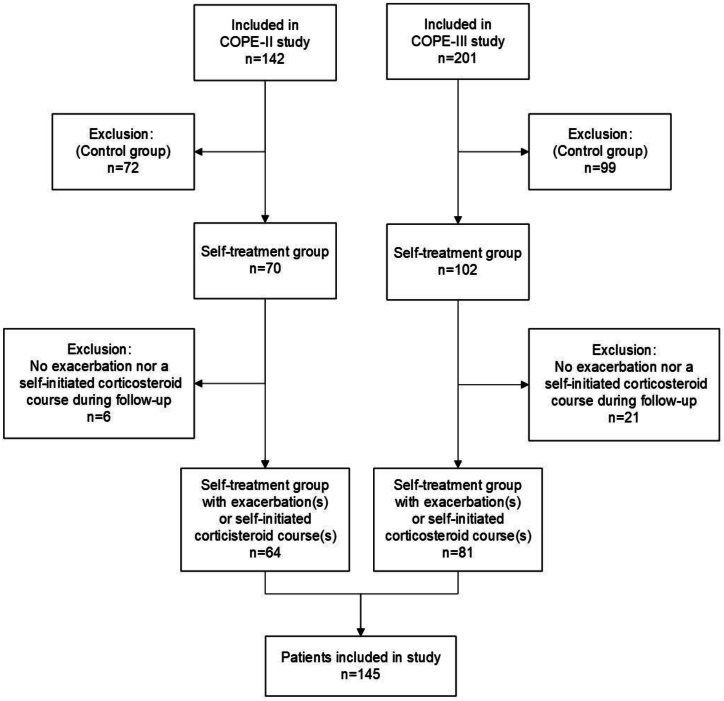
Materials and methods: Pooled COPD self-treatment intervention group data from two RCTs were analysed, only including patients who had ≥1 COPD exacerbation or started ≥1 course of oral corticosteroids over one-year follow-up. Optimal adherence was defined as 'self-treatment initiated ≤1 day before or after exacerbation start', suboptimal adherence as 'self-treatment initiated 2 days before or after exacerbation start or no self-treatment initiated for a short (1-3 days) exacerbation', and significant delay or no treatment as 'self-treatment initiated >2 days after exacerbation start or no self-treatment initiated for a longer (>3 days) exacerbation'. Regression models were built for several health outcomes, with the number of COPD exacerbation days/patient/year being the primary outcome.
Results: Patients with significant delay or no treatment (n = 46) had more exacerbation days/patient/year (33.3 (95 % CI 10.9; 55.6)) than optimal adherent patients (n = 38) (23.7 (95 % CI 1.7; 45.7)). The duration per COPD exacerbation was longer for patients with significant delay or no treatment (15.5 days) compared to optimal adherent patients (7.8 days). No differences in health outcomes were observed between optimal and suboptimal adherent patients.
Conclusions: Being adherent to action plans is associated with better health outcomes than significant delayed treatment or no treatment at all. Interestingly, suboptimal adherence demonstrated health benefits comparable to optimal adherence. COPD self-management interventions should prioritise strategies to optimise patients' adherence to action plans.
Keywords: Action planning; Adherence; Chronic obstructive pulmonary disease; Exacerbations; Health outcomes; Self-treatment.
© 2024 The Authors.
Conflict of interest statement
The authors declare that they have no known competing financial interests or personal relationships that could have appeared to influence the work reported in this paper.
Figures
References
-
- Ramsey S.D., Sullivan S.D. The burden of illness and economic evaluation for COPD. Eur. Respir. J. 2003;41:29s–35s. - PubMed
-
- Global Initiative for Chronic Obstructive Lung Disease . 2023. Global Strategy for the Diagnosis, Management, and Prevention of Chronic Obstructive Pulmonary Disease (2024 Report)
-
- Bourbeau J., van der Palen J. Promoting effective self-management programmes to improve COPD. Eur. Respir. J. 2009;33:461–463. - PubMed
-
- Effing T.W., Bourbeau J., Vercoulen J., et al. Self-management programmes for COPD: moving forward. Chron. Respir. Dis. 2012;9:27–35. - PubMed
LinkOut - more resources
Full Text Sources
