. 2024 Jul 24;33(15):3579-3589.
doi: 10.1007/s10068-024-01611-2. eCollection 2024 Dec.

Isopimpinellin inhibits UVA-induced overproduction of MMPs via suppression of MAPK/AP-1 signaling in human dermal fibroblasts

Affiliations

Isopimpinellin inhibits UVA-induced overproduction of MMPs via suppression of MAPK/AP-1 signaling in human dermal fibroblasts

Jung Hwan Oh et al. Food Sci Biotechnol. .

Abstract

Corydalis heterocarpa is an edible halophyte and an ingredient in traditional Korean medicine. In the present study, isopimpinellin (IPN), a bioactive coumarin, was isolated from the medicinal halophyte C. heterocarpa, and the effects of IPN against UVA-induced photoaging were investigated in human dermal fibroblasts. Photoaging is a skin disorder that manifests itself as premature skin aging due to chronic exposure to UV radiation. The symptoms of photoaging mainly arise from degraded skin connective tissue produced by overly expressed matrix metalloproteinases (MMPs). IPN treatment decreased the UVA-induced formation of reactive oxygen species and decreased MMP-1, MMP-3, and MMP-9 collagenases at the protein level. The UVA-mediated suppression of tissue inhibitors of MMP-1 and -2 was attenuated with IPN. The presence of 10 μM IPN inhibited the MAPK-mediated phosphorylation of c-Fos and c-Jun. In conclusion, the overall result of the current study indicated that IPN inhibited the UVA-induced overexpression of MMPs via blocking the MAPK/AP-1 pathway.

Keywords: Corydalis heterocarpa; Human dermal fibroblast; Isopimpinellin; MMP; Photoaging.


Conflict of interest statement

Competing interestsThe authors declare that they have no competing interests.

Figures
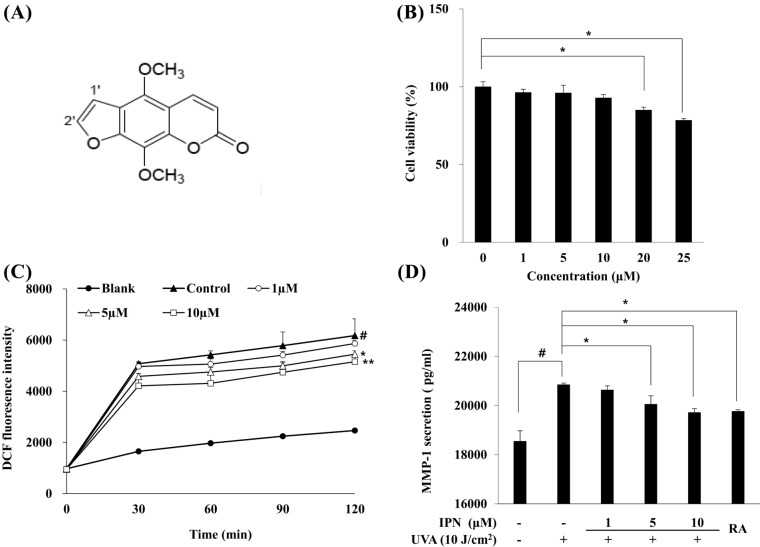
Fig. 1
Fig. 1
(A) The chemical structure of Isopimpinellin (IPN). (B) Effect of IPN on the viability of human dermal fibroblasts (HDFs). Viability of the cells was measured after 24 h IPN treatment. Viability was given as a relative percentage of the untreated group. Values are means ± SD (n = 3). *p < 0.05 vs. untreated (0 μM) group. (C) Effect of IPN on the UVA-induced intracellular ROS levels in HDFs. HDFs were loaded with DCFH-DA and treated with or without IPN for 2 h prior to UVA irradiation. The fluorescence intensity of DCF was measured at 30 min intervals. Values are means ± SD (n = 3). Blank: Non-irradiated, untreated group; Control: UVA-irradiated, untreated group. #p < 0.05 vs. Blank, and *p < 0.05, **p < 0.01 vs. Control. (D) Effect of IPN on the MMP-1 secretion of HDFs. HDFs were irradiated by UVA and treated with or without IPN for 24 h. MMP-1 levels in the cell culture medium was measured by ELISA. Values are means ± SD (n = 3). #p < 0.05 vs. non-irradiated untreated group, and *p < 0.05 vs. UVA-irradiated untreated group. RA: UVA-irradiated retinoic acid-treated (10 μM) positive control
Fig. 2
Fig. 2
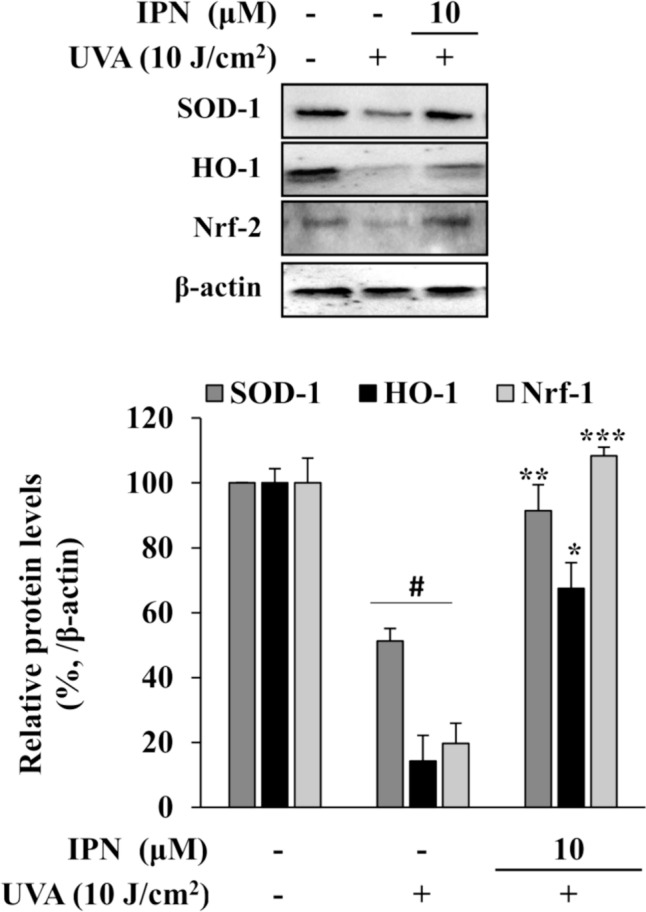
Effect of IPN on protein expression levels of SOD-1, HO-1 and Nrf-2 in HDFs, analyzed by Western blot. HDFs were irradiated by UVA and treated with or without IPN for 24 h. β-actin was used as loading control. Relative protein levels were measured densiometrically and normalized against β-actin levels. #p < 0.05 vs. non-irradiated untreated group, and *p < 0.05, **p < 0.01, ***p < 0.001 vs. UVA-irradiated untreated group
Fig. 3
Fig. 3
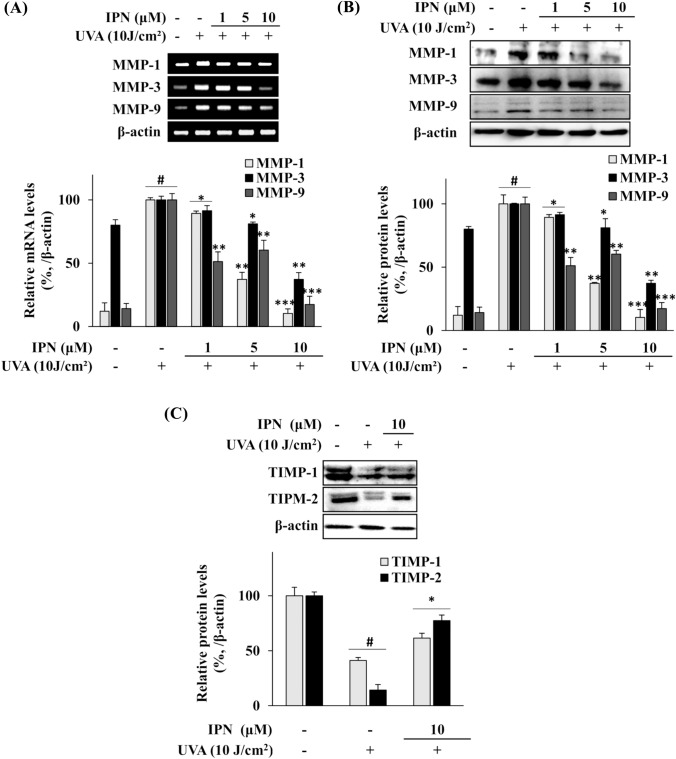
Effect of IPN on the mRNA (A) and protein (B, C) expression levels of MMP-1, MMP-3, MMP-9, TIMP-1 and TIMP-2 in HDFs, analyzed by RT-PCR and Western blot analysis, respectively. HDFs were irradiated by UVA and treated with or without IPN for 24 h. β-actin was used as loading control. Relative mRNA and protein levels were measured densiometrically and normalized against β-actin levels. #p < 0.05 vs. non-irradiated untreated group, and *p < 0.05, **p < 0.01, ***p < 0.001 vs. UVA-irradiated untreated group
Fig. 4
Fig. 4
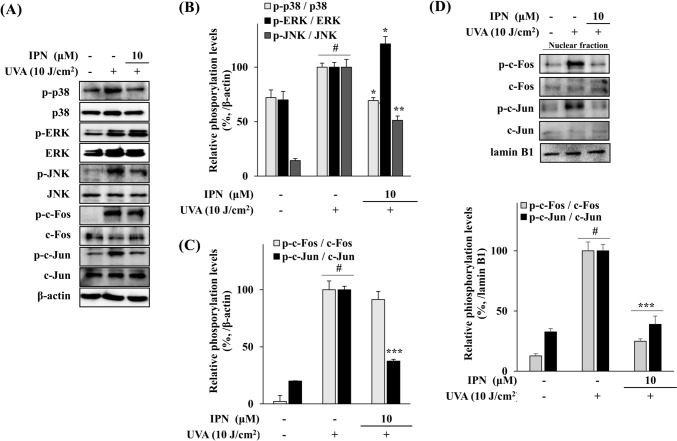
Effect of IPN on the total and phosphorylated (p-) levels p38, ERK and JNK MAPKs and AP-1 dimers c-Fos and c-Jun (A) in HDFs analyzed by Western blot. HDFs were irradiated by UVA and treated with or without IPN for 24 h. β-actin was used as loading control for total cell lysates (A) and lamin B1 was used for loading control for nuclear fractions (D). Relative protein levels were measured densiometrically and normalized against β-actin (B, C) and lamin B1 (D) levels. #p < 0.05 vs. non-irradiated untreated group, and *p < 0.05, **p < 0.01, ***p < 0.001 vs. UVA-irradiated untreated group
Fig. 5
Fig. 5
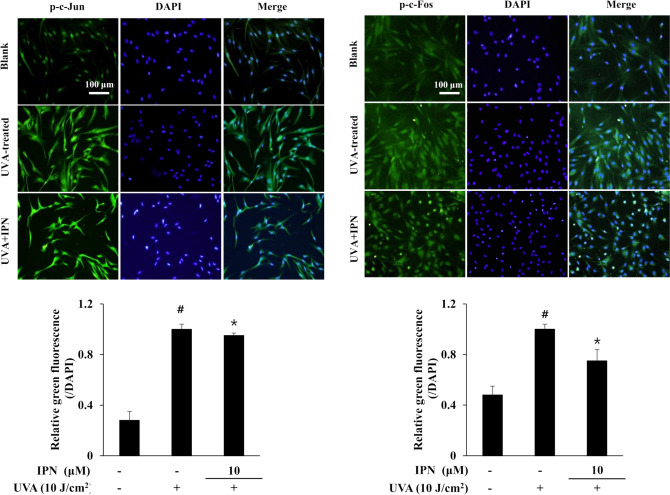
Effect of IPN (10 μM) on the levels of phosphorylated (p-) c-Fos and c-Jun in HDFs. Intracellular levels of p–c-Fos and p–c-Jun were stained with immunofluorescence staining (green) and the nuclei of HDFs were stained with DAPI (blue) as viable cell control. Relative green fluorescence was measured densiometrically and normalized against DAPI (blue) staining. #p < 0.05 vs. non-irradiated untreated group, and *p < 0.05 vs. UVA-irradiated untreated group

References

    1. Ahmed S, Khan H, Aschner M, Mirzae H, Küpeli Akkol E, and Capasso R. Anticancer potential of furanocoumarins: Mechanistic and therapeutic aspects. International Journal of Molecular Sciences. 21: 5622 (2020) - PMC - PubMed
    1. Ahn B-N, Kim J-A, Kong C-S, Seo Y, Kim S-K. Protective effect of (2′S)-columbianetin from Corydalis heterocarpa on UVB-induced keratinocyte damage. Journal of Photochemistry and Photobiology B: Biology. 109: 20-27 (2012) - PubMed
    1. Ansary TM, Hossain MR, Kamiya K, Komine M, Ohtsuki M. Inflammatory molecules associated with ultraviolet radiation-mediated skin aging. International Journal of Molecular Sciences. 22: 3974 (2021) - PMC - PubMed
    1. Battie C, Jitsukawa S, Bernerd F, Del Bino S, Marionnet C, Verschoore M. New insights in photoaging, UVA induced damage skin types. Experimental Dermatology. 23: 7-12 (2014) - PubMed
    1. Bhagavatheeswaran S, Ramachandran V, Shanmugam S, Balakrishnan A. Isopimpinellin extends antiangiogenic effect through overexpression of miR-15b-5p downregulating angiogenic stimulators. Molecular Biology Reports. 49: 279-291 (2022) - PubMed

LinkOut - more resources