. 2024 Oct 18:15:1486362.
doi: 10.3389/fphys.2024.1486362. eCollection 2024.

Molecular mechanism of GIRK2 channel gating modulated by cholesteryl hemisuccinate

Affiliations

Molecular mechanism of GIRK2 channel gating modulated by cholesteryl hemisuccinate

Meng Cui et al. Front Physiol. .

Abstract

Cholesterol, an essential lipid of cell membranes, regulates G protein-gated inwardly rectifying potassium (GIRK) channel activity. Previous studies have shown that cholesterol activates GIRK2 homotetrameric channels, which are expressed in dopaminergic neurons of the brain. Deletion of GIRK2 channels affects both GIRK2 homo- and heterotetrames and can lead to abnormal neuronal excitability, including conditions such as epilepsy and addiction. A 3.5 Å cryo-EM structure of GIRK2 in complex with CHS (cholesteryl hemisuccinate) and PIP2 (phosphatidylinositol 4,5-bisphosphate) has been solved. This structure provides the opportunity to study GIRK2 channel gating dynamics regulated by cholesterol using gating molecular dynamics (GMD) simulations. In the present study, we conducted microsecond-long GMD simulations on the GIRK2 channel in its APO, PIP2, and PIP2/CHS bound states, followed by systematic analysis to gain molecular insights into how CHS modulates GIRK2 channel gating. We found that CHS binding facilitates GIRK2 channel opening, with 43 K+ ion permeation events observed, compared to 0 and 2 K+ ion permeation events for GIRK2-APO and GIRK2/PIP2, respectively. Binding of CHS to the GIRK2 channel enhances PIP2 and channel interactions, which is consistent with previous experimental results. The negatively charged PIP2 alters the internal electrostatic potential field in the channel and lowers the negative free energy barrier for K+ ion permeation.

Keywords: GIRK channel; MD simulations; cholesterol; conformational changes; electrostatic potential; interaction network analysis; ion channel activation; protein-ligand interactions.


Conflict of interest statement

The authors declare that the research was conducted in the absence of any commercial or financial relationships that could be construed as a potential conflict of interest. The author(s) declared that they were an editorial board member of Frontiers, at the time of submission. This had no impact on the peer review process and the final decision.

Figures

FIGURE 1
FIGURE 1
MD simulation results on GIRK2-APO, GIRK2-PIP2 and GIRK-PIP2-CHS systems (A). GIRK2-PIP2: GIRK2 channel bound with 4 PIP2 molecules. (B). GIRK2-PIP2-CHS: GIRK2 channel bound with 4 PIP2 and 8 CHS molecules. (C). RMSD of Cα atoms of the GIRK2 channels for the three systems as function of simulation time (ns). (D). HBC gate residues’ distances as function of simulation time (ns). (E). Histogram of (D). (F). Residue F192 of the HBC gate in GIRK2-APO (262 ns). (G). Residue F192 of the HBC gate in GIRK2-PIP2-CHS (384 ns).
FIGURE 2
FIGURE 2
GIRK2 channel gating and K+ ion permeation during GMD simulations. (A). GIRK2-APO. (B). GIRK2/PIP2. (C). GIRK2/PIP2/CHS. Dish lines are gate distances of HBC (red) and G loop (blue) gates in the initial GIRK2 channel structure. Vertical solid lines are the time points for K+ ion permeation during the GMD simulations (0 ions for APO, 2 ions for GIRK2/PIP2, and 43 ions for GIRK2/PIP2/CHS). K+ ion permeation was defined as follows: an ion passing through the SF, HBC, and G loop gates from the extracellular to intracellular side along the direction of the electric field. The green lines are the cutoff distance (5.69 Å) for K+ ion permeation as shown by Li et al. (2019).
FIGURE 3
FIGURE 3
The dwell time of K+ ion in the GIRK2 channel. (A) Percentage of number of K+ ions in selectivity filter (SF) and HBC gate. Percentage of K+ dwell time per residue in the channel GIRK2/PIP2 (B), and GIRK2/PIP2/CHS (C).
FIGURE 4
FIGURE 4
The first eigenvector (EV1) and second eigenvector (EV2) from Combined Principal Component Analysis (PCA) of GIRK2-APO/GIRK2-PIP2-CHS based on the MD simulations (200–1,000 ns). The GIRK2 channel structures were shown as Cα traces (six frames colored from red to blue).
FIGURE 5
FIGURE 5
PIP2/CHS induced domain motions and backbone conformational changes on GIRK2 channel. (A). Domain and hinge motions identified by DynDom analysis based on PCA (EV1, the first and last frames). Bending residues (hinge, green) are G70-N71, and G189-S196. Domain 1 (cytosolic domain, blue) contains residues 57–70, and 196–380; Domain 2 (transmembrane domain, red) includes residues 71–195. (B). Backbone (phi/psi tortional angles) conformational changes between GIRK2-APO and GIRK2/PIP2/CHS during the MD simulations.
FIGURE 6
FIGURE 6
A heatmap plot of salt bridge pairs (Red: salt bridge formed; Blue: disrupted in GIRK2-APO system). Comparison of key salt bridge interactions between GIRK2-APO and GIRK2-PIP2-CHS based on MD simulations (200–1,000 ns). Selected salt bridge pairs are marked with arrows to show in the GIRK2 structure for Figure 7.
FIGURE 7
FIGURE 7
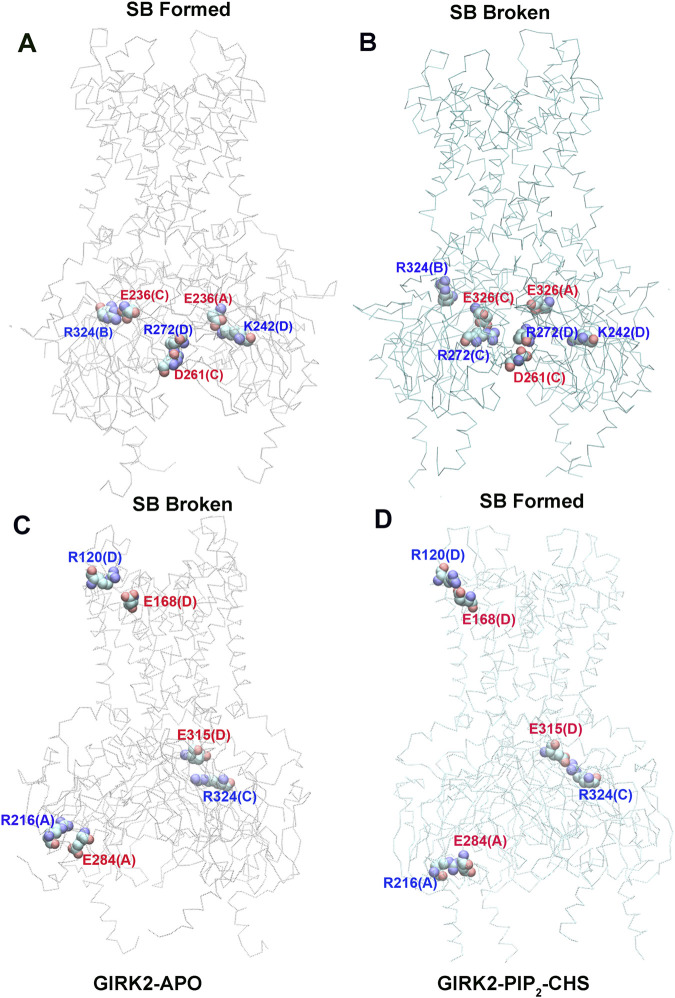
Selected key different salt bridge residues in GIRK-APO, and GIRK2-PIP2-CHS. (A). Salt bridge pairs, E236(C)-R324(B), R272(D)-D261(C), and E236(A)-K242(D) formed in GIRK2-APO; and (B). broken in GIRK2/PIP2/CHS. (C). Salt bridge pairs, R120(D)-E168(D), R216(A)-E284(A), and E315(D)-R324(C) broken in GIRK2-APO; (D). formed in GIRK2/PIP2/CHS. The last frame of GIRK2-APO and GIRK2/PIP2/CHS from 1µs MD simulations are used in this figure.
FIGURE 8
FIGURE 8
A heatmap plot of hydrogen bond pairs (Red: HB formed; Blue: HB disrupted in GIRK2-APO system). Comparison of key HB interactions between GIRK2-APO and GIRK2-PIP2-CHS based on MD simulations (200–1,000 ns). Selected HB pairs are marked with arrows to show in the GIRK2 structure for Figure 9.
FIGURE 9
FIGURE 9
Selected key different HB residues in GIRK-APO, and GIRK2-PIP2-CHS. (A). HB pairs, E152(D)-Q176(D), K194(A)-N94(A), E305(B)-S326(B) formed in GIRK2-APO; and (B). broken in GIRK2/PIP2/CHS. (C). HB pairs, D81(C)-T204(B), S326(C)-E305(C), E251(D)-T362(A), and E152(C)-Q176(C) broken in GIRK2-APO; (D). formed in GIRK2/PIP2/CHS. The last frame of GIRK2-APO and GIRK2/PIP2/CHS from 1µs MD simulations are used in this figure.
FIGURE 10
FIGURE 10
A heatmap plot of hydrophobic pairs (Red: HP formed; Blue: HP disrupted in GIRK2-APO system). Comparison of key HP interactions between GIRK2-APO and GIRK2-PIP2-CHS based on MD simulations (200–1,000 ns). Selected HP pairs are marked with arrows to show in the GIRK2 structure for Figure 11.
FIGURE 11
FIGURE 11
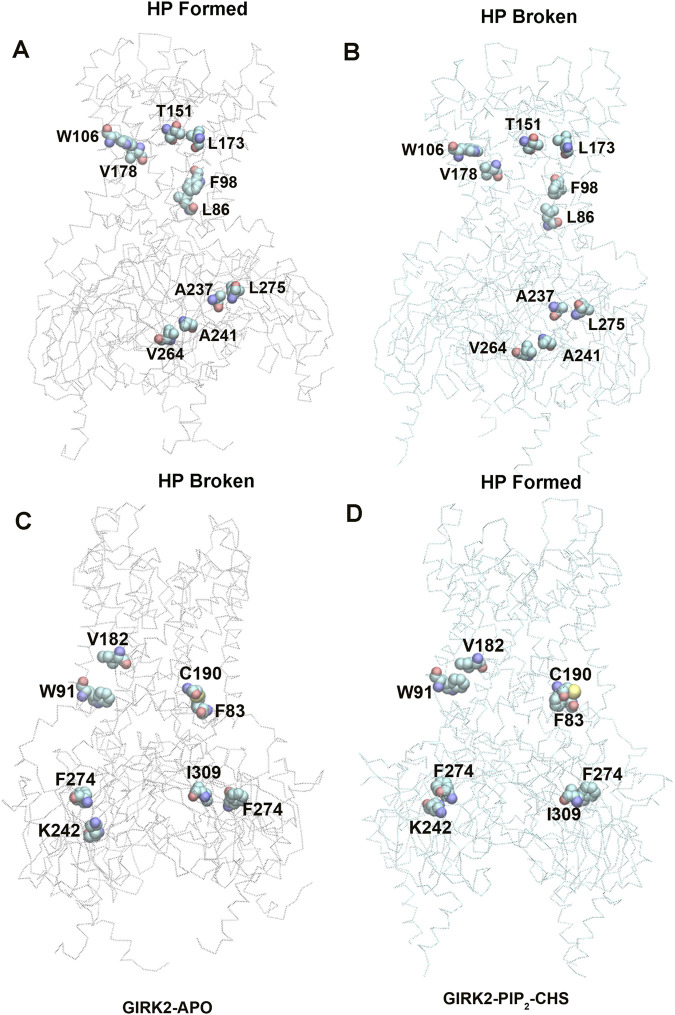
Selected key different HP residues in GIRK-APO, and GIRK2-PIP2-CHS. (A). HP pairs, W106-V178, T151-L173, F98-L86, A237-L275, and A241-V264 formed in GIRK2-APO; and (B). broken in GIRK2/PIP2/CHS. (C). HB pairs, V182-W91, C190-F83, F274-K242, and F274-I309 broken in GIRK2-APO; (D). formed in GIRK2/PIP2/CHS. The last frame of GIRK2-APO and GIRK2/PIP2/CHS from 1µs MD simulations are used in this figure.
FIGURE 12
FIGURE 12
A heatmap plot of residue correlation pairs (Red: positive correlation; Blue: negative correlation in GIRK2-APO system). Comparison of key residue correlations between GIRK2-APO and GIRK2-PIP2-CHS based on MD simulations (200–1,000 ns). Selected correlated residue pairs are marked with arrows to show in the GIRK2 structure for Figure 13.
FIGURE 13
FIGURE 13
Selected correlated residues in GIRK-APO, and GIRK2-PIP2-CHS. (A) correlated residue pairs, L146-L174, I112-T153 and G63-S325 positively correlated in GIRK2-APO; and (B) negatively correlated in GIRK2/PIP2/CHS. (C) correlated residue pairs, S148-F348, G70-T343, and Y78-T268 negatively correlated in GIRK2-APO; (D) positively correlated in GIRK2/PIP2/CHS. The first eigenvector (EV1) of GIRK2-APO and GIRK2/PIP2/CHS from MD simulations are used in this figure. Color coding (blue to red) on Cα atoms (balls) of selected residues shows a transition of the Cα atom movement in the EV1.
FIGURE 14
FIGURE 14
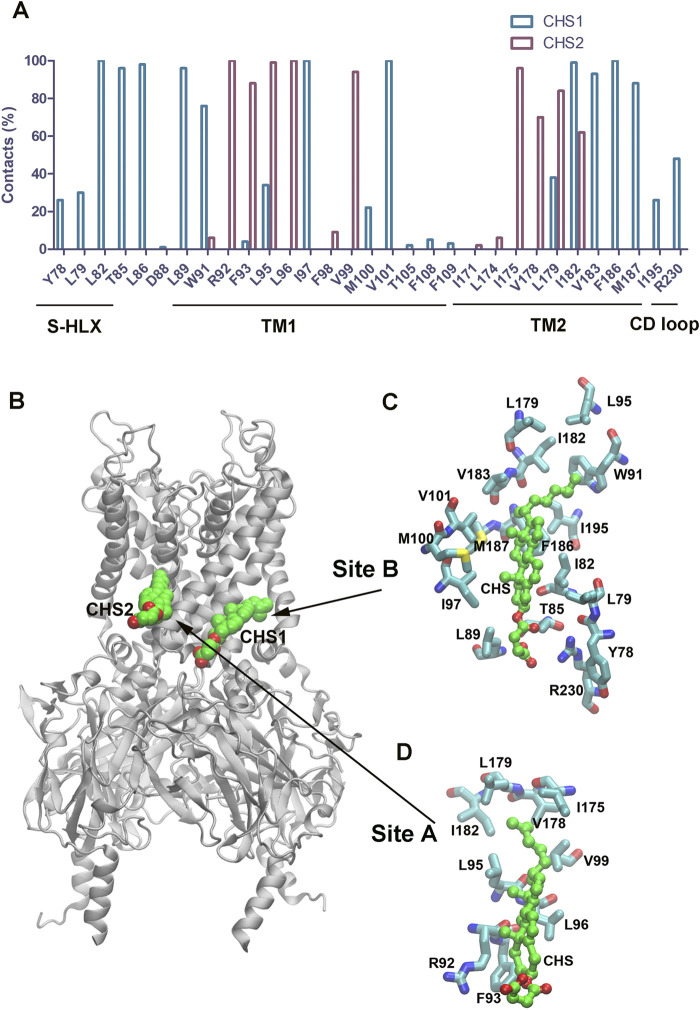
The binding site residues in GIRK2 interact with CHS. (A). Percentage contacts of the binding site residues in GIRK2 interactions with CHS during MD simulations (200–1,000 ns). (B). Binding sites for CHS1 and CHS2 in GIRK2. (C). Key CHS interacting residues in the CHS1 binding site B. (D). Key CHS interacting residues in the CHS2 binding site A. The snapshot was taken from the frame (265 ns) of the simulations.
FIGURE 15
FIGURE 15
The critical PIP2 interacting residues in the binding site of GIRK2 channel. Interaction energies for each residue were calculated using the MM-GBSA method of the Amber program. The interacting residues are colored blue for the GIRK2/PIP2 (Total interaction energy: −80.70 kcal/mol) and red for the GIRK2/PIP2/CHS (Total interaction energy: −98.97 kcal/mol) systems. Asterisks (*) denote significant changes seen in specific residue interactions with PIP2 in the conducting system induced by the presence of CHS (blue: reductions, red: increases).
FIGURE 16
FIGURE 16
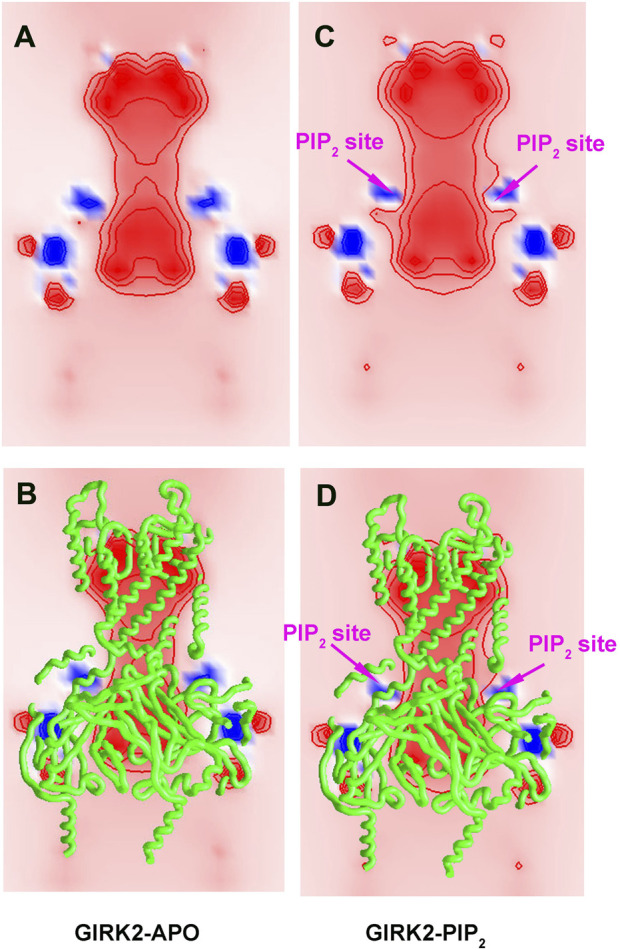
Electrostatic potential maps for GIRK2-APO and GIRK2-PIP2. A cross-section map of GIRK2-APO (A, B), and GIRK2/PIP2 (C, D) to show electrostatic potential distribution in the channel. The negative and positive electrostatic potential regions are colored by red and blue, respectively. The values of the electrostatic potential contours are ± 10, ± 20, and ± 40 kT/e, from outside to inside. The Grasp program was used for electrostatic potential calculations and figure generation.

References

    1. Amadei A., Ceruso M. A., Di Nola A. (1999). On the convergence of the conformational coordinates basis set obtained by the essential dynamics analysis of proteins' molecular dynamics simulations. Proteins 36 (4), 419–424. 10.1002/(sici)1097-0134(19990901)36:4<419::aid-prot5>3.0.co;2-u - DOI - PubMed
    1. Amadei A., Linssen A. B., Berendsen H. J. (1993). Essential dynamics of proteins. Proteins 17 (4), 412–425. 10.1002/prot.340170408 - DOI - PubMed
    1. Breneman C. M., Wiberg K. B. (1990). Determining atom-centered monopoles from molecular electrostatic potentials. The need for high sampling density in formamide conformational analysis. J. Comput. Chem. 11, 361–373. 10.1002/jcc.540110311 - DOI
    1. Case D. A., Cheatham T. E., Darden T., Gohlke H., Luo R., Merz K. M., et al. (2005). The Amber biomolecular simulation programs. J. Comput. Chem. 26 (16), 1668–1688. 10.1002/jcc.20290 - DOI - PMC - PubMed
    1. Ceruso M. A., Grottesi A., Di Nola A. (2003). Dynamic effects of mutations within two loops of cytochrome c551 from Pseudomonas aeruginosa . Proteins 50 (2), 222–229. 10.1002/prot.10269 - DOI - PubMed

LinkOut - more resources