Review
. 2024 Dec 10;332(22):1924-1935.
doi: 10.1001/jama.2024.19462.

CAR T Cells and T-Cell Therapies for Cancer: A Translational Science Review

Affiliations
Review

CAR T Cells and T-Cell Therapies for Cancer: A Translational Science Review

Jennifer N Brudno et al. JAMA. .

Abstract

Importance: Chimeric antigen receptor (CAR) T cells are T lymphocytes that are genetically engineered to express a synthetic receptor that recognizes a tumor cell surface antigen and causes the T cell to kill the tumor cell. CAR T treatments improve overall survival for patients with large B-cell lymphoma and progression-free survival for patients with multiple myeloma.

Observations: Six CAR T-cell products are approved by the US Food and Drug Administration (FDA) for 6 hematologic malignancies: B-cell acute lymphoblastic leukemia, large B-cell lymphoma, follicular lymphoma, mantle cell lymphoma, chronic lymphocytic leukemia, and multiple myeloma. Compared with standard chemotherapy followed by stem cell transplant, CAR T cells improved 4-year overall survival in patients with large B-cell lymphoma (54.6% vs 46.0%). Patients with pediatric acute lymphoblastic leukemia achieved durable remission after CAR T-cell therapy. At 3-year follow-up, 48% of patients were alive and relapse free. In people with multiple myeloma treated previously with 1 to 4 types of non-CAR T-cell therapy, CAR T-cell therapy prolonged treatment-free remissions compared with standard treatments (in 1 trial, CAR T-cell therapy was associated with progression-free survival of 13.3 months compared with 4.4 months with standard therapy). CAR T-cell therapy is associated with reversible acute toxicities, such as cytokine release syndrome in approximately 40% to 95% of patients, and neurologic disorders in approximately 15% to 65%. New CAR T-cell therapies in development aim to increase efficacy, decrease adverse effects, and treat other types of cancer. No CAR T-cell therapies are FDA approved for solid tumors, but recently, 2 other T lymphocyte-based treatments gained approvals: 1 for melanoma and 1 for synovial cell sarcoma. Additional cellular therapies have attained responses for certain solid tumors, including pediatric neuroblastoma, synovial cell sarcoma, melanoma, and human papillomavirus-associated cancers. A common adverse effect occurring with these T lymphocyte-based therapies is capillary leak syndrome, which is characterized by fluid retention, pulmonary edema, and kidney dysfunction.

Conclusions and relevance: CAR T-cell therapy is an FDA-approved therapy that has improved progression-free survival for multiple myeloma, improved overall survival for large B-cell lymphoma, and attained high rates of cancer remission for other hematologic malignancies such as acute lymphoblastic leukemia, follicular lymphoma, and mantle cell lymphoma. Recently approved T lymphocyte-based therapies demonstrated the potential for improved outcomes in solid tumor malignancies.


Figures
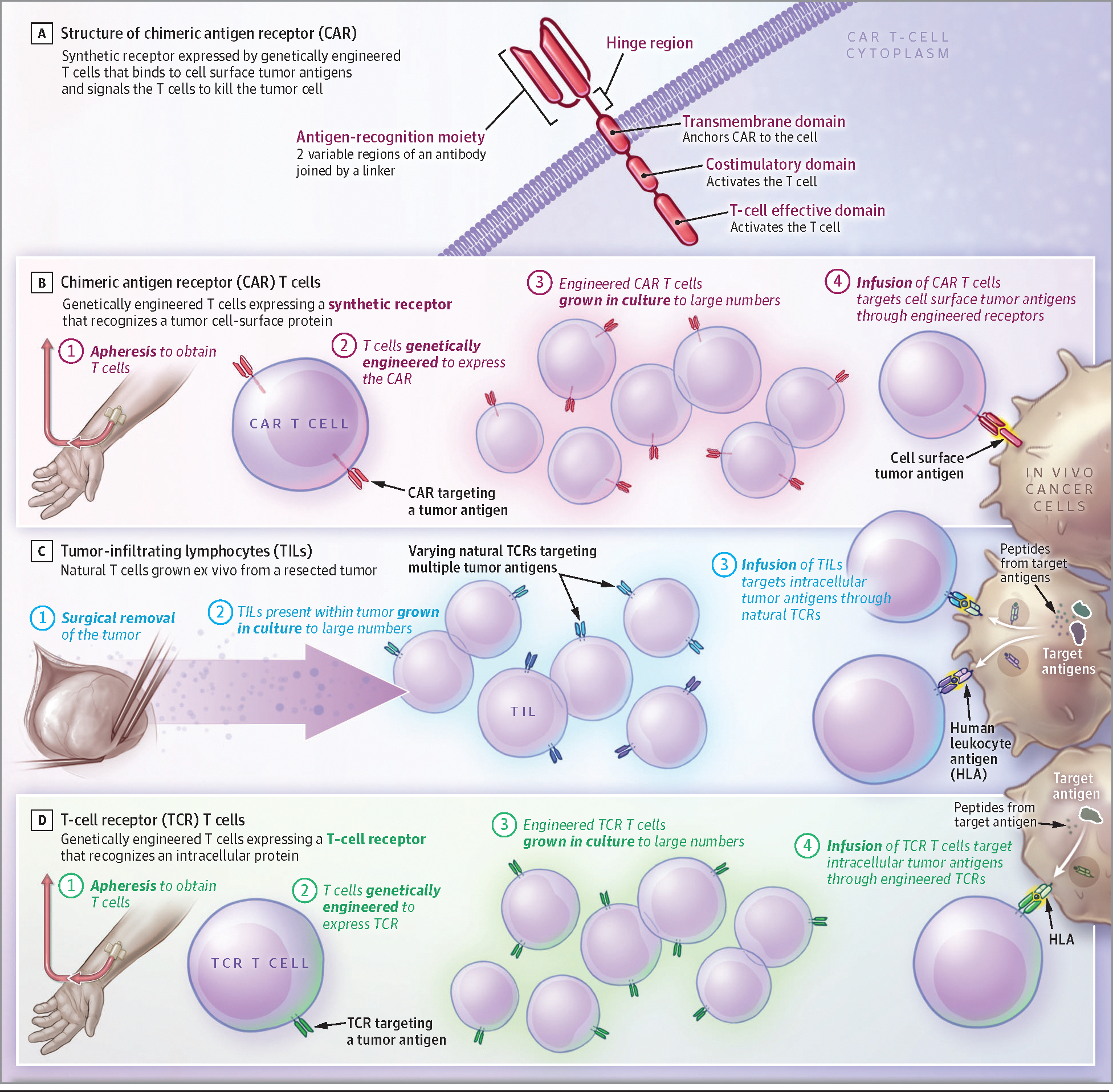
Figure.
Figure.. Schematic Diagram of a CAR and Different Types of T-Cell Therapies for Cancer
A, The structure of a CAR generally includes an extracellular antigen-recognition moiety, typically composed of the 2 variable regions (light and heavy chains) of a monoclonal antibody, connected by a linker. Hinge and transmembrane domains connect the antigen recognition moiety and intracellular components. The intracellular costimulatory domain, typically CD28 or 4–1BB, and a T-cell activation domain, typically CD3ζ, activate the T cell. B, CAR T cells are generated using the same type of gene-engineering processes as TCR T cells. Like TCR T cells, they possess defined antigen specificity and most commonly target a single antigen. CARs differ from TCRs in that they are single-chain chimeric proteins with the self-contained capability to bind target antigens and to activate T cells. Because of their antibody-like antigen recognition, CARs target cell surface antigens and generally cannot target intracellular antigens such as most oncoproteins, mutated gene products, and cancer germline antigens. However, CARs have the advantage that, unlike TCRs, their target recognition does not require a specific HLA molecule, which broadens the number of patients who can be treated with a given therapy. C, TILs are autologous T cells grown in a laboratory from a surgically resected fresh tumor specimen. The approach requires surgery to obtain a tumor specimen and generally requires several weeks to grow out cells for treatment. In contrast to CAR and TCR T cells, TILs are not genetically engineered to express an antigen receptor. TIL cell products are highly variable; they may target any number of tumor antigens or may not target any tumor antigens. The T cells in a TIL cell product engage tumor cells through their native TCRs, which bind to peptides complexed with HLA molecules. D, TCR T-cell therapies use T cells genetically engineered to express a TCR targeting a tumor-associated antigen. The T cells for genetic engineering are isolated from peripheral blood mononuclear cells obtained by an apheresis procedure, a method of removing T cells from blood. Genetic engineering may be accomplished using varied technologies, including viral vectors, transposons, or CRISPR-Cas9. TCR gene engineering involves the transfer of TCR α- and β-chains. These chains form a complex with endogenous CD3 molecules (γ, δ, ε, and ζ chains), which provide signaling function. Engineered TCR T cells are like TIL T cells in that they engage a target peptide-HLA complex through a TCR. The HLA molecule in the target complex must be matched to an HLA molecule in the patient’s haplotype (eg, if the therapeutic TCR targets a peptide presented by HLA-A*01:01, the patient must have the HLA-A*01:01 allele). TCR T cells are different from TIL T cells in that they possess defined specificity, generally for a single-target antigen.

Comment in

References

    1. Klebanoff CA, Khong HT, Antony PA, Palmer DC, Restifo NP. Sinks, suppressors and antigen presenters: how lymphodepletion enhances T cell-mediated tumor immunotherapy. Trends Immunol. 2005;26(2):111–117. doi:10.1016/j.it.2004.12.003 - DOI - PMC - PubMed
    1. Gattinoni L, Finkelstein SE, Klebanoff CA, et al. Removal of homeostatic cytokine sinks by lymphodepletion enhances the efficacy of adoptively transferred tumor-specific CD8+ T cells. J Exp Med. 2005;202(7):907–912. doi:10.1084/jem.20050732 - DOI - PMC - PubMed
    1. Maude SL, Laetsch TW, Buechner J, et al. Tisagenlecleucel in children and young adults with B-cell lymphoblastic leukemia. N Engl J Med. 2018;378(5):439–448. doi:10.1056/NEJMoa1709866 - DOI - PMC - PubMed
    1. Laetsch TW, Maude SL, Rives S, et al. Three-year update of tisagenlecleucel in pediatric and young adult patients with relapsed/refractory acute lymphoblastic leukemia in the ELIANA trial. J Clin Oncol. 2023;41(9):1664–1669. doi:10.1200/JCO.22.00642 - DOI - PMC - PubMed
    1. Schuster SJ, Bishop MR, Tam CS, et al.; JULIET Investigators. Tisagenlecleucel in adult relapsed or refractory diffuse large B-cell lymphoma. N Engl J Med. 2019;380(1):45–56. doi:10.1056/NEJMoa1804980 - DOI - PubMed

Publication types

MeSH terms

Substances
