. 2024 Nov 4;14(1):26691.
doi: 10.1038/s41598-024-77266-0.

A novel stent flow chamber system demonstrates reduced thrombogenicity of bioresorbable magnesium scaffolds

Affiliations

A novel stent flow chamber system demonstrates reduced thrombogenicity of bioresorbable magnesium scaffolds

Monja Müller et al. Sci Rep. .

Abstract

Coronary artery disease (CAD) is characterized by narrowing and subsequent blockade of coronary arteries, and imposes a significant health and economic burden. Stent and scaffold devices are introduced in advanced CAD to improve vascular stability and restore blood flow. Although in vitro flow systems like the Chandler loop have been developed to enhance the understanding of interactions between device materials, their coatings, and vascular cells, imaging-based in vitro analysis of device performance is limited. In this study, we established a novel stent flow chamber system designed to assess the thrombogenicity of bioresorbable magnesium scaffold (RMS) and stent materials in vitro. Additionally, we compared the thrombogenicity - an important clinical parameter in stent performance - of the Magmaris-316 L stainless steel stent with its predecessors, Magmaris RMS and a prototype of the third-generation RMS (DREAMS 3G). Analysis of platelet adhesion and coverage of the different devices under flow conditions demonstrated that the Magmaris RMS exhibits reduced thrombogenicity compared to the Magmaris-316 L stainless steel stent. Moreover, thrombogenicity of the DREAMS 3G prototype, composed of BIOmag material, is further decreased compared to its predecessors. The observed reduction in thrombogenicity of the DREAMS 3G prototype in vitro suggests additional improvements in clinical safety and efficacy, highlighting its promise for treating CAD. Future research on this prototype may thus open avenues for analyzing other blood components and patient-derived endothelial cells. In line with the 3R principles, this approach may also help reduce the need for animal testing.

Keywords: BIOmag; Bioresorbable magnesium scaffold; Coronary interventions; Freesolve RMS; Magmaris RMS; Platelets; Stent; Stent flow chamber; Thrombogenicity.


Conflict of interest statement

S.L. and P.BZ. are employees of Biotronik AG. M.F. reports a relationship with Biotronik AG/Cortronik GmbH that includes: consulting or advisory and funding of grants. M.M., L.L., M.C.M, H.E., K.A.R., S.A.H., M.B., R.K.M., and T.R. have no conflict of interest to disclose.

Figures
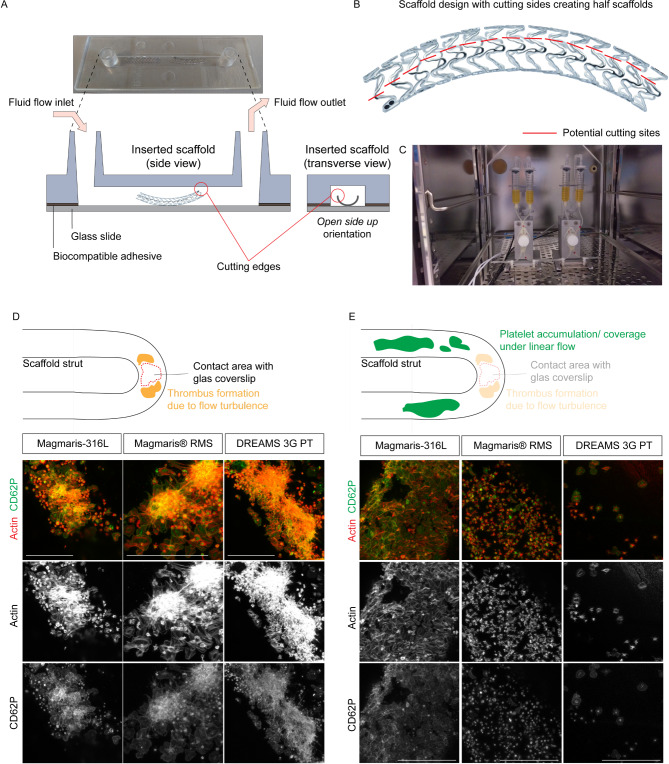
Figure 1
Figure 1
A novel in vitro flow chamber system to study thrombogenicity of scaffold material. (A) Schematic of scaffold embedding in side and front view. The open side up orientation of the half scaffold (with the cutting ends pointing upwards) in the channel slide was selected. (B) Cutting template of the stent and scaffold design to generate half stents and scaffolds using the indicated cutting edges. The stability of the scaffold is maintained via its connectors. (C) The scaffold embedded in the flow chamber is attached to the ibidi pump system, which is set up following manufacturer’s instructions. During the experiment fluidic units are placed inside a temperature-controlled CO2-incubator. (D) Micro-thrombotic events occurred at all scaffolds in the area of direct contact between the strut and glass coverslip. Individual flow experiments were conducted with PRP obtained from the same buffy coat for all scaffolds. Laminar shear stress of 10dyn/cm2 was applied for 2 h. Representative immunofluorescence of platelets attached to Magmaris-316 L, Magmaris and DREAMS 3G prototype (PT) scaffolds using an antibody against CD62P (green) and phalloidin (red, actin). Single channel images are depicted in grey. (E) Platelet accumulation and coverage of different scaffold materials can be reliably analyzed along the strut length under laminar flow. Individual flow experiments were conducted with PRP obtained from the same buffy coat for all scaffolds. Laminar shear stress of 10dyn/cm2 was applied for 2 h. Representative immunofluorescence of platelets attached to Magmaris-316 L, Magmaris and DREAMS 3G prototype scaffolds using an antibody against CD62P (green) and phalloidin (red, actin). Single channel images are depicted in grey. Scale bars: 50 μm (D, E).
Figure 2
Figure 2
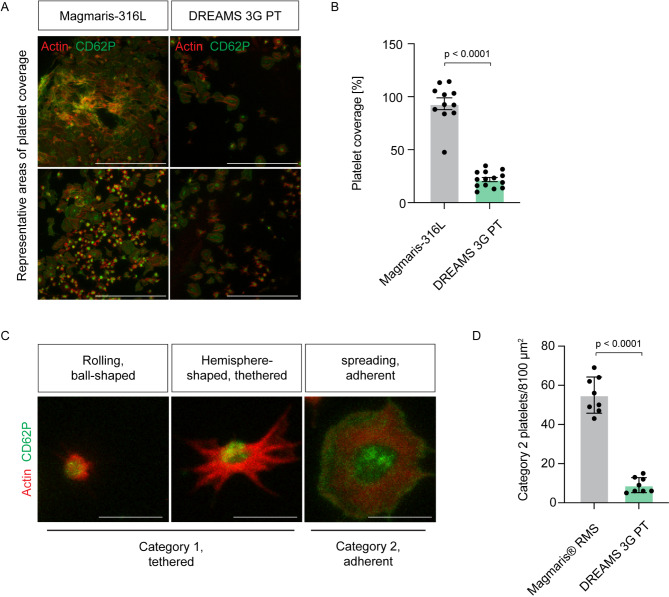
Thrombogenicity of the DREAMS 3G prototype made from BIOmag material is significantly diminished. (A) Individual flow experiments were conducted with PRP obtained from the same buffy coat for all scaffolds. Laminar shear stress of 10dyn/cm2 was applied for 2 h. Representative immunofluorescence of platelets attached to Magmaris-316 L and DREAMS 3G prototype (PT) scaffolds using an antibody against CD62P (green) and phalloidin (red, actin). (B) Quantification of platelet coverage (n = 3–6 images per scaffold from three independent experiments). Data represent mean ± s.e.m. p value, Two-tailed unpaired Student’s t-test. (C) Representative immunofluorescence of platelets attached to scaffold material in a reversible manner (category 1: rolling, ball-shaped and hemisphere-shaped) and in an irreversible manner (category 2: spreading platelet). (D) Irreversible platelet adhesion to the DREAMS 3G prototype scaffold is significantly diminished. Individual flow experiments were conducted with PRP obtained from the same buffy coat for all scaffolds. Laminar shear stress of 10dyn/cm2 was applied for 2 h. Quantification of irreversibly attached platelets (category 2) (n = 4 images per scaffold from two independent experiments). Data represent mean ± s.e.m. p value, Two-tailed unpaired Student’s t-test. Scale bars: 50 μm (A), 5 μm (C).

References

    1. Organization, W. H. Cardiovascular diseases (CVDs). (2021).
    1. Scafa Udriște, A., Niculescu, A. G., Grumezescu, A. M. & Bădilă, E. Cardiovascular Stents: A Review of Past, Current, and Emerging Devices. Materials (Basel) 14. (2021). 10.3390/ma14102498 - PMC - PubMed
    1. Filipovic, N. et al. In vitro and in silico testing of partially and fully bioresorbable vascular scaffold. J. Biomech.115, 110158. 10.1016/j.jbiomech.2020.110158 (2021). - DOI - PubMed
    1. Abbasnezhad, N., Zirak, N., Champmartin, S., Shirinbayan, M. & Bakir, F. An Overview of In Vitro Drug Release Methods for Drug-Eluting Stents. Polymers (Basel) 14. (2022). 10.3390/polym14132751 - PMC - PubMed
    1. Link, A. et al. In vitro investigation of an intracranial flow diverter with a fibrin-based, hemostasis mimicking, nanocoating. Biomed. Mater.16, 015026. 10.1088/1748-605X/abc8d3 (2020). - DOI - PubMed

LinkOut - more resources