


The role of femoral head size in metal-on-metal hip arthroplasty: analysis of a cohort of 3813 patients with long term follow-up
- PMID: 39496883
- PMCID: PMC11582203
- DOI: 10.1007/s00402-024-05567-0
The role of femoral head size in metal-on-metal hip arthroplasty: analysis of a cohort of 3813 patients with long term follow-up
Abstract
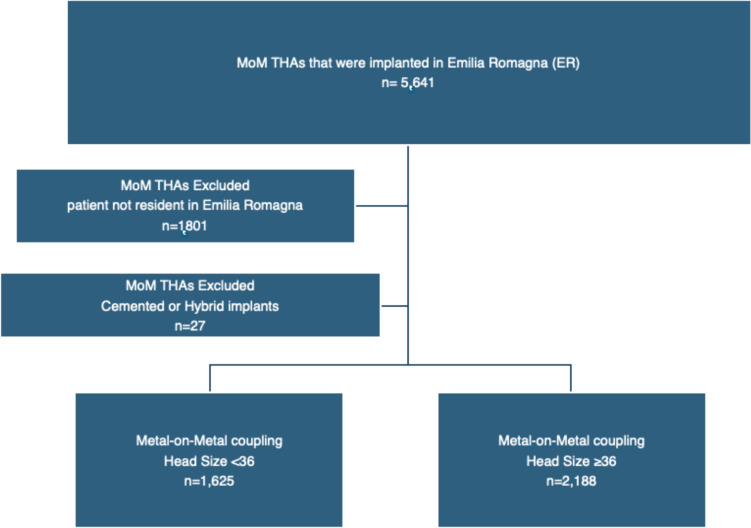
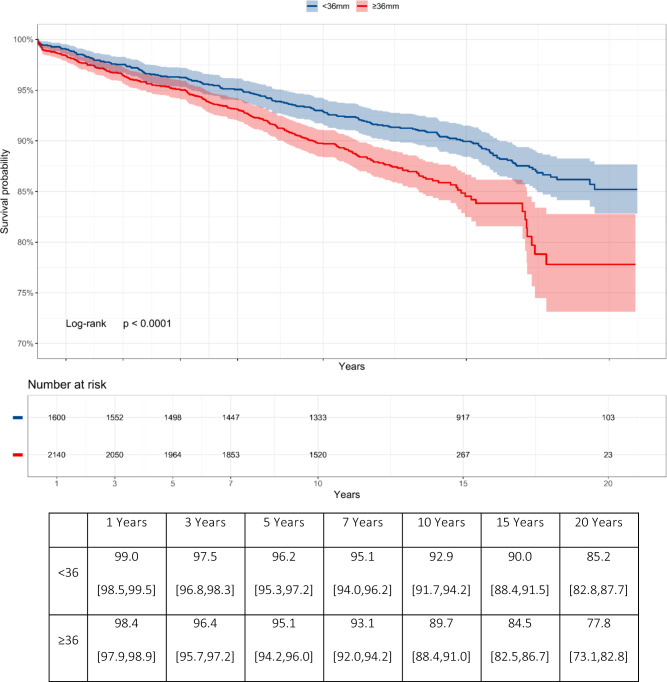
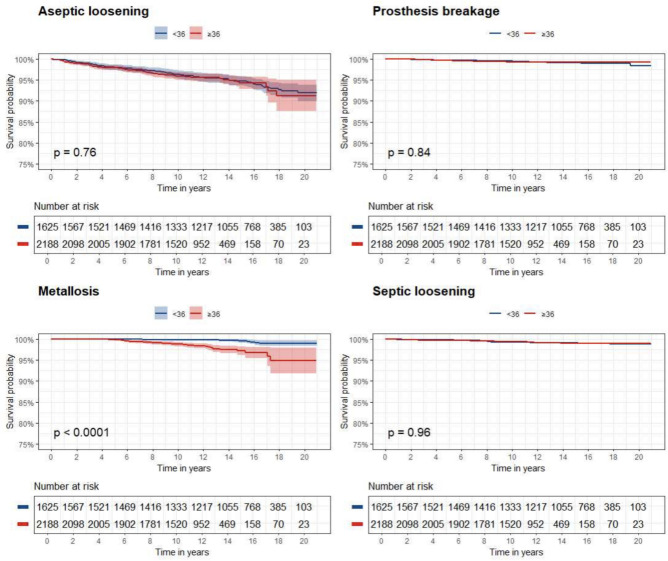
Metal-on-metal (MoM) large headed arthroplasties were suggested to decrease failure rates by means of reduced volumetric wear and enhanced implant stability. However, they caused high rates of revisions due to adverse reaction to metal debris, osteolysis, pseudotumor growth, and other issues. The study aims to present the long-term outcomes of MoM arthroplasties on a large cohort of patients, evaluating the impact of head sizes on survival rate. All data were retrieved from the regional joint register (Registro dell'Implantologia Protesica Ortopedica, RIPO, Italy). We include in the study all patient who underwent cementless MoM total hip arthroplasties (THAs) between 2000 and 2020, dividing them in two subgroups according to head size (<36 mm, ≥36 mm). Failures were recorded up to December 31, 2020. Patients lost to follow-up were excluded. A total of 3813 THAs met the inclusion/exclusion criteria. The average follow-up period is 12.4 years (0-21 years). 178/1625 (or 11.0%) small head MoM THAs and 265/2188 large head ones failed by the end of follow up. Large diameter heads reported lower survival rate (p-value < 0.001), with unexpected higher dislocation rate (1.0 vs. 0.4%). Moreover, large head size was found to increases the risk of metallosis (p-value < 0.0001). Gender, patient's age and the use of modular neck were not correlated with higher failure rates. MoM implants implants do not have the same reliability as other couplings, considering the significantly greater failure/complication rates. However, the knowledge of risks linked to head size is fundamental for establishing the right type of follow-up to the patient and recognize any complications early.
Keywords: Arthroplasty registry; Head size; Long term follow-up; Metal-on-metal; Total hip arthroplasty.
© 2024. The Author(s).
Conflict of interest statement
Declarations. Conflict of interest: The authors declare no conflict of interest.
Figures
References
-
- Learmonth ID, Young C, Rorabeck C (2007) The operation of the century: total hip replacement. Lancet Lond Engl 370:1508–1519. 10.1016/S0140-6736(07)60457-7 - PubMed
-
- Deutman R, Mulder TJ, Brian R, Nater JP (1977) Metal sensitivity before and after total hip arthroplasty. J Bone Joint Surg Am 59:862–865 - PubMed
-
- MacDonald SJ, McCalden RW, Chess DG, Bourne RB, Rorabeck CH, Cleland D, Leung F (2003) Metal-on-metal versus polyethylene in hip arthroplasty: a randomized clinical trial. Clin Orthop 406:282–296. 10.1097/01.blo.0000043066.62337.9d - PubMed
-
- Latteier MJ, Berend KR, Lombardi AV, Ajluni AF, Seng BE, Adams JB (2011) Gender is a significant factor for failure of metal-on-metal total hip arthroplasty. J Arthroplasty 26:19–23. 10.1016/j.arth.2011.04.012 - PubMed
MeSH terms
LinkOut - more resources
Full Text Sources
Medical
Miscellaneous
