. 2025 Oct;43(10):1624-1627.
doi: 10.1038/s41587-024-02460-4. Epub 2024 Nov 4.

Site-specific drug release of monomethyl fumarate to treat oxidative stress disorders

Affiliations

Site-specific drug release of monomethyl fumarate to treat oxidative stress disorders

Thomas D Avery et al. Nat Biotechnol. 2025 Oct.

Abstract

Treatment of diseases of oxidative stress through activation of the antioxidant nuclear factor E2-related factor 2 (NRF2) is limited by systemic side effects. We chemically functionalize the NRF2 activator monomethyl fumarate to require Baeyer-Villiger oxidation for release of the active drug at sites of oxidative stress. This prodrug reverses chronic pain in mice with reduced side effects and could be applied to other disorders of oxidative stress.


Conflict of interest statement

Competing interests: T.D.A., J.L., D.J.L.T., A.D.A. and P.M.G. are named inventors on patent application WO/2021/179049 and provisional patent application 63/641,731 covering peroxide-activated prodrugs to treat disorders of oxidative stress. T.D.A, A.D.A. and P.M.G. received funding from Biogen. T.D.A., D.J.L.T., A.D.A. and P.M.G. founded and/or hold equity in ImmunoLogic, a start-up company that is developing pathology-activated prodrugs to treat diseases of oxidative stress. The other authors declare no competing interests.

Figures
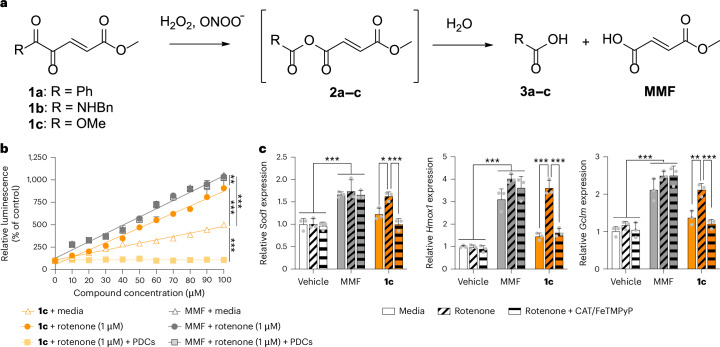
Fig. 1
Fig. 1. Pathological peroxides are required for compound 1c to activate NRF2 in vitro.
a, 1,2-Dicarbonyl prodrugs of MMF and their reaction with hydrogen peroxide and peroxynitrite. b, Compound 1c increased NRF2 reporter activity when peroxides were endogenously induced in vitro by mitochondrial complex I inhibitor rotenone and was blocked by PDCs. MMF had nonspecific action (n = 3 per group). Extra sum-of-squares F-tests: **P = 0.011 and ***P < 0.001. c, Compound 1c (30 μM) increased NRF2 target gene expression in the presence of rotenone and was blocked by PDCs. MMF had nonspecific action (n = 3 per group). Two-way ANOVA with Tukey’s post hoc tests: Sod1, *P = 0.036 and ***P < 0.001; Hmox1, ***P < 0.001; Gclm, **P = 0.003 and ***P < 0.001. All data are the mean ± s.d.; individual replicates are presented as gray dots.
Fig. 2
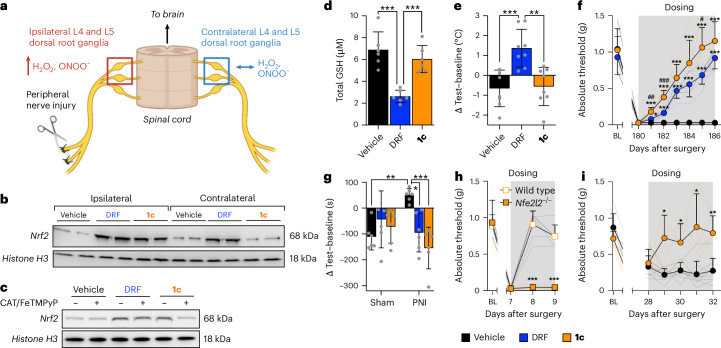
Fig. 2. Compound 1c preferentially activates NRF2 at sites of oxidative stress and relieves chronic pain in vivo.
a, Schematic of PNI and tissues of interest. b, Compound 1c preferentially increased NRF2 nuclear translocation in ipsilateral L4 and L5 DRG, in contrast to DRF (DRG from three mice pooled per sample). c, PDCs abolished NRF2 nuclear translocation induced by 1c in ipsilateral L4 and L5 DRG (DRG from two mice pooled per sample). d, In contrast to DRF, 1c did not reduce plasma glutathione levels (n = 3 mice per sex per group). One-way ANOVA with Tukey’s post hoc test: ***P < 0.001. e, In contrast to DRF, 1c did not increase skin temperature (n = 4 mice per sex per group). One-way ANOVA with Tukey’s post hoc test: **P = 0.002 and ***P < 0.001. f, Oral 1c and DRF reversed punctate allodynia 6 months after nerve injury (n = 4 mice per sex per group). Repeated-measures two-way ANOVA with Tukey’s post hoc tests: relative to vehicle, *P = 0.029 and ***P < 0.001; 1c versus DRF, #P = 0.012, ##P = 0.003 and ###P < 0.001. BL, baseline. g, Oral 1c and DRF reversed ongoing pain in the conditioned place preference assay (n = 3 mice per sex per group). Two-way ANOVA with Tukey’s post hoc test: *P = 0.018, **P = 0.007 and ***P < 0.001. h, Oral treatment with 1c did not reverse punctate allodynia in nerve-injured Nfe2l2−/− mice compared to wild-type controls (n = 4 mice per sex per group). Repeated-measures two-way ANOVA with Tukey’s post hoc test: ***P < 0.001. i, Oral 1c attenuated punctate allodynia in a model of osteoarthritis (n = 4 mice per sex per group). Repeated-measures two-way ANOVA with Šídák’s post hoc test: *P < 0.05 and **P = 0.002. Compound 1c and DRF were orally dosed at 350 μmol kg−1 day−1, represented by gray boxes. Data are the mean ± s.d. Individual replicates are presented as spaghetti plots or gray dots. Source data
Extended Data Fig. 1
Extended Data Fig. 1. Compound 1c preferentially activated NRF2 in vitro in the presence of pathological levels of exogenous peroxides.
(a) Compound 1c (10-100 μM) enhanced NRF2 activity in the presence of hydrogen peroxide and peroxynitrite, at levels comparable to monomethyl fumarate (MMF). N = 3/group. Extra sum-of-squares F tests, not significant (n.s.), ***P < 0.001. Data are mean ± s.d. (b) In contrast to MMF (30 μM), compound 1c (30 μM) preferentially increased NRF2 target gene expression in the presence of pathological peroxide concentrations. N = 3/group. Two-way ANOVA with Tukey’s post hoc tests, **P < 0.01, ***P < 0.001. Data are mean ± s.d. (c-d) Compound 1c (10-100 μM) increased NRF2 activity in the presence of pathological, but not physiological concentrations of (c) hydrogen peroxide (H2O2), (d) or peroxynitrite (ONOO) in vitro. N = 3/group. Extra sum-of-squares F tests, not significant (n.s.), ***P < 0.001. Data are mean ± SD. (e) NRF2 activity induced by 1c per se is blocked by peroxide decomposition catalysts. N = 3/group. Extra sum-of-squares F test, ***P < 0.001. Data are mean ± s.d.
Extended Data Fig. 2
Extended Data Fig. 2. Hydrogen peroxide triggered monomethyl fumarate (MMF) release from compound 1c.
(a) Compound 1c (500 µM) was activated by 1.1 or 5 molar equivalents but not 0.01 molar equivalents of hydrogen peroxide (H2O2). Stacked HPLC traces of authentic samples of 1c and MMF, compared with reactions of 1c with H2O2 after 40 and 130 minutes in water. (b) Schematic of compound 1c reactivity in aqueous solutions and with H2O2. Compound 1c formed an equilibrium between the keto and hydrate forms in water and hydrolysed in pH 7.4 phosphate buffer to compound 1d, which also formed an equilibrium between the keto and hydrate forms. The keto forms of compounds 1d and 1c can undergo Baeyer-Villiger oxidation with H2O2 to release MMF. The hydrate forms of compounds 1d and 1c lack the 1,2-dicarbonyl moiety to react with H2O2. (c) Excerpt of the alkene region from 1H NMR spectra of MMF in pH 7.4 phosphate buffer, 1c in water and 1c in pH 7.4 phosphate buffer. MMF appeared as a single species, whilst 1c was present in the keto and hydrate forms in water. In pH 7.4 phosphate buffer, 1c (present in the keto and hydrate forms) hydrolysed to α-ketoester 1d, also in the keto and hydrate forms. (d) Excerpts of the alkene region and the 2,2-dimethyl-2-silapentane-5-sulfonate sodium salt (DSS)-d6 peak from 1H NMR spectra showing the reactivity of compound 1c with H2O2 in pH 7.4 phosphate buffer. Compound 1c is converted cleanly and completely to MMF by 2 molar equivalents of H2O2 after 86.1 minutes. The presence of only MMF and 1c in the hydrate form suggests H2O2 reacts rapidly with the keto form of 1c upon conversion from the hydrate form, releasing MMF. 1H NMR spectra taken with an internal reference of 10 mM DSS-d6.
Extended Data Fig. 3
Extended Data Fig. 3. α-Ketoacid glutathione S-conjugate 4d is the major circulating species after oral 1c administration.
(a) Proposed metabolic profile of α-ketoester 1c. (b) Plasma concentrations of metabolites after a single oral dose of 1c (350 μmol/kg). N = 6 male rats. No data point shown if metabolite was not detected at the specific time. Data are mean ± s.d. Raw data in Supplementary Data Table 1.
Extended Data Fig. 4
Extended Data Fig. 4. Compound 1c preferentially activates NRF2 at sites of oxidative stress in vivo.
(a) In contrast to diroximel fumarate (DRF), 1c preferentially increased NRF2 target gene expression in L4/5 dorsal root ganglia (DRG) ipsilateral to peripheral nerve injury. Compound 1c and DRF were orally dosed at 350 μmol/kg/day. N = 3 mice/sex/group. Two-way ANOVA with Tukey’s post hoc tests, *P < 0.05, **P < 0.01, ***P < 0.001. Data are mean ± s.d. Individual replicates presented in grey dots. (b) Co-administration of catalase and FeTMPyP prevented expression of genes encoding antioxidants induced by 1c in L4/5 DRG ipsilateral to peripheral nerve injury. Compound 1c and DRF were orally dosed at 350 μmol/kg/day. N = 3 mice/sex/group. Unpaired, two-tailed T tests, **P < 0.01, ***P < 0.001. Data are mean ± s.d. Individual replicates presented in grey dots. (c) Glutathione S-conjugate 4d preferentially increased NRF2 nuclear translocation in ipsilateral L4/5 DRG, in contrast to monomethyl fumarate (MMF). Compound 4d and MMF were intravenously dosed at 190 μmol/kg/day. DRG from 2 mice pooled/sample; n = 2 samples/sex/group. Two-way ANOVA and Tukey’s post hoc test. *P < 0.05, **P < 0.01. (d) In contrast to DRF, 1c did not increase NRF2 nuclear translocation in heart, lung, liver, or kidney. Compound 1c and DRF were orally dosed at 350 μmol/kg/day. Ν=3 mice/sex/group. One-way ANOVA with Tukey’s post hoc tests, ***P < 0.001. Data are mean ± s.d. Individual replicates presented in grey dots. Source data
Extended Data Fig. 5
Extended Data Fig. 5. Compound 1c relieves chronic pain in vivo.
(a) Oral 1c and diroximel fumarate (DRF) reversed dynamic allodynia 6 months after peripheral nerve injury. Compound 1c and DRF were orally dosed at 350 μmol/kg/day, represented by grey boxes. N = 4 mice/sex/group. Friedman with Dunn post hoc test, relative to 1c day 180: §§§P < 0.001; relative to DRF day 180: P < 0.05, ††P < 0.01, †††P < 0.001. Data are median ± range. (b) Oral 1c and DRF reversed cold allodynia 6 months after peripheral nerve injury. Compound 1c and DRF were orally dosed at 350 μmol/kg/day, represented by grey boxes. N = 4 mice/sex/group. Repeated measures two-way ANOVA with Tukey’s post hoc tests, relative to vehicle: *P < 0.05, **P < 0.01, ***P < 0.001; 1c vs. DRF: #P < 0.05, ##P < 0.01, ###P < 0.001. Data are mean ± s.d. Individual replicates presented in spaghetti plots. (c) Compound 1c did not alter punctate allodynia in sham-operated animals after three days of treatment (unpaired, two-tailed t test). Compound 1c dose-dependently reversed punctate allodynia induced by peripheral nerve injury (PNI) (one-way ANOVA with Dunnett’s post hoc test). Relative to vehicle (0 μmol/kg): ***P < 0.001. Anti-allodynic effects of DRF are shown after equimolar treatment. N = 3 mice/sex/group. Data are mean ± s.d. (d) Compound 1c did not alter dynamic allodynia in sham-operated animals after three days of treatment (two-tailed Mann-Whitney test). Compound 1c dose-dependently reversed dynamic allodynia induced by peripheral nerve injury (Kruskal Wallis with Dunn’s post hoc test). Relative to vehicle (0 μmol/kg): *P < 0.05, ***P < 0.001. Anti-allodynic effects of DRF are shown after equimolar treatment. N = 3 mice/sex/group. Data are median ± range. (e) Five-day treatment with oral 1c (350 μmol/kg/day) did not result in loss of anti-allodynic efficacy after peripheral nerve injury, compared to subcutaneous morphine (3 mg/kg b.i.d.). N = 3 mice/sex/group. One-way ANOVA with Dunnett’s post hoc tests. Relative to 1c at day 0 (D0, prior to surgery): **P < 0.01, ***P < 0.001; relative to morphine D0: #P < 0.05, ###P < 0.001. Data are mean ± s.d. (f-g) There were no genotype differences in the effects of morphine (5 mg/kg, s.c.) on (f) punctate (repeated measures three-way ANOVA with Šídák’s post hoc test) or (g) dynamic allodynia (two-tailed Mann-Whitney test). N = 4 mice/sex/group. Relative to vehicle: ***P < 0.001. Data are mean ± s.d. for punctate allodynia and median ± range for dynamic allodynia. (h) Glutathione S-conjugate 4d and monomethyl fumarate (MMF) reversed punctate allodynia after peripheral nerve injury. Compound 4d and MMF were intravenously dosed at 190 μmol/kg/day. N = 4 mice/sex/group. Repeated measures two-way ANOVA with Tukey’s post hoc tests, relative to vehicle: ***P < 0.001. (i-j) Oral 1c attenuated (i) punctate allodynia and (j) numbness after two cycles of cisplatin (hatched boxes) were complete. Compound 1c was orally dosed at 350 μmol/kg/day, represented by grey box. N = 4 mice/sex/group. Repeated measures two-way ANOVA with Tukey’s post hoc test, or unpaired two-tailed t test. *P < 0.05, ***P < 0.001. Data are mean ± s.d. Individual replicates presented in grey dots. (k) Oral 1c attenuated punctate allodynia in mice chronically fed a high fat diet. Compound 1c was orally dosed at 225 μmol/kg/day, represented by grey box. N = 4 mice/sex/group. Repeated measures two-way ANOVA with Tukey’s post hoc test. *P < 0.05, ***P < 0.001. Data are mean ± s.d.

References

    1. GBD Diseases and Injuries Collaborators. Global burden of 369 diseases and injuries in 204 countries and territories, 1990–2019: a systematic analysis for the Global Burden of Disease Study 2019. Lancet396, 1204–1222 (2020). - PMC - PubMed
    1. Dodson, M. et al. Modulating NRF2 in disease: timing is everything. Annu. Rev. Pharmacol. Toxicol.59, 555–575 (2019). - PMC - PubMed
    1. Cuadrado, A. et al. Therapeutic targeting of the NRF2 and KEAP1 partnership in chronic diseases. Nat. Rev. Drug Discov.18, 295–317 (2019). - PubMed
    1. Forman, H. J. & Zhang, H. Targeting oxidative stress in disease: promise and limitations of antioxidant therapy. Nat. Rev. Drug Discov.20, 689–709 (2021). - PMC - PubMed
    1. Hoogendoorn, A. et al. Emerging therapeutic applications for fumarates. Trends Pharmacol. Sci.42, 239–254 (2021). - PMC - PubMed

LinkOut - more resources