


Association between lipid accumulation products and stress urinary incontinence: a cross-sectional study from NHANES 2005 to 2018
- PMID: 39497148
- PMCID: PMC11533302
- DOI: 10.1186/s12944-024-02350-3
Association between lipid accumulation products and stress urinary incontinence: a cross-sectional study from NHANES 2005 to 2018
Abstract
Background: Stress urinary incontinence (SUI), a common disorder of the pelvic floor, often results in anxiety, poor quality of life, and psychological issues among its sufferers. The relationship between lipid accumulation products (LAP) and stress-related urine incontinence remains unclear. This research aimed to investigate any possible correlation between the risk of SUI and the level of lipid accumulation products.
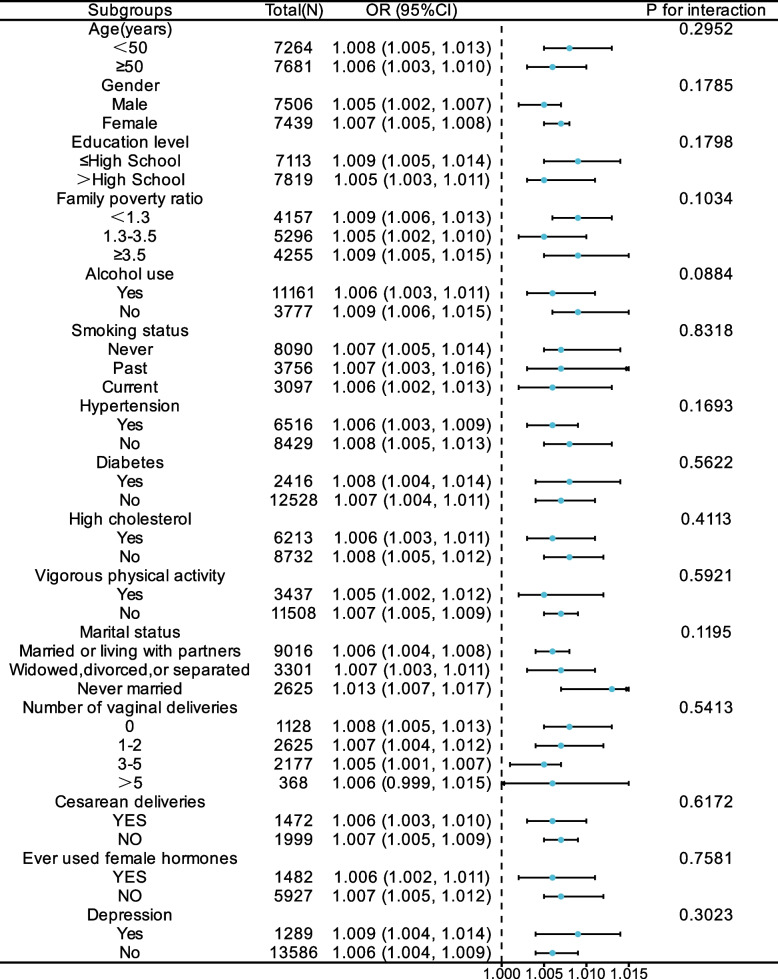
Methods: For this cross-sectional research, people with SUI who were 20 years of age or older were recruited using information from the National Health and Nutrition Examination Survey (NHANES) from 2005 to 2018. A weighted multivariate logistic regression model was used to evaluate the findings. As a potential biomarker, lipid accumulation product levels were sorted among individuals in ascending order and subjected to a trend test (P for trend). Additionally, a nonlinear analysis was conducted using smooth curve-fitting methods. Lipid accumulation products' effectiveness in predicting SUI was evaluated using receiver operating characteristic (ROC) curves. Finally, a subgroup analysis was performed to confirm that the connection between SUI and lipid accumulation products was consistent across all demographic groups.
Results: A thorough survey performed on 14,945 participants indicated that 23.61% of the respondents had SUI. A noteworthy association was observed between higher lipid accumulation product values and a greater probability of SUI in multivariate logistic regression analysis. Specifically, the stratification of lipid accumulation products into quartiles demonstrated a substantial positive correlation between the upper and lower quartiles, as evidenced by an elevated odds ratio for SUI (OR = 1.92; 95%CI 1.51-2.44; P < 0.0001). The subgroup analysis supported link consistency across all cohorts under investigation. Finally, the ROC curve indicated that lipid accumulation products (AUC = 0.67, 95%CI 0.654-0.690) had a superior predictive effect on the likelihood of SUI.
Conclusions: Increased lipid accumulation product values are associated with a higher chance of SUI in adult participants. This suggests that lipid accumulation products could be a valuable marker for detecting SUI, offering new perspectives for its evaluation and treatment.
Keywords: Abdominal pressure; Lipid accumulation products; Obesity; Stress urinary incontinence.
© 2024. The Author(s).
Conflict of interest statement
The authors declare no competing interests.
Figures



References
-
- Chow PM, Chuang YC, Hsu KCP, Shen YC, Liu SP. Impact of female stress urinary incontinence on quality of life, mental health, work limitation, and healthcare seeking in China, Taiwan, and South Korea (LUTS Asia): results from a cross-sectional, population-based study. Int J Womens Health. 2022;14:1871–80. - DOI - PMC - PubMed
MeSH terms
Substances
LinkOut - more resources
Full Text Sources
Medical
Research Materials
