


Impact of Overweight on Renal Prognosis in Malignant Hypertension Patients With Thrombotic Microangiopathy
- PMID: 39498977
- PMCID: PMC11632844
- DOI: 10.1002/jcla.25118
Impact of Overweight on Renal Prognosis in Malignant Hypertension Patients With Thrombotic Microangiopathy
Abstract
Objective: Overweight and obesity is a risk factor for hypertension. Malignant hypertension (MHT) is the most severe form of hypertension, and thrombotic microangiopathy (TMA), one of its complications, has been linked to significant renal outcomes. However, the impact of overweight and obesity on renal prognosis in MHT patients with TMA is not well understood.
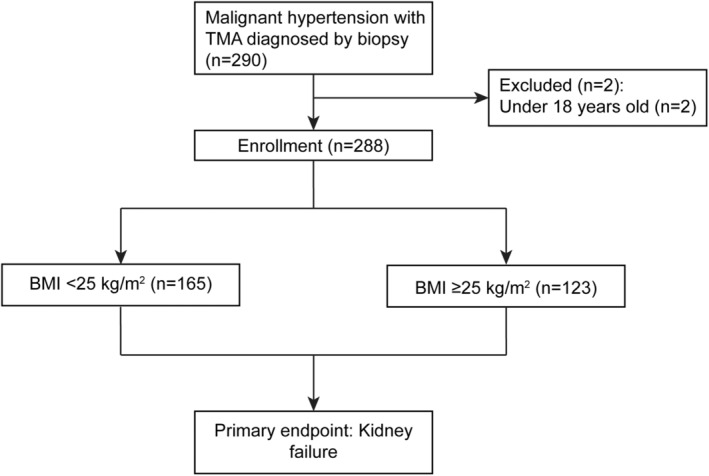
Methods: This was a prospective cohort enrolled 288 MHT patients with renal TMA from 2008 to 2023. The clinical and histopathological characteristics were recorded based on body mass index (BMI, < 25 and ≥ 25 kg/m2). The outcome was the incidence of kidney failure. The associations of BMI with kidney failure were examined in logistic regression models.
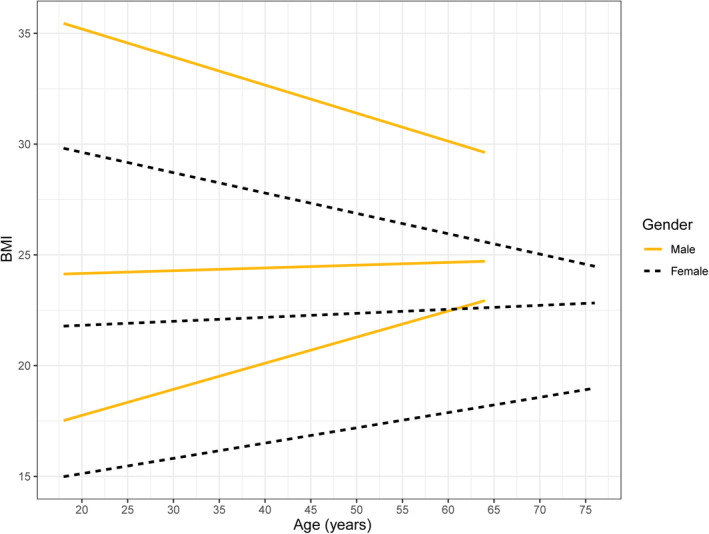
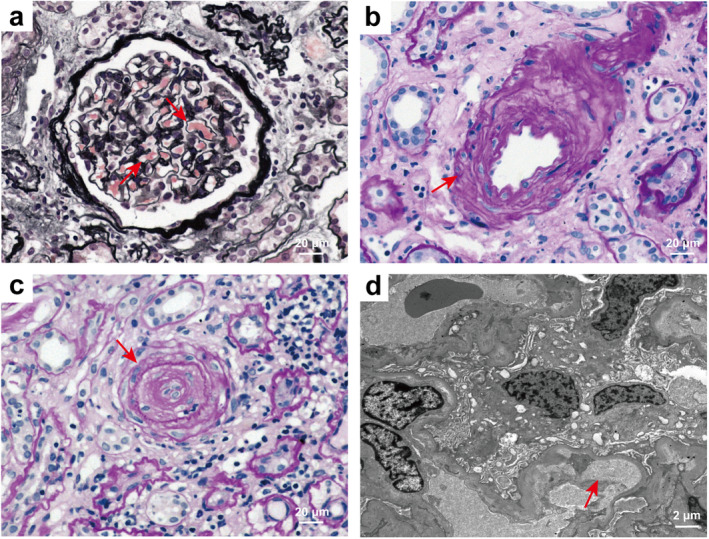
Results: Among 288 patients, 180 (62.5%) progressed to kidney failure, including 113 (68.5%) patients with BMI < 25 kg/m2. Participants with obesity had higher levels of hemoglobin, estimated glomerular filtration rate and C3, but lower levels of serum creatinine and IgA nephropathy. BMI ≥ 25 kg/m2 was associated with a better outcome of kidney failure in MHT patients with TMA (odd ratios [ORs]: 0.49 [95% confidence interval (CI): 0.27-0.91], p = 0.025). Male, uric acid, onion skin lesions, and global sclerosis ratio were correlated with higher risk of kidney failure; serum albumin and treatment with renin-angiotensin system blockers were related to lower risk of kidney failure.
Conclusions: In MHT patients with renal TMA, normal-weight rather than overweight was found to associate with a worse renal prognosis. Management efforts for MHT may be directed toward controlling body weight within a reasonable range for patients.
Keywords: kidney failure; malignant hypertension; overweight and obesity; renal biopsy; thrombotic microangiopathy.
© 2024 The Author(s). Journal of Clinical Laboratory Analysis published by Wiley Periodicals LLC.
Conflict of interest statement
We declare that the results presented in this paper have not been published previously in whole or part, except in abstract format.
The authors declare no conflicts of interest.
Figures
References
-
- Fakhouri F. and Frémeaux‐Bacchi V., “Thrombotic Microangiopathy in Ahus and Beyond: Clinical Clues From Complement Genetics,” Nature Reviews. Nephrology 17 (2021): 543–553. - PubMed
-
- van den Born B. J., Koopmans R. P., Groeneveld J. O., et al., “Ethnic Disparities in the Incidence, Presentation and Complications of Malignant Hypertension,” Journal of Hypertension 24 (2006): 2299–2304. - PubMed
-
- Lip G. Y., Beevers M., and Beevers D. G., “Complications and Survival of 315 Patients With Malignant‐Phase Hypertension,” Journal of Hypertension 13 (1995): 915–924. - PubMed
-
- Lusco M. A., Najafian B., Alpers C. E., and Fogo A. B., “Ajkd Atlas of Renal Pathology: Arterionephrosclerosis,” American Journal of Kidney Diseases 67 (2016): 21–22. - PubMed
MeSH terms
Grants and funding
- 2021YFC2501302/National Key Research and Development Program of China
- 82070752/National Natural Science Foundation of China
- 82170737/National Natural Science Foundation of China
- 82370707/National Natural Science Foundation of China
- 202201020273/the Guangdong Provincial Department of Science and Technology
- 2022B1515020106/Natural Science Foundation of Guangdong Province
- 2023A1515012477/Natural Science Foundation of Guangdong Province
- 2002B60118/Key Laboratory of National Health Commission, and Key Laboratory of Nephrology, Guangdong Province, Guangzhou, China
- 2020B1212060028/Key Laboratory of National Health Commission, and Key Laboratory of Nephrology, Guangdong Province, Guangzhou, China
- 2024B03J1337/Guangzhou Municipal Programme of Science and Technology
LinkOut - more resources
Full Text Sources
Miscellaneous
