. 2024 Nov 5;3(1):33.
doi: 10.1038/s44185-024-00064-4.

Sounds as taxonomic indicators in Holocentrid fishes

Affiliations

Sounds as taxonomic indicators in Holocentrid fishes

Marine Banse et al. NPJ Biodivers. .

Abstract

The species-specific character of sounds in the animal kingdom has been extensively documented, yet research on fishes has predominantly focused on a limited number of species, overlooking the potential of acoustic signals to reflect broader taxonomic ranks. In this study, we analyzed acoustic data of hand-held sounds from 388 specimens spanning 5 genera and 33 species within the family Holocentridae, with the objective of evaluating the use of sound characteristics for taxonomic discrimination across various levels (subfamily, genus, species). Sounds could be indicative of grouping. Taxa discriminability depends on taxonomic level; the higher the taxonomic level, the better the discrimination of taxa based on sounds. Analogous to the role of morphological traits in taxonomic delineation, this research corroborates the utility of acoustic features in identifying fish taxa across multiple hierarchical levels. Remarkably, certain holocentrid species have evolved complex sound patterns characterized by unique temporal arrangements where pulses are not continuous but emitted in blocks, facilitating the exploitation of the acoustic space.


Conflict of interest statement

The authors declare no competing interests.

Figures

Fig. 1
Fig. 1. Relationships between the holocentrid species ability to produce sounds with pattern and their positioning in the most recent phylogeny of this family.
a Phylogenetic tree of Holocentridae modified from Dornburg et al. and b corresponding histogram of the percentage of sounds consisting in discontinuous series of pulses (i.e., made of several blocks of pulses or pattern) and in continuous series of pulses (i.e., made of one block of pulses or without pattern). The numbers 1 and 2 refer to the two subgroups within the genus Myripristis. c Species that are not found in the existing phylogenety. Due to its high percentage of sounds with pattern (formed by blocks of pulses), Myripristis seychellensis was considered as belonging to species of group 2. Sargocentron violaceum seems to be closely related to Sargocentron spiniferum and Sargocentron caudimaculatum. The position of Sargocentron dorsomaculatum in the tree is unknown.
Fig. 2
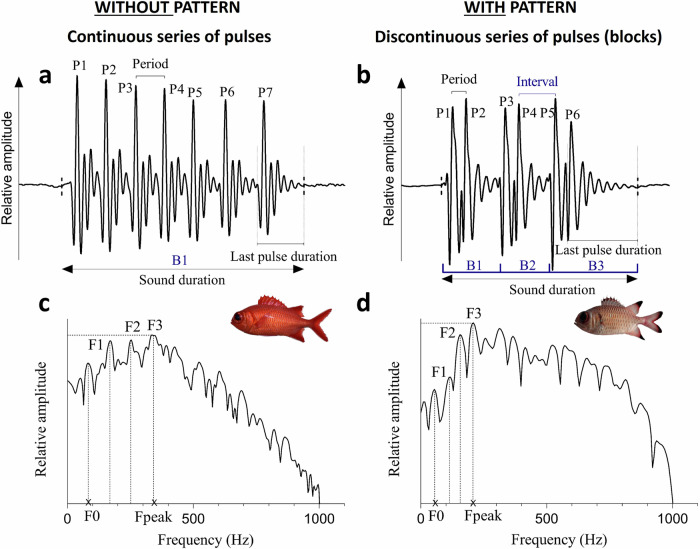
Fig. 2. Illustration of the different acoustic features describing sounds.
Oscillograms (a, b) with corresponding power spectra in Myripristis vittata and M. adusta (c, d), respectively. This comparison enables to highlight the difference between sounds without pattern that consist of a continuous series of pulses forming a single block (illustrated sound of M. vittata is composed of 7 pulses grouped in one block) and sounds with pattern consisting of a discontinuous series of pulses forming several blocks (illustrated sound of M. adusta is composed of three blocks made of two pulses each). P pulses; B blocks; F harmonics; F0 fundamental frequency; Fpeak dominant frequency.
Fig. 3
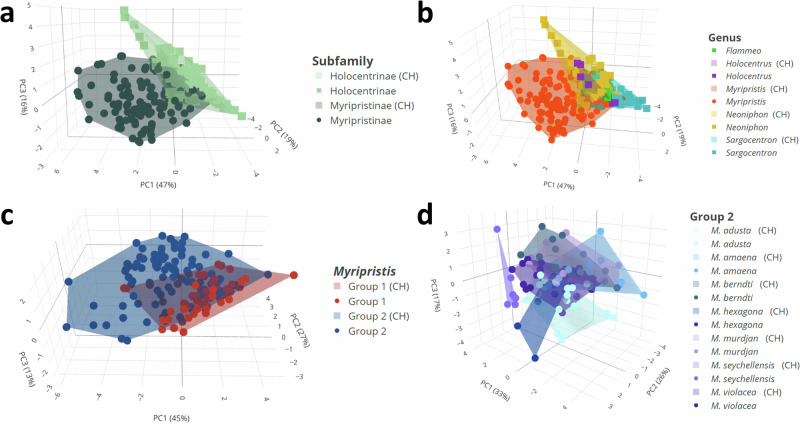
Fig. 3. Scatterplots of the first three principal components (PC1, PC2, PC3) based on various acoustic features in Holocentridae across different taxonomic levels.
Scatterplots of the sounds (N = 365) at the subfamily level (a) and genus level (five genera) (b) were performed with six acoustical variables (sound duration, number of pulses, fundamental and dominant frequencies, pulse period, and duration of the last pulse). Scatterplot of the sounds at the subgeneric level c illustrated by the two groups of Myripristis (N = 176) was performed with eight acoustical variables (sound duration, number of pulses, fundamental and dominant frequencies, pulse period and duration of the last pulse, number of blocks in sounds, percentage of sounds with pattern). Scatterplot of the sounds at the species level (d) illustrated by Myripristis species of group 2 (N = 101) was performed with 10 acoustical variables (sound duration, number of pulses, fundamental and dominant frequencies, pulse period, and duration of the last pulse, number of blocks in sounds, number of pulses in blocks, interval, percentage of sounds with pattern). CH convex hull. 3D scatterplots are available in Supplementary Videos 1-4.
Fig. 4
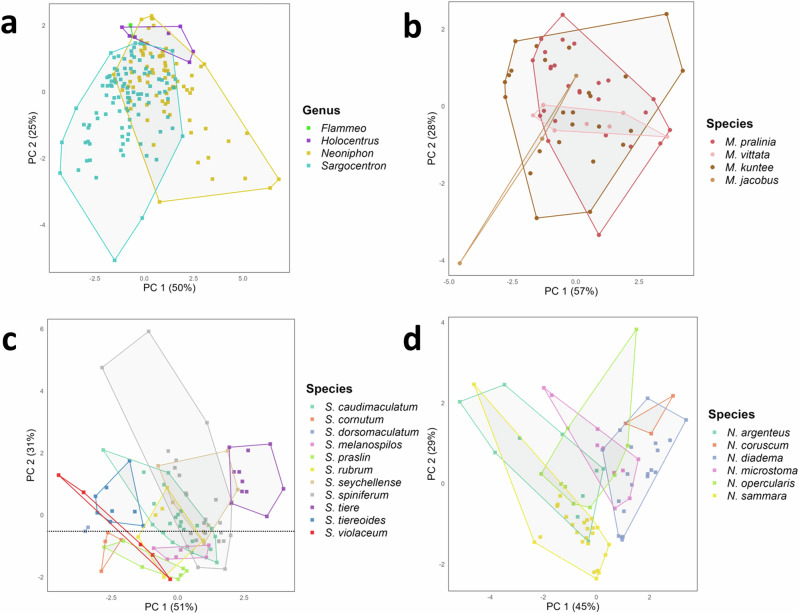
Fig. 4. Scatterplots of the first two principal components (PC1 and PC2) based on various acoustic features in Holocentridae across different taxonomic levels.
All scatterplots were performed with six acoustical variables (sound duration, number of pulses, fundamental and dominant frequencies, pulse period, and duration of the last pulse) of the sounds produced by (a) the different genera of Holocentrinae (N = 189), b Myripristis species of group 1 (N = 61), c Sargocentron species (N = 101), d Neoniphon species (N = 77).
Fig. 5
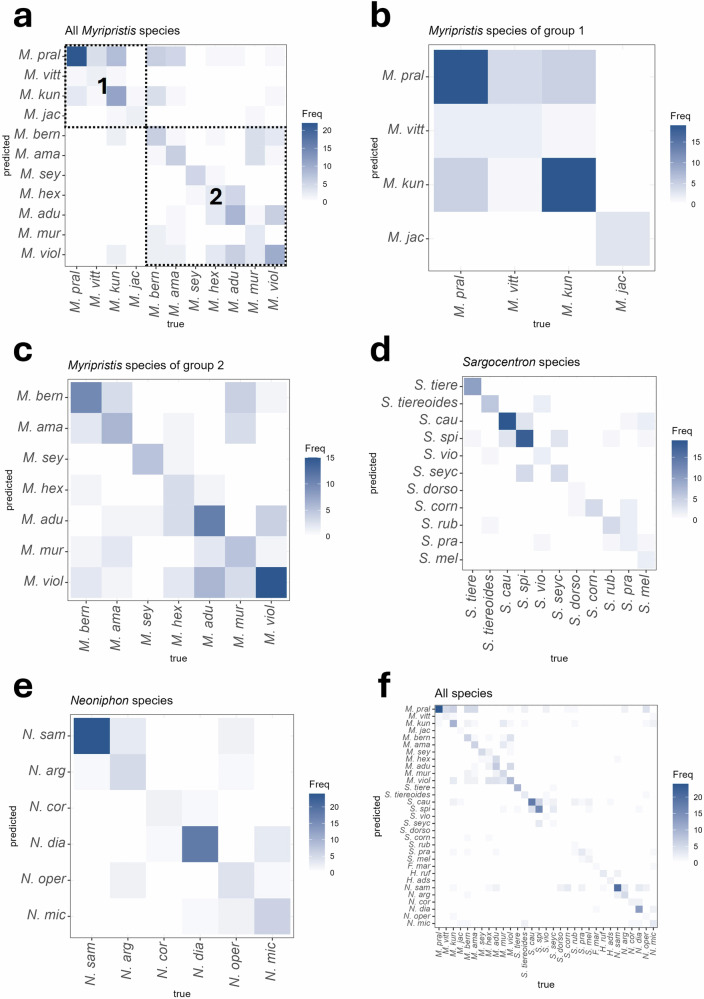
Fig. 5. Confusion matrices showing the conditional frequency of classification of holocentrids based on sounds at different taxonomic levels resulting from flexible discriminant analyses.
Matrices concern (a) Myripristis species, b Myripristis species of group 1, c Myripristis species of group 2, d Sargocentron species, e Neoniphon species, and (f) all species of Holocentridae investigated. Variables used to perform these analyses were those used in the PCAs. The probability of correct classification is found in the diagonal of the matrix. Boxes in (a) indicate probabilities of classification that correspond to the same Myripristis group.
Fig. 6
Fig. 6. Boxplots of the acoustical variables of the sounds of the two Holocentrus species.
*p < 0.05; **p < 0.01; ***p < 0.001. NS nonsignificant.

References

    1. Papadatou, E., Butlin, R. K. & Altringham, J. D. Identification of bat species in Greece from their echolocation calls. Acta Chiropterologica10, 127–143 (2008).
    1. Walters, C. L. et al. A continental-scale tool for acoustic identification of European bats. J. Appl. Ecol.49, 1064–1074 (2012).
    1. Braune, P., Schmidt, S. & Zimmermann, E. Acoustic divergence in the communication of cryptic species of nocturnal primates (Microcebus ssp.). BMC Biol. 6, 19 (2008). - PMC - PubMed
    1. Bernstein, S. K., Sheeran, L. K., Wagner, R. S., Li, J. & Koda, H. The vocal repertoire of Tibetan macaques (Macaca thibetana): a quantitative classification. Am. J. Primatol.78, 937–949 (2016). - PubMed
    1. Baumann-Pickering, S. et al. Species-specific beaked whale echolocation signals. J. Acoust. Soc. Am.134, 2293–2301, 10.1121/1.4817832 (2013). - PubMed

LinkOut - more resources