


BCAA was more closely associated with visceral fat area than subcutaneous fat area in patients of type 2 diabetes mellitus: a cross-sectional study
- PMID: 39501211
- PMCID: PMC11539729
- DOI: 10.1186/s12902-024-01768-1
BCAA was more closely associated with visceral fat area than subcutaneous fat area in patients of type 2 diabetes mellitus: a cross-sectional study
Abstract
Background: Branched-chain amino acid (BCAA) has been reported to be associated with obesity, the association of BCAA with visceral fat area (VFA) and subcutaneous fat area (SFA) remained unclear in patients with type 2 diabetes.
Methods: This cross-sectional study was conducted in 284 patients with type 2 diabetes mellitus. Enzyme-linked immunospecific assay was used to measure levels of serum BCAA and branched-chain keto acid (BCKA). VFA and SFA were measured with bio-impedance analysis method. The association between BCAA and VFA was calculated using Pearson correlation and multivariable linear regression analysis.
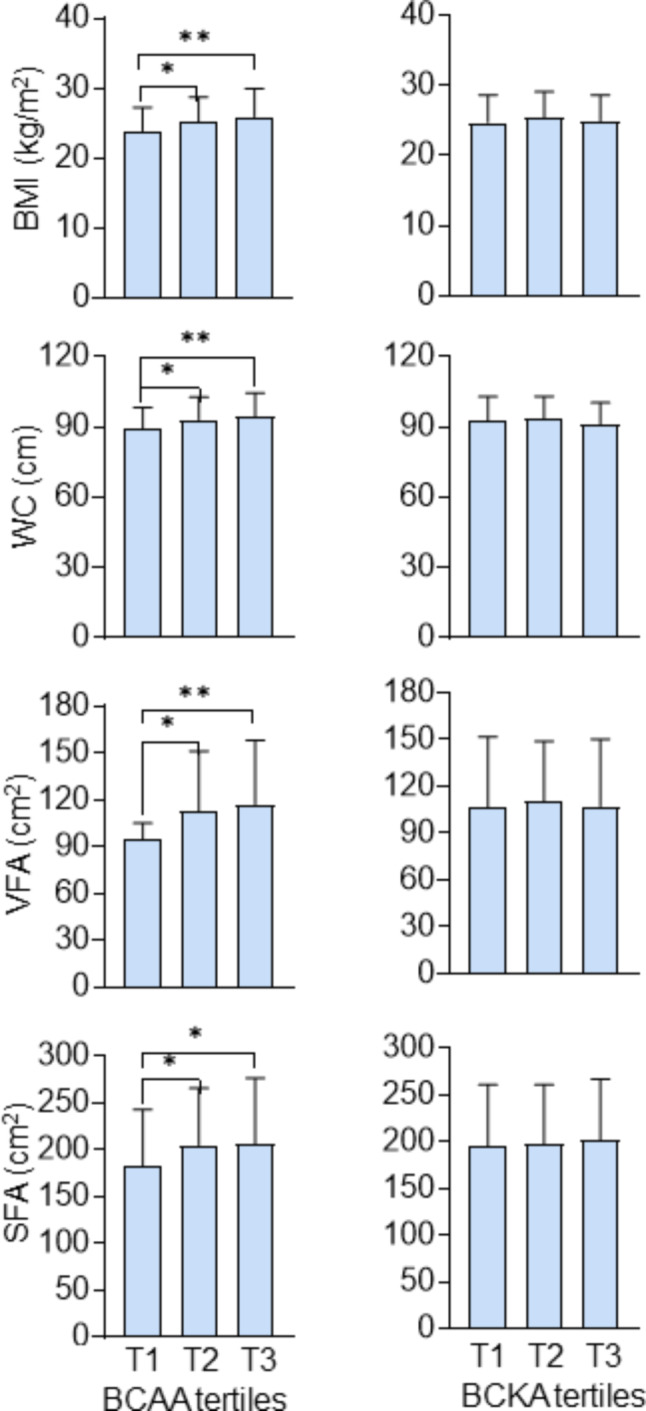
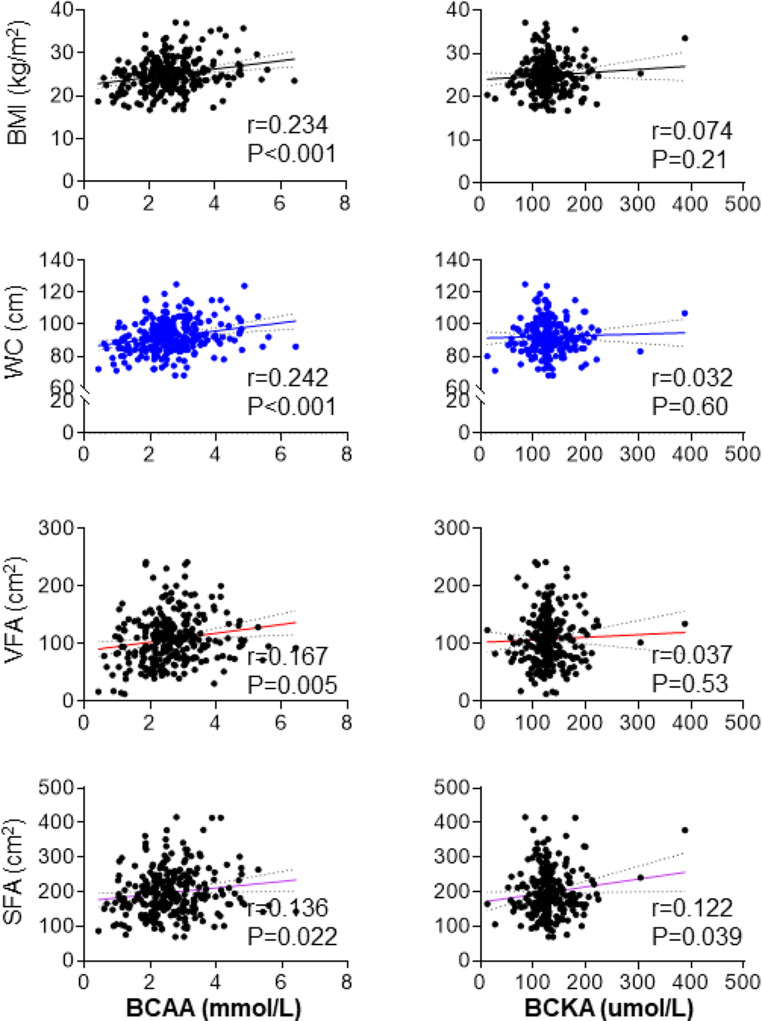
Results: There were significant differences in the means of body mass index, waist circumstance, SFA and VFA among the three groups divided by total BCAA tertiles (all p < 0.05). Compared to patients with lower levels of serum BCAA (the lower tertile group), the means of VFA and SFA were significantly larger in the middle and upper tertile groups (all p < 0.05). However, the differences in above obesity parameters were nonsignificant according to various BCKA tertiles. Pearson correlation analysis also demonstrated that BCAA levels were positive associated with each obesity parameter (p < 0.05). Nevertheless, multivariable linear regression analysis showed that levels of serum BCAA were correlated with VFA, BMI and WC (all p < 0.05) rather than SFA after adjusted for other confounders.
Conclusions: levels of serum BCAA were more closely correlated with VFA than SFA, prospective studies should be warranted to further explore the mechanism mediating BCAA and visceral fat accumulation in Human beings.
Clinical trial number: Not applicable.
Keywords: Branched-chain amino acids; Obesity; Subcutaneous fat area; Type 2 diabetes; Visceral fat area.
© 2024. The Author(s).
Conflict of interest statement
The authors declare no competing interests.
Figures
References
-
- World Health organization. obesity-and-overweight (accessed on 9 June 2021). https://www.who.int/news-room/fact-sheets/detail/
-
- (WHO) WHO. Waist circumference and waist-hip ratio: report of a WHO expert consultation, Geneva, 8–11 December 2008. Geneva: World Health Organization; 2021.
-
- Divino V, Ramasamy A, Anupindi VR, et al. Complication-specific direct medical costs by body mass index for 13 obesity-related complications: a retrospective database study. J Manag Care Spec Pharm. 2021;27(2):210–22. 10.18553/jmcp.2020.20272. [published Online First: 20201214]. - DOI - PMC - PubMed
MeSH terms
Substances
Grants and funding
- 2020tszk01/Clinical Characteristic of Health System in Putuo District, Shanghai
- 2020tszk01/Clinical Characteristic of Health System in Putuo District, Shanghai
- 2020tszk01/Clinical Characteristic of Health System in Putuo District, Shanghai
- ZK2019B16/Shanghai Medical Key Specialties
- ZK2019B16/Shanghai Medical Key Specialties
- ZK2019B16/Shanghai Medical Key Specialties
- 202240309/Research Project of Shanghai Municipal Health Care Commission
- 202240309/Research Project of Shanghai Municipal Health Care Commission
- 202240309/Research Project of Shanghai Municipal Health Care Commission
- ptkwws202003, ptkwws202302/Technology Innovation Project of Putuo District Health System
- ptkwws202003, ptkwws202302/Technology Innovation Project of Putuo District Health System
- ptkwws202003, ptkwws202302/Technology Innovation Project of Putuo District Health System
LinkOut - more resources
Full Text Sources
Medical
