Review
. 2024 Nov 1;16(1):2415734.
doi: 10.1080/20002297.2024.2415734. eCollection 2024.

Methanobrevibacter oralis: a comprehensive review

Affiliations
Review

Methanobrevibacter oralis: a comprehensive review

Virginie Pilliol et al. J Oral Microbiol. .

Abstract

Methanobrevibacter oralis (M. oralis) has predominated human oral microbiota methanogenic archaea as far back as the Palaeolithic era in Neanderthal populations and gained dominance from the 18th century onwards. M. oralis was initially isolated from dental plaque samples collected from two apparently healthy individuals allowing its first characterization. The culture of M. oralis is fastidious and has been the subject of several studies to improve its laboratory growth. Various PCR methods are used to identify M. oralis, targeting either the 16S rRNA gene or the mcrA gene. However, only one RTQ-PCR system, based on a chaperonin gene, offers specificity, and allows for microbial load quantification. Next-generation sequencing contributed five draft genomes, each approximately 2.08 Mb (±0.052 Mb) with a 27.82 (±0.104) average GC%, and two ancient metagenomic assembled genomes. M. oralis was then detected in various oral cavity sites in healthy individuals and those diagnosed with oral pathologies, notably periodontal diseases, and endodontic infections. Transmission pathways, possibly involving maternal milk and breastfeeding, remain to be clarified. M. oralis was further detected in brain abscesses and respiratory tract samples, bringing its clinical significance into question. This review summarizes the current knowledge about M. oralis, emphasizing its prevalence, associations with dysbiosis and pathologies in oral and extra-oral situations, and symbiotic relationships, with the aim of paving the way for further investigations.

Keywords: Methanogen; abscess; ancient dental calculus; dysbiosis; endodontic infection; oral microbiota; periodontitis.

Plain language summary

Methanobrevibacter oralis, the most predominant methanogen in human oral microbiota, traces back to the Palaeolithic era and emerges as the dominant methanogen from the 18th century onwards.Our understanding of Methanobrevibacter oralis microbiology remains limited, particularly regarding its phenotypic, genomic, and metabolic characteristics. Furthermore, specific identification and quantification methods are still limited.Although Methanobrevibacter oralis has been found in dysbiotic conditions, such as periodontitis, and in other oral and extra-oral pathologies, its pathogenicity remains largely understudied and should be the focus of future research.


Conflict of interest statement

Michel DRANCOURT is co-inventor of SAB medium (patent FR2990954A1).

Figures
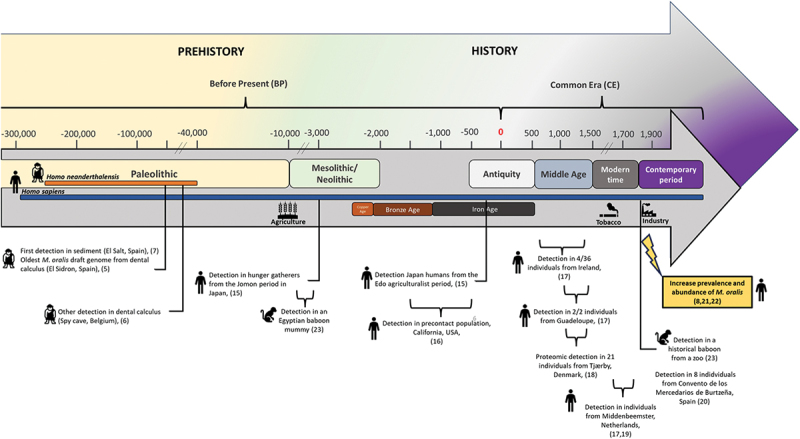
Figure 1.
Figure 1.
Timeline of M. oralis antiquity. This figure provides a chronological timeline highlighting the periods and locations pertinent to M. oralis antiquity. It illustrates key milestones and their correlation with significant historical and prehistorical periods, emphasizing their relevance to the study of M. oralis.
Figure 2.
Figure 2.
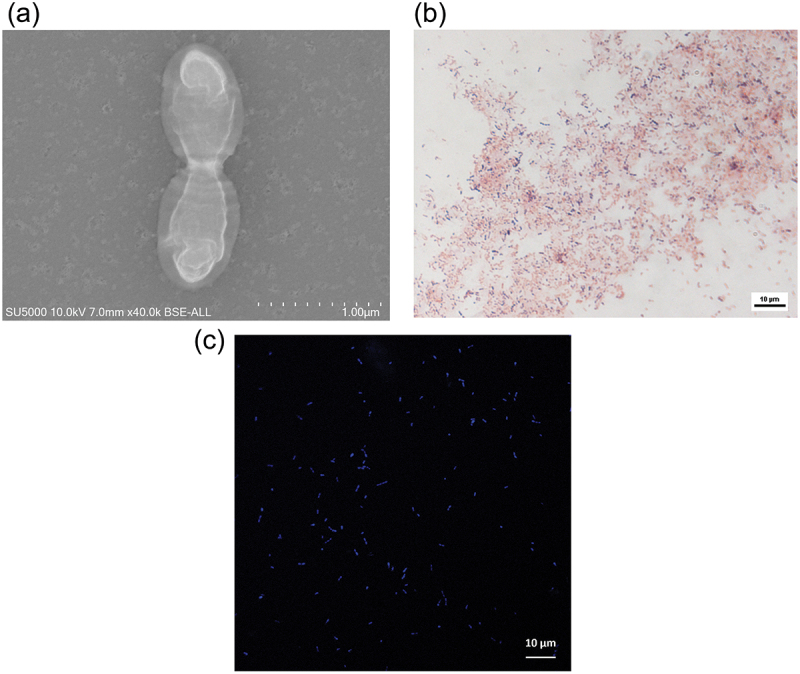
Microscopy features of M. oralis DSM 7256. (a). Electron microscopy: high-resolution electron microscopy (SU5000 hITACHI, 10 KV, X 40,000) reveals M. oralis diplococcobacilli with distinct external cell walls and internal membrane. (b). Gram staining: M. oralis is observed as gram-variable coccobacilli, appearing both gram-positive and gram-negative, typically arranged in pairs or short chains. (c). Confocal microscopy: visualization of M. oralis under confocal microscopy (LSM 900, Carl Zeiss microscopy GmbH) shows autofluorescent coccobacilli and diplococcobacilli emitting blue fluorescence at 420 nm.
Figure 3.
Figure 3.
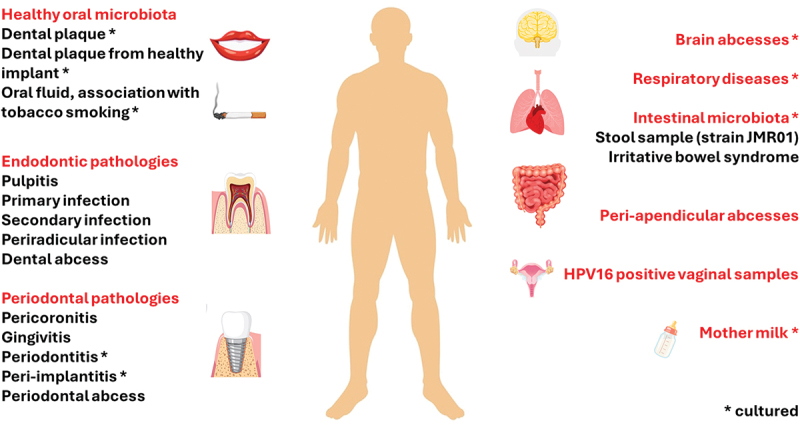
Localization and clinical insights of M. oralis in microbiota. The figure illustrates the presence of M. oralis in the human microbiota, depicting both oral and extra-oral locations and its association with dysbiosis or other pathological conditions. It highlights whether M. oralis has been cultured from associated clinical samples.
Figure 4.
Figure 4.
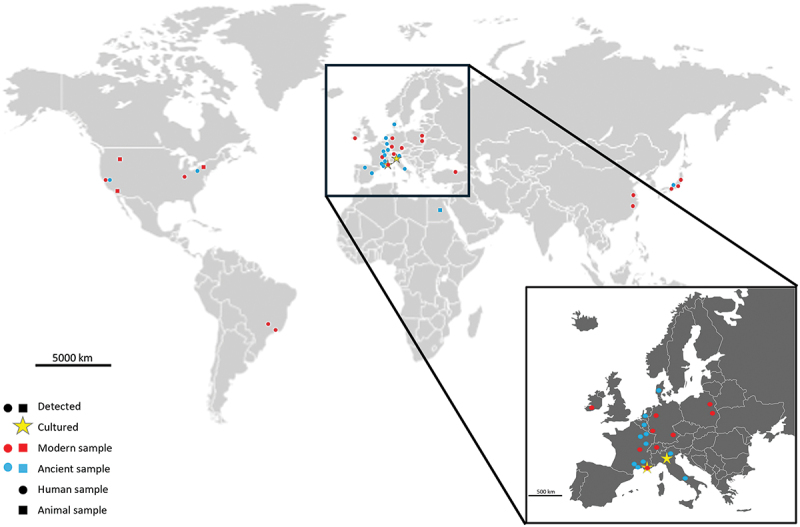
Geographical distribution and pathological contexts of M. oralis worldwide. The figure illustrates the global distribution of M. oralis, indicating its presence in various geographical locations and pathological contexts. In America, M. oralis has been found in sanitary indoor environments in the United States, as well as in animals such as baboons and cattle. In Europe, it has been cultured from mother milk, saliva, feces, and has been associated with conditions like periodontitis, peri-implantitis, and various respiratory diseases. Ancient dental calculus samples also revealed the presence of M. oralis in countries such as Belgium, France, Italy, and the Netherlands. In Asia, its presence is mainly noted in periodontitis, as well as in sanitary indoor environments in Japan and China. In Africa, traces of M. oralis have been discovered in ancient dental calculus in Egypt. M. oralis has been successfully cultured only in Marseille, France, and during its initial isolation in Milan, Italy.
Figure 5.
Figure 5.
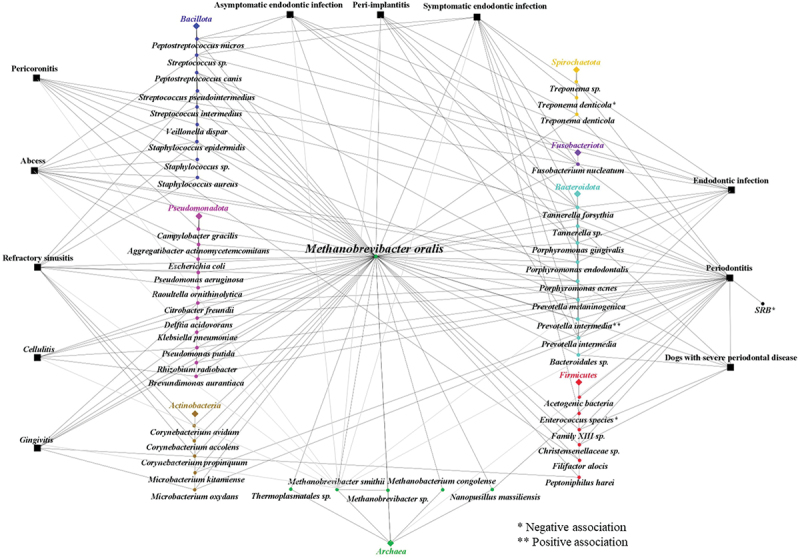
Interactions of M. oralis with various bacteria and archaea in different pathological conditions. This figure illustrates the complex network of interactions between M. oralis and various bacterial and archaeal species across different pathological conditions. The connections highlight both positive and negative associations with other microbes, indicating potential synergistic or antagonistic relationships.

References

    1. Belmok A, de Cena Ja, Kyaw CM, et al. The oral archaeome: a scoping review. J Dent Res. 2020;99(6):630–20. doi: 10.1177/0022034520910435 - DOI - PubMed
    1. Huynh HTT, Pignoly M, Nkamga VD, et al. The repertoire of archaea cultivated from severe periodontitis. PLoS One. 2015;10(4):e0121565. doi: 10.1371/journal.pone.0121565 - DOI - PMC - PubMed
    1. Ferrari A, Brusa T, Rutili A, et al. Isolation and characterization of methanobrevibacter oralis sp. nov. Curr Microbiol. 1994;29(1):7–12. doi: 10.1007/BF01570184 - DOI
    1. Lepp PW, Brinig MM, Ouverney CC, et al. Methanogenic archaea and human periodontal disease. Proc Natl Acad Sci U S A. 2004;101(16):6176–6181. doi: 10.1073/pnas.0308766101 - DOI - PMC - PubMed
    1. Weyrich LS, Duchene S, Soubrier J, et al. Neanderthal behaviour, diet, and disease inferred from ancient DNA in dental calculus. Nature. 2017;544(7650):357–361. doi: 10.1038/nature21674 - DOI - PubMed

LinkOut - more resources