[Preprint]. 2024 Oct 19:2024.10.19.619093.
doi: 10.1101/2024.10.19.619093.

Amino acid competition shapes Acinetobacter baumannii gut carriage

Affiliations

Amino acid competition shapes Acinetobacter baumannii gut carriage

Xiaomei Ren et al. bioRxiv. .

Update in

  • Amino acid competition shapes Acinetobacter baumannii gut carriage.
    Ren X, Clark RM, Bansah DA, Varner EN, Tiffany CR, Jaswal K, Geary JH, Todd OA, Winkelman JD, Friedman ES, Jarrett RN, Zemel BS, Wu GD, Zackular JP, DePas WH, Behnsen J, Palmer LD. Ren X, et al. Cell Host Microbe. 2025 Aug 13;33(8):1396-1411.e9. doi: 10.1016/j.chom.2025.07.003. Epub 2025 Aug 4. Cell Host Microbe. 2025. PMID: 40763731 Free PMC article.

Abstract

Antimicrobial resistance is an urgent threat to human health. Asymptomatic colonization is often critical for persistence of antimicrobial-resistant pathogens. Gut colonization by the antimicrobial-resistant priority pathogen Acinetobacter baumannii is associated with increased risk of clinical infection. Ecological factors shaping A. baumannii gut colonization remain unclear. Here we show that A. baumannii and other pathogenic Acinetobacter evolved to utilize the amino acid ornithine, a non-preferred carbon source. A. baumannii utilizes ornithine to compete with the resident microbiota and persist in the gut in mice. Supplemental dietary ornithine promotes long-term fecal shedding of A. baumannii. By contrast, supplementation of a preferred carbon source-monosodium glutamate (MSG)-abolishes the requirement for A. baumannii ornithine catabolism. Additionally, we report evidence for diet promoting A. baumannii gut carriage in humans. Together, these results highlight that evolution of ornithine catabolism allows A. baumannii to compete with the microbiota in the gut, a reservoir for pathogen spread.

Keywords: Acinetobacter baumannii; carbon preference; dietary supplements; gut colonization; microbiota; ornithine.


Conflict of interest statement

Declaration of interests The authors declare no competing interests.

Figures

Figure 1.
Figure 1.. A partial second AST pathway operon confers ornithine catabolism in pathogenic Acinetobacter species and contributes to A. baumannii gut colonization
(A) ast loci in A. baumannii complex (ABC). (B) Schematic of the predicted arginine succinyl transferase (AST) pathway in A. baumannii. (C) A. baumannii 17978 WT, ΔastO, astAL125A H229A and astAL125A H229A ΔastO strains were grown in M9 minimal media with arginine, ornithine, or succinate as the sole carbon source. Growth was monitored by optical density at 600 nm (OD600) (n = 3, mean ± SD, experiments were repeated at least 6 times with similar results). (D) Phylogenetic species tree with inferred copy numbers of AstA/O and AstC/N (tree scale in amino acid substitutions). Max OD600 of cultures grown with arginine or ornithine as the sole carbon or nitrogen source in M9 medium with succinate (glucose for E. coli) or NH4 as controls. Growth was over 20 h (n = 3, mean ± SD, experiments were repeated at least 2 times with similar results). (E) Prevalence of the ast2 operon in genomes of A. baumannii isolates. (F) Experimental design of post-abx A. baumannii 17978 gut colonization model. (G-H) A. baumannii 17978 CFU from fecal samples at 1, 4, and 9 DPI and in the cecum and colon at 10 DPI (n = 10 female Swiss Webster mice combined from 2 independent experiments; p by Wilcoxon test with Holm-Sidak’s multiple comparisons). Arg, arginine; Orn, ornithine; Glu, glutamate; α-KG, α-ketoglutarate; n.d., not determined; DPI, days post inoculation; LOD, average limit of detection.
Figure 2.
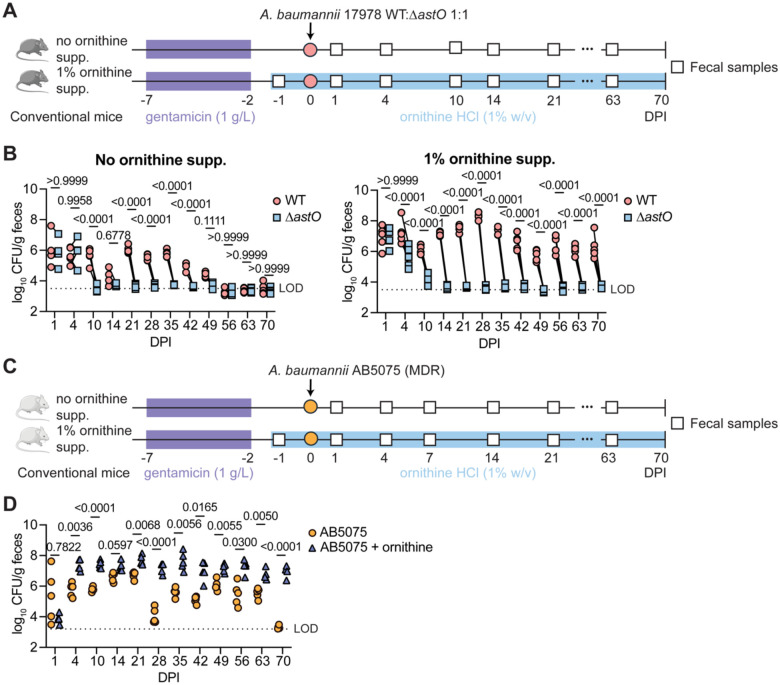
Figure 2.. Supplemental dietary ornithine promotes long-term A. baumannii gut colonization and fecal shedding in mice
(A) Experimental design for ornithine supplementation and A. baumannii 17978 gut colonization. (B) A. baumannii 17978 CFU from fecal samples at the indicated DPI (n = 5 female C57BL/6J mice, p by two-way ANOVA with Sidak’s multiple comparisons; experiments were repeated 2 times with similar results). (C) Experimental design for ornithine supplementation and A. baumannii AB5075 inoculation. (D) A. baumannii AB5075 CFU from fecal samples the indicated DPI (n = 5 female Swiss Webster mice, p by two-way ANOVA with Sidak’s multiple comparisons). DPI, days post inoculation; LOD, average limit of detection.
Figure 3.
Figure 3.. Microbiota diversity associates with A. baumannii AstO-dependent ornithine utilization and the gut amino acid metabolome
(A) α-diversity was calculated from 16S rRNA gene sequencing at 0 DPI and 9 DPI of A. baumannii 17978 WT and ΔastO (n = 10; data combined from mice in Figure 1G–H; mean ± SD are shown; p by one-way ANOVA with Tukey’s multiple comparisons). (B) Representative image of A. baumannii 17978 WT colonization at 10 DPI in the colon, visualized by MiPACT-HCR. Scale bar is 50 μm. blue, DAPI; magenta, WGA-lectin; green, anti-Acinetobacter HCR. From mice in Figure S3C. (C) Experimental design with germ-free mice. (D) A. baumannii 17978 CFU from fecal samples at 1, 4, and 9 DPI (n = 6 female and n = 4 male Swiss Webster mice, p by two-way ANOVA with Sidak’s multiple comparisons; experiment was repeated three times with similar results). (E) L-Ornithine was quantified in chow and fecal samples from untreated, post-abx, and germ-free at 0 and 10 DPI of A. baumannii 17978 (fecal samples are n = 10 mice shown in Figure 1G–H and Figure 3D (LOD = 5 nmol/g), chow samples are n = 3 (LOD = 1 nmol/g), mean ± SD, p by two-way ANOVA with Fisher’s LSD multiple comparisons only on fecal samples). (F) Principal component analysis of amino acids in fecal samples from untreated, post-abx and germ-free Swiss Webster mice at 0 and 10 DPI of A. baumannii 17978 with chow samples shown in each plot (n = 10 mice shown in Figure 1G–H and Figure 3D, chow n = 3). DPI, days post inoculation; MiPACT-HCR, microbial identification after passive clarity technique via hybridization chain reaction; WGA, wheat germ agglutinin; LOD, average limit of detection; PC, principal component.
Figure 4.
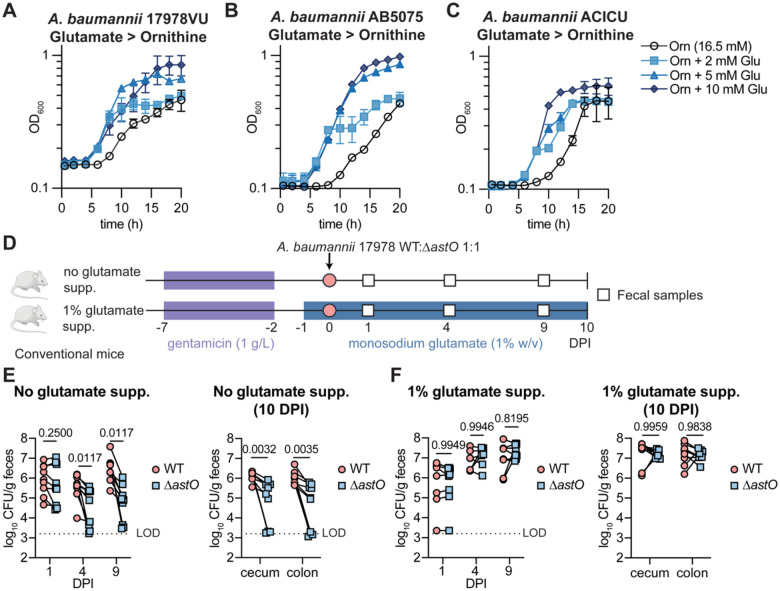
Figure 4.. Glutamate is a preferred carbon source for A. baumannii that promotes gut colonization by the ΔastO mutant.
(A-C) A. baumannii strains were grown in M9 media with ornithine at 16.5 mM and glutamate at indicated concentrations as the sole carbon sources. Growth was monitored by OD600 (n = 3; mean ± SD). (D) Experimental design for monosodium glutamate supplementation. (E-F) CFU from fecal samples at 1, 4, and 9 DPI and in the cecum and colon at 10 DPI (n = 8–9 female Swiss Webster mice, data combined from 2 independent experiments, p by two-way ANOVA with Sidak’s multiple comparisons). DPI, days post inoculation; LOD, average limit of detection.
Figure 5.
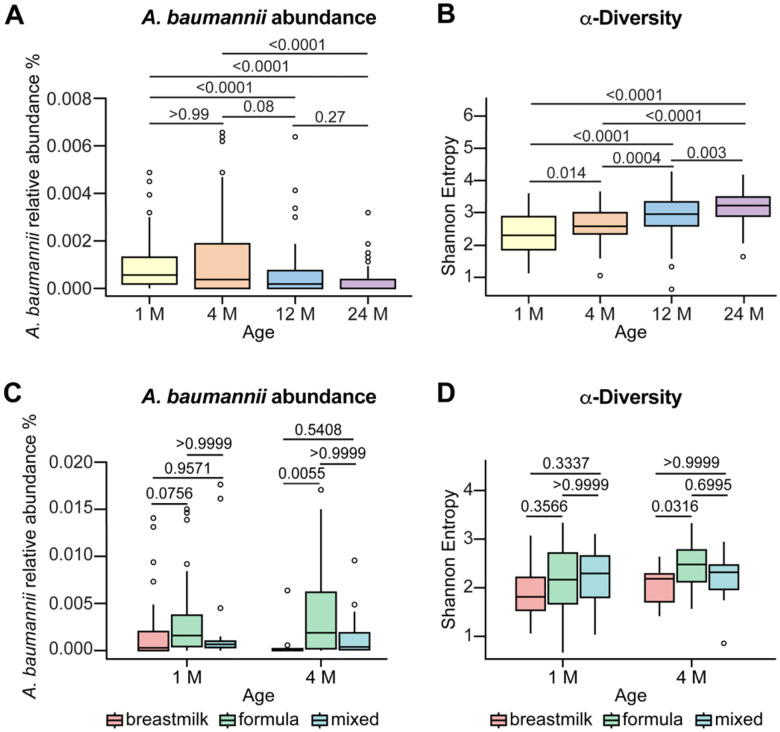
Figure 5.. A. baumannii abundance in fecal samples from healthy human infants is increased with formula feeding
(A-B) Relative abundance of A. baumannii and microbiota α-diversity in the gut of infants age 1 month (M), 4 M, 12 M, 24 M by shotgun metagenomic sequencing (1 M, n = 104; 4 M, n = 98; 12 M, n = 104; 24 M n = 88; p by Kruskal-Wallis with Dunn’s post hoc test). (C-D) Relative abundance of A. baumannii and microbiota α-diversity in the gut of infants across feeding types at 1 M and 4 M (1 M formula, n = 45; 1 M breastmilk, n = 30; 1 M mixed, n = 29; 4 M formula, n = 62; 4 M breastmilk, n = 17; 4 M mixed, n = 19; p by Kruskal-Wallis with Dunn’s post hoc test). Box plots are: center line, median; box limits, upper and lower quartiles; whiskers, 1.5X interquartile range; points, outliers.

References

    1. GBD 2021 Antimicrobial Resistance Collaborators (2024). Global burden of bacterial antimicrobial resistance 1990–2021: a systematic analysis with forecasts to 2050. Lancet Lond. Engl., S0140–6736(24)01867–1. 10.1016/S0140-6736(24)01867-1. - DOI - PubMed
    1. Anthony W.E., Burnham C.-A.D., Dantas G., and Kwon J.H. (2021). The gut microbiome as a reservoir for antimicrobial resistance. J. Infect. Dis. 223, S209–S213. 10.1093/infdis/jiaa497. - DOI - PMC - PubMed
    1. Despotovic M., De Nies L., Busi S.B., and Wilmes P. (2023). Reservoirs of antimicrobial resistance in the context of One Health. Curr. Opin. Microbiol. 73, 102291. 10.1016/j.mib.2023.102291. - DOI - PMC - PubMed
    1. Dijkshoorn L., Nemec A., and Seifert H. (2007). An increasing threat in hospitals: multidrugresistant Acinetobacter baumannii. Nat. Rev. Microbiol. 5, 939–951. 10.1038/nrmicro1789. - DOI - PubMed
    1. World Health Organization (2024). WHO Bacterial Priority Pathogens List, 2024: bacterial pathogens of public health importance to guide research, development and strategies to prevent and control antimicrobial resistance. (World Health Organization; ).

Publication types

LinkOut - more resources