


An IoT-based cognitive impairment detection device: A newly proposed method in older adults care-choice reaction time-device development and data-driven validation
- PMID: 39502483
- PMCID: PMC11536570
- DOI: 10.1177/20552076241293597
An IoT-based cognitive impairment detection device: A newly proposed method in older adults care-choice reaction time-device development and data-driven validation
Abstract
Background: Research shows that older adults' performance on choice reaction time (CRT) tests can predict cognitive decline. A simple CRT tool could help detect mild cognitive impairment (MCI) and preclinical dementia, allowing for further stratification of cognitive disorders on-site or via telemedicine.
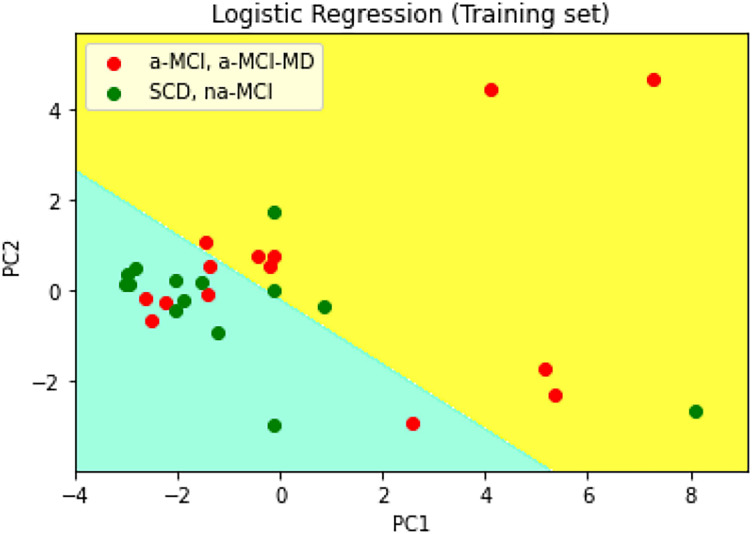
Objective: The primary objective was to develop a CRT testing device and protocol to differentiate between two cognitive impairment categories: (a) subjective cognitive decline (SCD) and non-amnestic mild cognitive impairment (na-MCI), and (b) amnestic mild cognitive impairment (a-MCI) and multiple-domain a-MCI (a-MCI-MD).
Methods: A pilot study in Italy and Romania with 35 older adults (ages 61-85) assessed cognitive function using the Mini-Mental State Examination (MMSE) and a CRT color response task. Reaction time, accuracy, and demographics were recorded, and machine learning classifiers analyzed performance differences to predict preclinical dementia and screen for mild cognitive deficits.
Results: Moderate correlations were found between the MMSE score and both mean reaction time and mean accuracy rate. There was a significant difference between the two groups' reaction time for blue light, but not for any other colors or for mean accuracy rate. SVM and RUSBoosted trees were found to have the best preclinical dementia prediction capabilities among the tested classifier algorithms, both presenting an accuracy rate of 77.1%.
Conclusions: CRT testing with machine learning effectively differentiates cognitive capacities in older adults, facilitating early diagnosis and stratification of neurocognitive diseases and can also identify impairments from stressors like dehydration and sleep deprivation. This study highlights the potential of portable CRT devices for monitoring cognitive function, including SCD and MCI.
Keywords: Elderly medicine; connected devices personalized medicine; machine learning general; mental health psychology; remote patient monitoring personalized medicine; well-being psychology.
© The Author(s) 2024.
Conflict of interest statement
The authors declared no potential conflicts of interest with respect to the research, authorship, and/or publication of this article.
Figures
References
-
- Stadlbauer A, Salomonowitz E, Strunk G, et al. Age-related degradation in the central nervous system: assessment with diffusion-tensor imaging and quantitative fiber tracking. Radiology 2008; 247: 179–188. - PubMed
-
- Woods DL, Wyma JM, Yund EW, et al. Age-related slowing of response selection and production in a visual choice reaction time task. Front Hum Neurosci [Internet] 2015; 9: 1–12. Available from: http://journal.frontiersin.org/article/10.3389/fnhum.2015.00193/abstract. - DOI - PMC - PubMed
LinkOut - more resources
Full Text Sources
Research Materials
