


Global burden of zoonotic infectious diseases of poverty, 1990-2021
- PMID: 39506825
- PMCID: PMC11539463
- DOI: 10.1186/s40249-024-01252-x
Global burden of zoonotic infectious diseases of poverty, 1990-2021
Abstract
Background: The zoonotic infectious diseases of poverty (zIDPs) are a group of diseases contributing to global poverty, with significant impacts on a substantial population. This study aims to describe the global, regional, and national burden of zIDPs-schistosomiasis, cystic echinococcosis, cysticercosis, and food-borne trematodiases (FBTs)-to support policy making and resource allocation for their control and elimination.
Methods: Data of zIDPs from the Global Burden of Diseases, Injuries, and Risk Factors Study (GBD) 2021 were retrieved from 1990 to 2021. The age-standardized prevalence rate (ASPR), age-standardized mortality rate (ASMR), and age-standardized disability-adjusted life-year (DALY) rate were described and the estimated annual percentage changes (EAPCs) were calculated to quantify their burden and temporal trends. Spearman correlation analysis was conducted to examine the relationship between age-standardized rates and Socio-demographic Index (SDI).
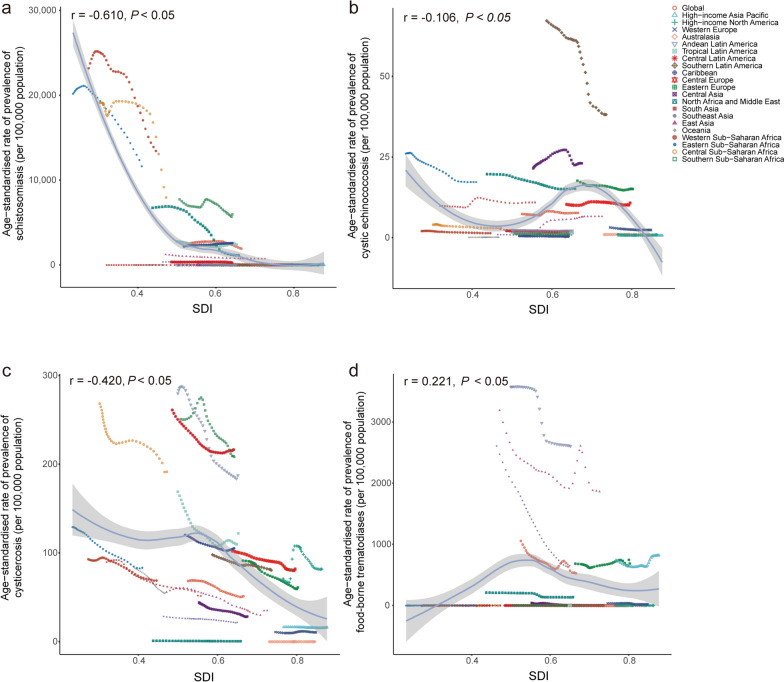
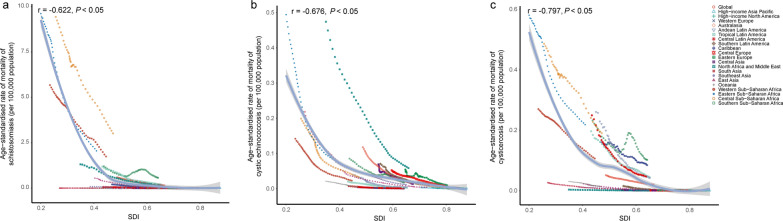
Results: In 2021, these zIDPs exhibited a certain level of ASPRs and age-standardized DALY rates, while maintaining relatively low ASMRs. Noticeably, schistosomiasis presented the highest ASPR of 1914.299 (95% UI: 1378.920, 2510.853 per 100,000 population) and an age-standardized DALY rate of 21.895 (95% UI: 12.937, 37.278 per 100,000 population) among the zIDPs. The tapestry of burden-woven predominantly through low and lower-middle SDI regions-stretched across Africa, Latin America, and parts of Asia. From 1990 to 2021, a kaleidoscopic shift was observed globally as ASPRs, ASMRs, and age-standardized DALY rates declined significantly, as reflected by the EAPC values. Negative correlations were observed between the ASPRs, ASMRs, age-standardized DALY rates of schistosomiasis (r value = - 0.610, - 0.622 and - 0.610), cystic echinococcosis (- 0.676 of ASMR, - 0.550 of age-standardized DALYs), cysticercosis (- 0.420, - 0.797 and - 0.591) and the SDI. In contrast, a slight positive correlation was noted between the ASPR, age-standardized DALY rates of FBTs and SDI with r value of 0.221 and 0.213, respectively.
Conclusion: The burden of zIDPs declined across almost all endemic regions from 1990 to 2021, yet still predominated in low and low-middle SDI regions. Substantial challenges exist to achieve the goal of control and elimination of zIDPs, and integrated approaches based on One Health need to be strengthened to improve health outcomes.
Keywords: Age-standardized rate; Cystic echinococcosis; Cysticercosis; Disability-adjusted life year; Food borne trematodiases; Global burden of disease; Prevalence; Schistosomiasis.
© 2024. The Author(s).
Conflict of interest statement
The authors declare that there are no competing interests.
Figures



References
-
- Department of Economic and Social Affairs, UN. The sustainable development goals report 2021. https://digitallibrary.un.org/record/3932350. Accessed 23 June 2024.
-
- Prüss-Ustün A, Wolf J, Bartram J, Clasen T, Cumming O, Freeman MC, et al. Burden of disease from inadequate water, sanitation and hygiene for selected adverse health outcomes: an updated analysis with a focus on low- and middle-income countries. Int J Hyg Environ Health. 2019;222(5):765–77. - DOI - PMC - PubMed
MeSH terms
Grants and funding
- 21410750200/International Joint Laboratory on Tropical Diseases Control in Greater Mekong Subregion
- 20204Y0050/Health and Family Planning Commission of Sichuan Province
- 2018ZX10101002 002/the National Science and Technology Major Project of China
- 2021YFC2300800/National Key Research and Development Program of China
- 2021YFC2300804/National Key Research and Development Program of China
LinkOut - more resources
Full Text Sources
Medical
