


Exploring Psychotherapists' Attitudes on Internet- and Mobile-Based Interventions in Germany: Thematic Analysis
- PMID: 39510514
- PMCID: PMC11582492
- DOI: 10.2196/51832
Exploring Psychotherapists' Attitudes on Internet- and Mobile-Based Interventions in Germany: Thematic Analysis
Abstract
Background: In recent years, internet- and mobile-based interventions (IMIs) have become increasingly relevant in mental health care and have sparked societal debates. Psychotherapists' perspectives are essential for identifying potential opportunities for improvement, facilitating conditions, and barriers to the implementation of these interventions.
Objective: This study aims to explore psychotherapists' perspectives on opportunities for improvement, facilitating conditions, and barriers to using IMIs.
Methods: The study used a qualitative research design, utilizing open-ended items in a cross-sectional survey. A total of 350 psychotherapists were asked to provide their written opinions on various aspects of IMIs. Thematic analysis was conducted to analyze the data and identify core themes.
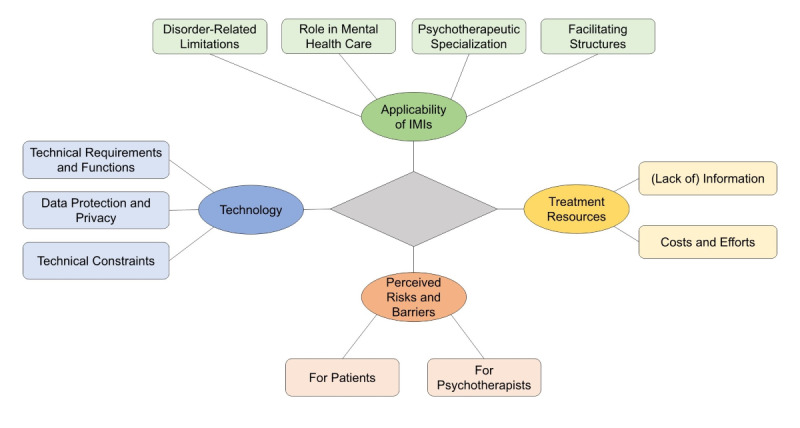
Results: The analysis revealed 11 core themes related to the use of IMIs, which were categorized into 4 superordinate categories: "Applicability," "Treatment Resources," "Technology," and "Perceived Risks and Barriers." While many psychotherapists viewed IMIs as a valuable support for conventional psychotherapy, they expressed skepticism about using IMIs as a substitute. Several factors were perceived as hindrances to the applicability of IMIs in clinical practice, including technological issues, subjective concerns about potential data protection risks, a lack of individualization due to the manualized nature of most IMIs, and the high time and financial costs for both psychotherapists and patients. They expressed a desire for easily accessible information on evidence and programs to reduce the time and effort required for training and advocated for this information to be integrated into the conceptualization of new IMIs.
Conclusions: The findings of this study emphasize the importance of considering psychotherapists' attitudes in the development, evaluation, and implementation of IMIs. This study revealed that psychotherapists recognized both the opportunities and risks associated with the use of IMIs, with most agreeing that IMIs serve as a tool to support traditional psychotherapy rather than as a substitute for it. Furthermore, it is essential to involve psychotherapists in discussions about IMIs specifically, as well as in the development of new methodologies in psychotherapy more broadly. Overall, this study can advance the use of IMIs in mental health care and contribute to the ongoing societal debate surrounding these interventions.
Keywords: eHealth; internet- and mobile-based intervention; psychotherapists’ perspectives; psychotherapy; thematic analysis.
©Anne Sophie Hildebrand, Jari Planert, Alla Machulska, Lena Maria Margraf, Kati Roesmann, Tim Klucken. Originally published in JMIR Formative Research (https://formative.jmir.org), 07.11.2024.
Conflict of interest statement
Conflicts of Interest: None declared.
Figures
Similar articles
-
The Use of Mobile Apps in Adolescent Psychotherapy: Assessment of Psychotherapists' Perspectives.JMIR Form Res. 2025 Apr 8;9:e65788. doi: 10.2196/65788. JMIR Form Res. 2025. PMID: 40198916 Free PMC article.
-
[How can the potential of internet- and mobile-based interventions be used in the treatment of depression? Findings from a qualitative survey among German psychotherapists].Z Evid Fortbild Qual Gesundhwes. 2024 May;186:62-68. doi: 10.1016/j.zefq.2024.03.001. Epub 2024 Apr 10. Z Evid Fortbild Qual Gesundhwes. 2024. PMID: 38604921 German.
-
Positive mental health in psychotherapy: a qualitative study from psychotherapists' perspectives.BMC Psychol. 2022 Apr 29;10(1):111. doi: 10.1186/s40359-022-00816-6. BMC Psychol. 2022. PMID: 35488353 Free PMC article.
-
Heterogeneity of Treatment Effects in Internet- and Mobile-Based Interventions for Depression: A Systematic Review and Meta-Analysis.JAMA Netw Open. 2024 Jul 1;7(7):e2423241. doi: 10.1001/jamanetworkopen.2024.23241. JAMA Netw Open. 2024. PMID: 39023887 Free PMC article.
-
[Internet- and Mobile Based Psychotherapy for Depression].Fortschr Neurol Psychiatr. 2017 Jan;85(1):48-58. doi: 10.1055/s-0042-123540. Epub 2017 Jan 23. Fortschr Neurol Psychiatr. 2017. PMID: 28114693 Review. German.
Cited by
-
Mobile-Based Cognitive Behavioral Therapy for Health Care Workers' Mental Health in Ecuador: Quasi-Experimental Study.JMIR Hum Factors. 2025 Aug 5;12:e58943. doi: 10.2196/58943. JMIR Hum Factors. 2025. PMID: 40764043 Free PMC article.
-
Attitudes of Mental Health Professionals Towards the Use of Routine Outcome Monitoring in Psychotherapeutic Inpatient Settings: A Thematic Analysis.Adm Policy Ment Health. 2025 Jul;52(4):771-784. doi: 10.1007/s10488-025-01455-w. Epub 2025 Jul 1. Adm Policy Ment Health. 2025. PMID: 40591161 Free PMC article.
-
Blended Mobile-Based Interventions With Integrated Virtual Reality Exposure Therapy for Anxiety Disorders: Thematic Analysis of Patient Perspectives.JMIR Hum Factors. 2025 Apr 24;12:e60957. doi: 10.2196/60957. JMIR Hum Factors. 2025. PMID: 40273440 Free PMC article.
References
-
- Ebert DD, Van Daele T, Nordgreen T, Karekla M, Compare A, Zarbo C, Brugnera A, Øverland S, Trebbi G, Jensen KL, Kaehlke F, Baumeister H. Internet- and mobile-based psychological interventions: applications, efficacy, and potential for improving mental health. European Psychologist. 2018 May;23(2):167–187. doi: 10.1027/1016-9040/a000318. - DOI
-
- Meyer B, Berger T, Caspar F, Beevers CG, Andersson G, Weiss M. Effectiveness of a novel integrative online treatment for depression (Deprexis): randomized controlled trial. J Med Internet Res. 2009 May 11;11(2):e15. doi: 10.2196/jmir.1151. https://www.jmir.org/2009/2/e15/ v11i2e15 - DOI - PMC - PubMed
-
- Hildebrand A, Roesmann K, Planert J, Machulska A, Otto E, Klucken T. Self-guided virtual reality therapy for social anxiety disorder: a study protocol for a randomized controlled trial. Trials. 2022 May 12;23(1):395. doi: 10.1186/s13063-022-06320-x. https://trialsjournal.biomedcentral.com/articles/10.1186/s13063-022-06320-x 10.1186/s13063-022-06320-x - DOI - DOI - PMC - PubMed
-
- Ebert DD, Cuijpers Pim, Muñoz Ricardo F, Baumeister Harald. Prevention of mental health disorders using internet- and mobile-based interventions: a narrative review and recommendations for future research. Front Psychiatry. 2017;8:116. doi: 10.3389/fpsyt.2017.00116. https://europepmc.org/abstract/MED/28848454 - DOI - PMC - PubMed
Publication types
MeSH terms
LinkOut - more resources
Full Text Sources
